
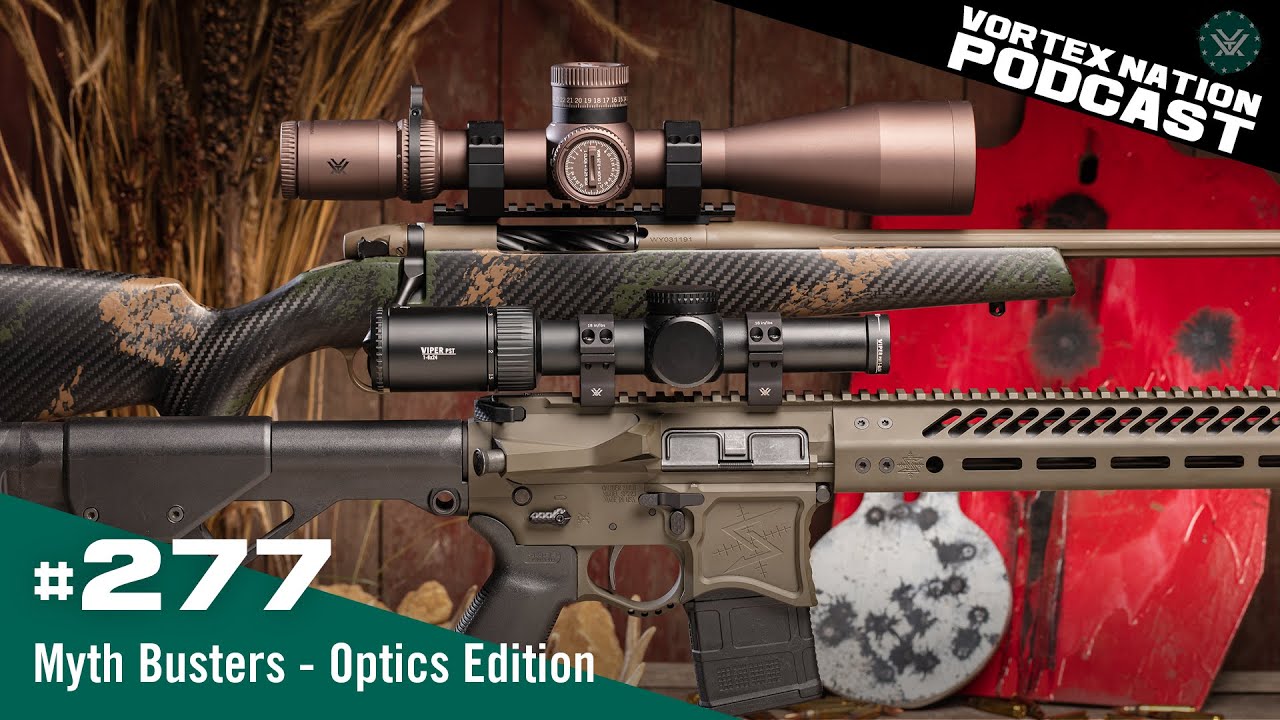
Welcome to “Myth Busters – Optics Edition.” On this episode, Mark Boardman and Ryan Muckenhirn debunk common optics myths and misconceptions. Oculars to objectives, tubes to turrets, they break down stuff folks get, well, wrong.
Sign up now for a chance to win an optics and apparel shopping spree valued at $5,500.
join.vtxnation.com
As always, we want to hear your feedback! Let us know if there are any topics you’d like covered on the Vortex Nation™ podcast by asking us on any one of our social media platforms and using #VortexNationPodcast.
Follow Vortex Nation Podcast on Instagram:
www.instagram.com/vortexnationpodcast
39 Comments
Hunting in Michigan. Did not need binos unless hunting over open farm field. We just used the scope to get a more precise view. Mainly because you really didn't have time to look over the field, then go to binos, then pull up the rifle and find it in the scope. Usually by the time you did all that it was through your opening and gone. Now that I am older, and the eyes aren't as good anymore, the looking part is done with binos then straight to the scope.
Would like to see a 10 min on 6mm Rem.
WRT air rifle making a scope malfunction… I thought it was because of the inertia, and essentially a reverse recoil compared to a centerfire rifle. Centerfire scopes are not designed to withstand recoil in the opposite direction.
Do loctite your scope ring screws? And if so does the lubricant qualities of loctite change these torque specs?
I’ve hunted most everything in the lower 48 and Europe in the last 50 years with scopes from 1.5-5 to 3.5-10. Made 500 plus yard shots with no problems, there is no substitute for good glass. Nuff said.
The MRAD vs MOA discussion was pretty interesting. The only reason I continue to buy MOA scopes is because my other 20 scopes except for 1 are in MOA.
Given the chance to do it over I would definitely choose MRAD for the very same points Ryan brought up. Caveman brain prefers small numbers.
If Vortex wants to do a 1 to 1 swap I'd be down 🤣.
Nice to see Ryan with his own coffee mug…bring on the .35 Rem 10 min. Talk!
Antlers blending in with cut corn is how I had to burn a buck tag on a 1×1 while convinced it was a doe laying down.
Bigger tube more chance of looking through the better quality of the centre of the lens
#vortexnationpodcast suggestion for a podcast is spotting optics and good hunting practice. People using scopes instead of binoculars to spot deer. The last 20 years it’s more and more common in my personal experience to look across a valley (PNW) and see someone scoping me. It’s really upsetting, maybe because I was in the army for a long time but it causes a physical reaction. The last few years I just stand up and walk to them and ask them to stop pointing a loaded rifle at me.
Maybe other people are having this experience and it’s not just me? But it’s happened with an increasing frequency. Since you gentlemen have a deep experience in hunting in all kinds of environments that I’ll never come close to, I’d imagine there’s a discussion to be had there.
Comment posted here as most the videos I’ve watched ask for feed back and suggestions for topics to cover. And if this topic has been discussed already, my apologies I’ve recently discovered these Vortex podcasts and have a lot of content to catch up on.
On the topic of focal plane. I have seen some manufacturers starting to get very clever with their FFP reticle designs. So that when you are zoomed way in you have all the fancy stuff, and when you zoom out, bolder and thicker lines or markers come into view and you end up with a fast and useful reticle on the lower end power levels in the scope. I think we should keep an eye on these types of reticles as more and more are developed, because I think they could be a game changer.
I have a PRimary Arms PLXc 1-8 with the raptor M8-m on a 16" AR and it's like it's 2 different scopes. 1-4 it's fast and bold, and 5-8 you have this super precise and clear image with etched ED glass and it's just awesome in its own right for the DMR type of role. I know this isn't a hunting example and there are different considerations to be made, but the principal still holds true either way.
The gun’s lament……..I’m with stupid
excellent episode.
Great info shared.
Thank you!
First focal plane vs. Second focal plane: I found that out hunting in Idaho up high. We were scanning long distances looking across canyons, but when we actually found the deer, they were in the dark timber sections. My Diamondback 4X16 FFP reticle almost disappeared in the heavy timber when I dropped the magnification down. I wished I had a second focal plane scope at that point, or at least an illuminated reticle…… Ah, you learn…
We would love a talk where you just geek on scope rings… they are so important, but so boring…what makes them tick.
Once again Vortex proves that they are industry leading in knowing jack shit about optics, don't waste your time and money and don't buy Vortex.
Thank you 😊
You guys should start a rumble account
I liked Ryan's explanation. MRAD gets you on target quick because the numbers are smaller. But MOA gets you more precise. The adjustments are smaller, mainly.
I also agree you don't need the most expensive. That being said, I do believe in using what is comfortable for me. So, my rifles have had Diamnondback Tactical 6-24X50 on them but now they all have Venom 5-25X56. That reticle just suits my eye, regardless. And the eyebox is the most comfortable. I don't always need all the magnification. In fact, I have rarely needed to go past 10, maybe to 16. After that, I can loose resolution on targets that are only intermediate range. Because that scope is comfortable to me regardless of what I am doing, I am willing to endure the 35 oz. That being said, my rifle, loaded, is around 12 lbs. Me strong like bull.
(Just my opinion, do what you will with it) On the topic of first and second focal plane for hunting. I don't see where a hunter within the max point blank range of thier given caliber and game species would ever be severed better by a first focal plane scope or a busy retical. I wouldn't think until you get outside that max point blank range number that dialing or holding off on a marked retical would be advantageous to shooting a nice fine duplex second focal plane scope with capped turrets for most calibers that will do you a little more or less than 400 yards depending on your gear and game, just like the old days. Now, if you may take the occasional shot at 400-600, I can really see where dialing turrets with a clean retical is much better. But in my opinion the only place where a first focal plane scope that dials and has a busy retical does me any good over a standard duplex is when I plan on using d.o.p.e (data of previous engagement) aka shooting multiple times at the same target. Which having tools in my optic for using previous shots to get on target better in my mind is range or tactical shooting situations, not hunting. When I'm hunting I want less things to confuse me, I want a simple retical that stays a size that is adequately sized to make a precise shot at any magnification with a busy background or difficult target color.
Photographers have F stop, cinematographers have something similar to describe brightness of the optics. You probably can add this, so that you can objectively compare lenses.
Very Informative for those new to Magnified Optics
This is such a valuable and intelligent supplement to your products to offer the public. Cannot thank you guys enough for these talks.
Love your shoes guys but I beg to differ about scope quality from 40year ago, I have an old 8×56 Schmidt and bender not sure when it was made but that darn thing is sharp and crisp as ever, the details is amazing, my favorite scope by far of all the ones I have.
We need a video on airguns and the mounting practices that allow for good shooting with airguns.
Also waiting for a series on the best Western backcountry hunting calibers. You can even break them down by species
Myth: "MRAD scopes are metric" and/or something like "they are for use when you are measuring distances in meters and drops in, like, centimeters" sometimes plus something like "while MOA scopes are for use when you are measuring distances in yards."
Truth: MRAD scopes relate to the decimal system, i.e. base 10 system, no matter what the distance and subtension units of measure (yards, meters, donkey leaps, football throws, etc.), and MOA scopes relate to the base 60 system. One MRAD of angle in a right triangle subtends to 1/1,000ths of the length of the base leg of the right triangle (distance between rifle and target).
Example: If you shoot 500 yards (that's the base leg of the right triangle) and your bullet drops 24 inches (that's the subtension of the angle), then the angle of the drop = 24 / (500 x3 x 12) = 0.00133 x 1,000 = 1.33 MRAD.
Excellent information. Much appreciated. Keep doing these, please.
9.3×62, 9.3×57, 9.3×64 Brenneke, 9.3×66 Sako, 9.3x any dam thing you want, but please do an hour+ special on the truly awesome 9.3 calibers. And then do one on African pg and dg cartridges, starting with the big bore black powders and through the Nitro Expresses.
FABULOUS PODCAST…. LOTS OF GREAT INFO. THANKS👍🏼
So, bananas request for a recommendation… looking for a LPVO 1-6 maybe 1-8 that I can use on my 5.56 and throw on my 308 bolt gun for pigs/deer maybe elk… a literal 1 scope for everything inside of 500 yards. Preferably 1st focal plane. I realize that it’s a borderline ridiculous concept, but it’s where I’m at right now.
The biggest question you need to ask yourself (and be honest with yourself) when trying to decide on focal plane is "how much maximum magnification do (or might) I need for the task, and how often will I be at that maximum magnification vs somewhere in the middle?"
For two examples (using my preferences, so this isn't a hard rule) my AR has a 1-10 SFP optic with a mil reticle. I have this setup because if a target is far enough that I need to use a hold-over then I'm going to be at maximum magnification because like Mark I like my magnification.
On my long range rifle I have a 5-25 FFP optic with an illuminated reticle because I might shoot at something on 8x that I might need to use a hold-over for, AND I might also need to dial up to 18-20 and take a shot at a longer distance (and also need a hold-over) and I can do both without dialing my turrets as long as I know my dope.
what a great topic, amazing technology now a days with optics. now imagine in the old days people who took long shots with very little optics to none. but for this guy vortex 1×6 viper 2, on two of my comp rifles and two strike eagles 🦅 1×6 and 1×8. on the others. if i can see it through the scope, ding 🛎️ on them steel targets.
Welp 1/4 of the way in and I’m suffering from busted myth syndrome! Larger tube yields more light and air gun scopes being the biggest. I know very little about binoculars but smaller objective yields bigger field of view? That doesn’t compute but I believe you.
This is very informative.
One topic which I think should be address is what is the durability of an optic. I don’t mean 50 big recoil or air gun recoil, I mean more practical durability. Like attached to a 12lb rifle, how far can I drop it without losing zero on the right, left or top sides?
I think hunters consider this very important. We are always having a rifle fall over leaned on a tree, Hunter falling on the rifle or just bumping it and it rolling while on a tripod.
A guy named Formidilous is doing testing like this on Rokslide and many makers are struggling. Could be an opportunity to show Vortex’s superior engineering!
If you agree as a user, please reply to this comment!
I clicked on this video by accident and immediately was wondering why Edward Snowden was talking about optics. Their voices sound very similar.
Vortex nation , im a leupold guy, but im looking at a vortex viper hs 2.5-10×44 for my tikka 300 wsm elk gun. Would that be a good choice for a lightweight packing gun shooting 20-400 yards max?
Not a myth but one of my annoyances is: "thats too much scope for that gun."
I'm slapping a 3-18 on my 5.56 AR. Is 18x pretty high for most distances that 5.56 is viable? Yeah. But I dont have to use it. As the inevitable car analogy goes, your tacometer has a redline but you dont have to use it. Its there if i need it, like if I'm observing something or spotting for someone else, but it doesnt need to sit on 18x all day.
Super ED glass..?
1:07:50 – no matter how you mount your optic, the projectile arc is only going to meet up with your straight line of sight twice. getting an optic closer to the barrel brings your straight line of sight closer the the starting point of the projectile arc. this makes it so that any point of impact that is closer to you than your optic's set zero will not be as far below your point of aim. likewise, any impact in-between your primary and secondary zero points will not be very far above your point of aim. the higher you mount your optic, the greater the difference between your aim and impact will be in front of and between your zero points. the difference will be exactly equal to the added distance above your barrel. keep in mind that if you were able to aim directly down your barrel, there would only be one zero point. and the flatter your rifle and cartage shoot, the greater the distance between the primary and secondary zero points.