

Imagine that it’s early spring. The lawn, buried by the winter’s snow, is just starting
to emerge. You smile knowing that gardening work is just around the corner. But the
smile quickly turns to dismay upon noticing snake-like trails disfiguring the turf.
A shrub and an ornamental tree planted last year also look “off.” You walk over to
take a closer look and see that the bark below the snow line has been stripped, exposing
the white wood beneath. Voles. Could anything have been done to prevent this?
Voles occur throughout Montana. The Montana Field Guide (http://fieldguide.mt.gov/displaySpecies.aspx?family=Cricetidae) lists eight species of voles occurring in Montana, but only four have economic significance,
namely the Long-tailed Vole, Meadow Vole, Prairie Vole, and the Montane Vole. Though
similar in size to mice, voles can be distinguished from mice by their smaller ears,
blunter nose, and shorter tail (i.e., a tail less than half the length of the body
is true for all voles except the Long-tail vole). Voles inhabit areas containing abundant
vegetation for food and to hide them from their many predators.
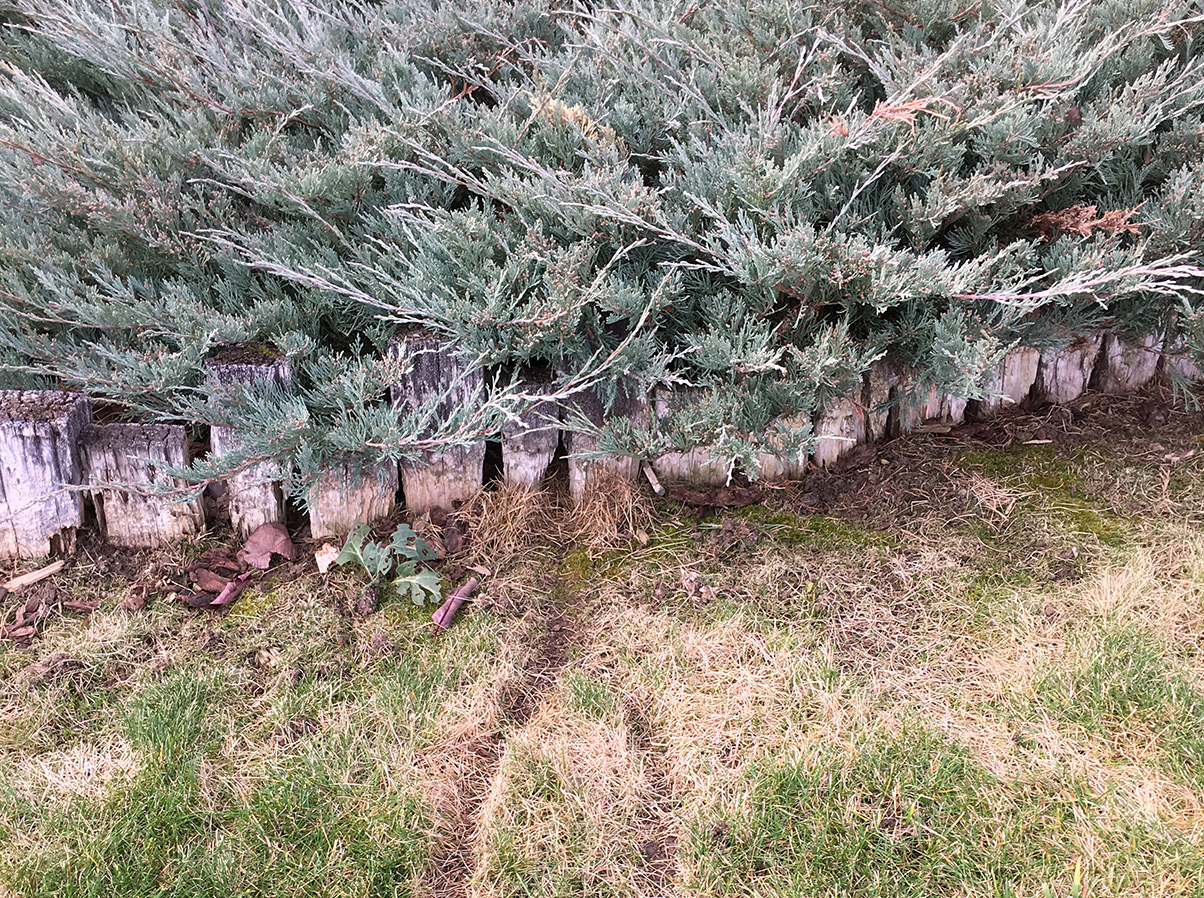
Photo: Stephen M. Vantassel
DAMAGE IDENTIFICATION
Most people don’t notice voles until their numbers increase enough to cause significant
damage (called irruptions) or they see the damage in the spring. In turf, voles carve
runways or dig holes. Runways are up to two-inch wide trails that allow voles quick
access to feeding areas. Holes are dime- to quarter-sized holes cut cleanly in the
turf that lead to burrows and nesting areas.
During the winter, food-stressed voles gnaw tree bark for nourishment. Gnaw damage
often occurs as high as the snow line and will contain irregular gnaw marks 1/16-inch
wide and ⅜-inch long. Rabbits also gnaw bark but their marks will be wider, occur
up to three feet above the snow line and will be accompanied with round droppings.
CONTROLLING DAMAGE
The most important step in controlling vole damage is to reduce ground cover and food
that voles need to thrive. Keep grass mowed to four inches or less and create weed-free
zones around trees out to the drip line. Modify birdfeeders so that seed does not
reach the ground. To reduce migration from adjacent unmowed fields, create a weed-free
zone 5-15 feet wide. Protect individual plants by installing ¼-inch hardware cloth
around plants. The screen should start three inches below the ground and extend to
12 inches above the expected snow line.
Timing of control efforts is the second most important factor. To prevent winter damage,
control voles in September and October. Otherwise, control voles whenever you notice
damage above your tolerance level.
TRAPPING
Voles are easily trapped with mouse-sized snap traps. Simply place the snap traps
perpendicular to the trail with the trigger in the runway to catch voles. Bait is
not required. If choosing to use bait, be sure to place traps under a protective cover
to prevent birds from being attracted to the traps and possibly injured. Placing baited
traps under sheets of plywood propped up with bricks is often sufficient.
RODENTICIDES
Numerous rodenticides are available for controlling voles. Read the rodenticide label
carefully BEFORE purchasing the product as the label will explain how to use the product
properly and legally. Many mistakes have been made, some with tragic consequences,
because users did not read and understand the label. As a side note, I do not recommend
fumigants for control of voles because their burrows are often too porous to obtain
effective results. Likewise, repellents and frightening devices are not worth the
money.
Here are a few tips to improve safety and effectiveness when using toxicants.
Follow application guidelines carefully. Make sure the application aligns with label
instructions BEFORE purchasing the pesticide. The label should list voles as a target
animal AND the site intended to use the product. For example, there are voles causing
damage in the 10 acres behind your home. At the hardware store, you find a product
called Fastrac All-Weather Blox (EPA Reg. No. 12455-95). It lists voles on the label.
But as you read further, the label restricts application to within 100 feet of a structure
(i.e., your home). Should you purchase this product? No, because the voles you need
to control are not within 100 feet of your home.
If the label requires using tamper-resistant bait stations, select stations with openings
no larger than 1½ inches in diameter, or reduce the opening size with screen or metal
flashing.
SAFETY
While not significant threats to health, voles can carry babesiosis and Rocky Mountain
Spotted Fever. Always wear protective gloves when handling rodents and related control
equipment. Hand washing, using insect repellent, and avoiding contact with urine and
feces will reduce potential disease risks as well.
For more information on the control of voles, modifying bird feeders and using bait
stations visit https://agr.mt.gov/Vertebrate-Pests.
Stephen M. Vantassel is the Vertebrate Pest Specialist for the Montana Department
of Agriculture.
Comments are closed.