
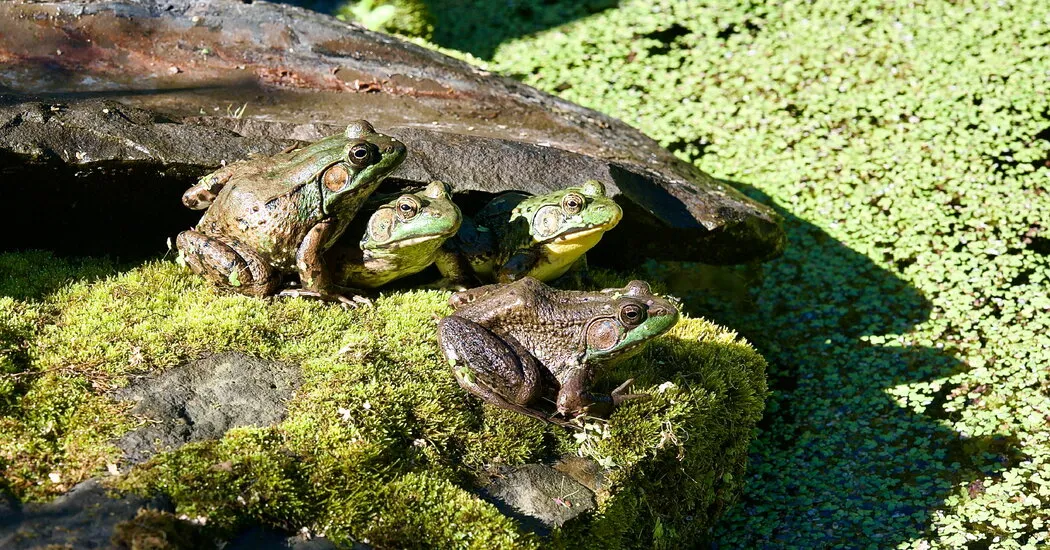
“Looks messy, helps frogs.”
So read the subject line atop a recent issue of The ARC’ives, the newsletter of the Amphibian and Reptile Conservancy, which described how a wetland under restoration may at first look messier — as invasive plants are removed, for example, or prescribed burns are conducted — before the system starts to heal.
Messiness can signal a new beginning, and much more. For gardeners, it probably also conjures the recent “leave the leaves” mantra of gentler, conscious fall cleanup aimed at supporting a different set of vulnerable animals, the pollinators and other invertebrates who rely on leaf litter as an overwintering habitat.
But as colder weather approaches, what about management of a real biodiversity hub of the home landscape, the water garden? A bit of messiness comes into play there, too, all year round. In the way we’ve come to understand how so much life depends on those fallen leaves on the ground, said JJ Apodaca, a conservation biologist and the conservancy’s executive director, “your water garden can basically be doing the same thing.”
Fallen vegetation helps provide structure necessary for certain amphibians to overwinter in water. Then when spring approaches, emerging insects feed on the decaying material, and amphibians in turn feed on the insects, giving them what Dr. Apodaca called “the food to start to build back up after a long winter and fatten up for eggs and reproduction, and to lay the foundations for the next generation.”
“Just like with the habitat on land, you need the dead and the live plants,” said Nancy Lawson, a naturalist and habitat consultant known as the Humane Gardener, which is also the title of her first book. Ms. Lawson built two ponds in her wildish backyard, as I did in mine in New York’s Hudson Valley.
The water garden is not a swimming pool. We don’t add chemicals or change out the water, skim out every last leaf or twig that falls in, or cover it with a tarp at season’s end — because the season doesn’t end. In the Eastern United States, for example, adult-stage bullfrogs, green frogs, pickerel frogs, leopard frogs, Eastern newts and painted turtles overwinter in the bottom of water bodies that don’t freeze completely.
Including, potentially, your backyard pond. Every drop helps.
“From 1786 to 1986, in those 200 years, we lost 60 acres of wetland an hour in the United States,” said Dr. Apodaca, noting that roughly 60 percent of amphibian species worldwide are at risk of extinction.
In the face of that, his organization’s mission is to identify and conserve the highest-priority places for amphibians and reptiles. One project in the Florida Panhandle aims to repopulate the frosted flatwoods salamander, which has “lost 99 percent of their range and 99 percent of their habitat,” he said, “one of the most endangered salamander species in the United States, if not the world.”
Amphibians “play a huge role in nutrient cycling,” said Dr. Apodaca, who described them as the “bridge between the insects and vertebrates.” They consume insects and other invertebrates like slugs, worms and spiders, “and then everything eats amphibians — birds, snakes, mammals, fish obviously,” he added. “So they make up a really important link in the food chain, and a really important connection between those worlds.”
Adventures in Water Gardening
Ms. Lawson and I began our water-garden explorations similarly, though decades apart. In 2020, she dug her first pond, just 18 inches deep, then worried, as I had, when winter approached about what the risk of solid ice would mean for the residents. The one she added in May is three feet deep, like my second.
Despite the greater depth, I use a thermostatically controlled floating electric de-icer to keep an opening in the surface, allowing gas exchange. It earns extra credit: Unfrozen water is a major attraction for a diversity of winter birds.
We’ve been privileged to see every manner of wildlife use the ponds, including dragonflies, damselflies and, in my case, black bears. Plus, birds that wouldn’t otherwise be drawn to our sites have appeared — a green heron recently beside Ms. Lawson’s, a mating pair of wood ducks this spring in mine.
And we’ve come to follow similar management guidelines:
No fish. They are predators of eggs and tadpoles, which is why many amphibians use ephemeral pools — temporary seasonal water bodies that can’t support fish — to reproduce in spring.
No chemicals, either to treat the water or in our gardens. These highly vulnerable animals breathe in part or even entirely through their skin.
No major cleaning. Ms. Lawson and I don’t drain our ponds to replace the water, but merely top it up as needed. If a heavy buildup of organic material risks making a water feature more marsh- than pool-like, a portion can be carefully skimmed out with a net. My process: I never do this in breeding season when eggs might be present. I gently place what’s removed in a wheelbarrow to examine manually, returning an occasional tadpole to the water.
Aquatic plants are a yes. Submerged ones create underwater habitat; floating ones like duckweed and water lilies shade the surface, reducing major algal blooms. Different species have different habitat requirements, Dr. Apodaca said. For gray tree frogs, for instance, it’s shallow water with a lot of emergent vegetation; bullfrogs seek much deeper water and may prefer less vegetation.
Provide an exit strategy. Prevent animals from getting trapped and drowning with a gently sloped or shelflike edge design, or rocks or a branch positioned to form an exit ramp.
Watch, Wonder — and Welcome
Not all our gardens’ amphibians head beneath the surface to brumate (like hibernating, but for ectotherms). Leaving the leaves benefits some who slumber aboveground, including gray tree frogs and spring peepers.
Spotted salamanders go deeper: They spend much of their lives underground, emerging only during late winter and early spring rains to migrate to seasonal pools to breed. In the surface debris of one pool here, their egg masses join the wood frog’s — among the earliest breeders (and the only frog sufficiently freeze-proof to live north of the Arctic Circle).
As people have developed more interest in butterflies, bees and other pollinators, Dr. Apodaca said, “they’re more willing to do more for them.” He hopes amphibians capture gardeners’ attention and inspire action, too — maybe even turning more of us into water gardeners.
I’d only known the Eastern newt in its vividly colored terrestrial life stage until I dug my first pool maybe 35 years ago. That red eft stage, up to five years or so of a life-span that can reach 15, is the juvenile phase of an animal that begins as an egg in water and then has a monthslong olive-greenish aquatic larval stage — the salamander equivalent of a tadpole — before it comes to live on land. At sexual maturity, the newt enters a second aquatic phase, returning to the water to breed.
No flashy red outfit here: Though camouflaged in mottled neutrals that render it nearly invisible among leaves and soil, the American toad caught Ms. Lawson’s attention. A primarily terrestrial species, it uses the water only for breeding. When winter signals its approach, toads burrow beneath the soil surface to brumate, employing a signature move powered by their strong hind legs.
“How they dig backward and the earth closes around them — it’s so beautiful,” she said. “Why can’t we just do that, too, and come back refreshed?”
Comments are closed.