
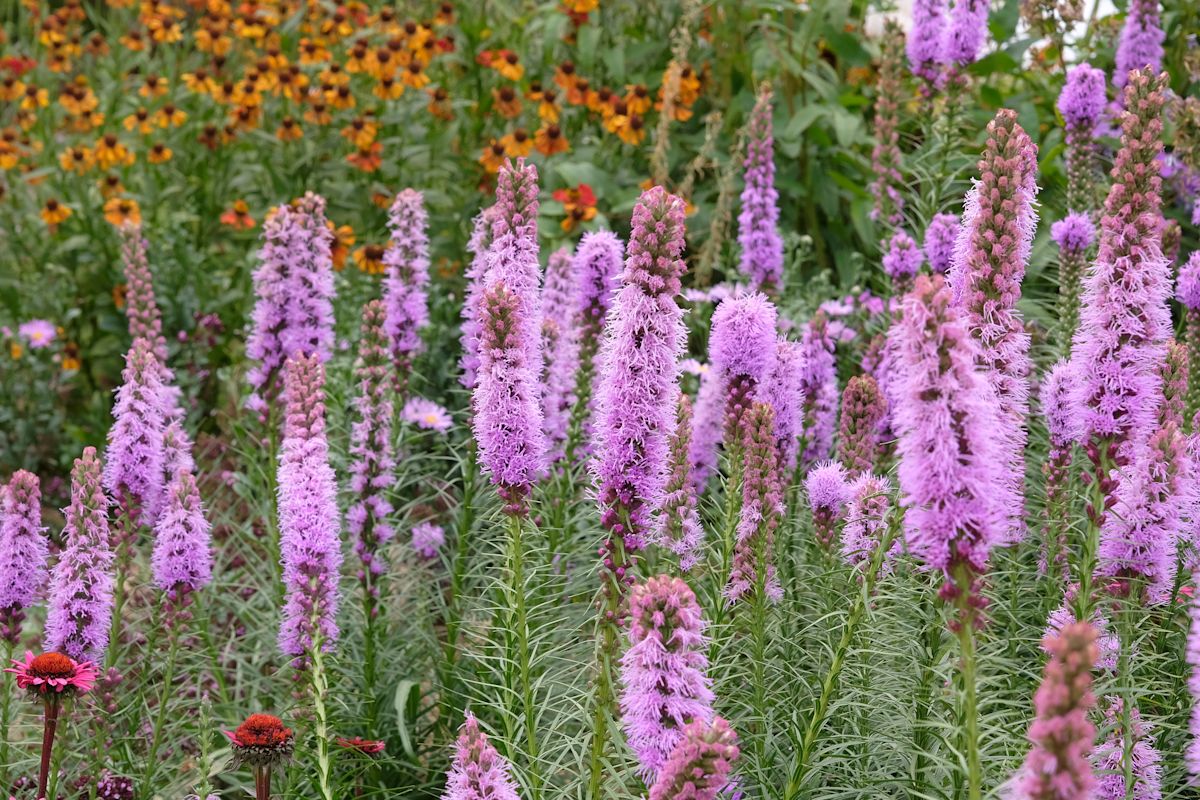
Every summer, right around early August, my Wisconsin front yard starts to flicker orange. Up close, it’s monarch butterflies — dozens of them, drinking up my blazing stars like they’ve nowhere else they’d rather be. They come every day, reliably, for hours and weeks on end. It’s the best show of my summer.
I’ve been slowly renativing my yard since 2021, and I now have hundreds of native plants in the ground, both front yard and back (and side yard!). For a long time, that put me in a slightly eccentric category: the neighbor with the “messy” yard. But that category is getting crowded fast, and the latest sign comes from a place I didn’t expect: the real estate industry.
Even realtors are telling people to plant native
The National Association of Realtors has published sustainable landscaping guidance for its members, and native plants are right there on the list. NAR points to the National Wildlife Federation’s recommendation to aim for 70% native plants in any yard or landscaping overhaul, noting that natives support local birds, butterflies and wildlife, and tend to be low-maintenance, since they’re growing exactly where they evolved to grow.
That matters, because realtors care about what sells. According to NAR, 92% of Realtors recommend that sellers boost their curb appeal, and homeowners who upgrade their landscaping report a “joy score” of 9.7 out of 10. Meanwhile, the Arbor Day Foundation’s 2024 Canopy Report found that four in 10 Americans chose where to live based on access to green space.
Tim Snyder, executive director of the nonprofit Homegrown National Park, flagged the NAR guidance in a new post, arguing that when an organization built around real estate starts recommending native plants, it’s “a sign the culture is shifting, not just the science.”
He’s right, and the numbers back him up. In 2018, natives made up only about 10% of plant sales. But in a 2022 national survey of 2,066 people funded by the Horticultural Research Institute, half said native plants were very or extremely important in their home landscapes, a third said moderately important, and only 17% said they mattered little or not at all. The skeptics are a shrinking minority, and growers surveyed by Nursery Management in 2025 reported that customer demand continues to climb.

Cardinal flower (Lobelia cardinalis) in bloom in summer.
(ErikAgar via Getty Images)What a native yard gives you back
Like Snyder says, a native yard gets better every year. A lawn demands water, fertilizer, and mowing forever, while a native planting sends its roots deeper each season, needs less water over time, and supports more wildlife as it matures.
I see it in my own yard all the time. The first moment the potential for impact really hit me was actually a bit sad: In 2021, I had one blazing star in total. One. A monarch butterfly practically lived on that one plant. I felt terrible — my yard was the only food option it had in my neighborhood, and all I had to offer was one measly plant. I vowed then and there to explode my yard with blazing stars, and as that video above attests, I have. Now, that one monarch told all his friends, and my yard is a waystation to save the species. It’s both heartbreaking and makes me so, so happy.
Of course, the birds love them too — that’s actually how I got into this, wanting to birdscape my yard for the chickadees and nuthatches. My red osier dogwoods are absolute bird-friendly juggernauts — they’re ridiculously hardy and still ridiculously beautiful. And my cardinal flowers? The most glorious shade of red you’ve ever seen, and so many hummingbirds. They make me so happy.

A monarch butterfly feeds on the purple flowers of a Blazing Star (Liatris) plant in the Ornamental Gardens of the Central Experimental Farm in Ottawa, Ontario
(Richard A. Whittaker via Getty Images)Start smaller than you think
If you’re hesitant, here’s my advice: Don’t rip out your lawn. I started with a single 5-by-10-foot patch, and I’ve added a little more every year since. My partner, for the record, loves mowing less, especially on the slopes and awkward corners that were always a pain to reach.
If you live in an HOA, you’re not alone in feeling boxed in. In the Arbor Day Foundation’s 2025 Canopy Report, 14% of Americans said HOA or local rules were a reason they hadn’t planted even a single tree. Homegrown National Park suggests starting with one visible area and giving it clear signs that it’s tended — clean borders, a defined path, maybe a small sign — so it reads as intentional rather than neglected. And rules do change: Green Bay, here in Wisconsin, rewrote its vegetation ordinance to formally support native landscapes.
One patch is enough to start. Mine turned into hundreds of plants, a summer full of monarchs and a lot less mowing. Not a bad return.
If you love nature as much as I do, I’d love if you could follow me on Yahoo Creators for more articles on our wild world. This shows the Yahoo team what their readers want — and the more brands that support the planet, the better.
Comments are closed.