

SINGAPORE – One year ago, the ribbon of garden bordering Irene Ngoo’s new cluster house in Holland Road was desolate – it dissolved into a muddy rivulet on rainy days.
The scattering of potted plants and condo shrubbery was a jarring departure from her original Min’s Garden, a botanical sanctuary she had spent 36 years tending lovingly within the family’s 7,800 sq ft colonial bungalow compound in Clementi.
Her prize-winning Min’s Garden, a haven for tropical greenery and biodiversity, inspired plant lovers and emerged as one of Singapore’s best documented private home gardens on social media.
Across Instagram (@minsgarden), TikTok (@irenengoo) and Facebook, she has more than 140,000 followers.
But a lifetime of gardening was uprooted. “We became gardeners in reverse – carefully dismantling what we had spent decades creating,” she tells The Straits Times.
Within four frenzied weeks, Ngoo and her Filipino domestic helper Jay replanted much of the tropical jungle they had salvaged from the landed property to the compact corner condo with a built-in area of 2,500 sq ft.
More than 10 lorry-loads of plants left Min’s Garden, named after Ngoo, whose Chinese name is Ai Min.
Many found homes in private gardens. Some of the most cherished specimens were relocated to the atrium garden of the Shangri-La Singapore hotel.
It was a long goodbye, and the former ST journalist struggles even today to describe the upheaval and grief.
Dreading 70, finding transformation
She had marked her dreaded 70th birthday in April 2025 ahead of the traumatic move; the unappealing planting strips at her condo profoundly mirrored her personal loss.
“To me, 70 seemed to carry labels I was reluctant to embrace – senior citizen, retired, no longer professionally relevant,” she says.
“Society often treats ageing as a gradual withdrawal from life rather than a continuation of growth. I worried about becoming invisible, irrelevant, dependent or unemployable. The number weighed heavily on me.”
But today, the sad strips are transformed – and so is Ngoo. Now 71, she is enjoying a buoyant season of life.
It is exactly a year since Sept 26, 2025, when Ngoo and her husband Ronnie Lim, 77, a former editor at The Business Times, moved into their condo.
Their two daughters, who are in their 30s, have lived many years in the United States. A grandchild is arriving in November.
Min’s Garden 2.0, lavish and layered, encompasses linear planting strips; a little backyard patio; a shaded indoor courtyard with a vertical green wall; and a sunny rooftop terrace verdant with container plants.
The foliage is flourishing after a months-long “beauty sleep”.
In a residential unit where space is at a premium, Ngoo has traded her original jungle for an intimate curation.
How to conquer every square metre
“At Min’s Garden, I had space. Here, every square metre counts,” she says. Besides, the narrow planting strips are “common grounds” that she gardens within strict parameters and on a much smaller scale, she explains.
“I had to rethink scale, plant placement, light conditions and how residents would experience the garden.”
In this light, instead of creating splendid vistas, she has focused on presenting “intimate moments – a leafy pathway, a courtyard view, a rooftop retreat and small pockets of greenery that reveal themselves gradually”.

Unlike the original, sprawling Min’s Garden, the new, smaller Min 2.0 version presents intimate moments, such as a leafy pathway.
ST PHOTO: GIN TAY
Replication is impossible, she has realised. “Once I embraced that mindset, the design process became much more enjoyable.”
This garden has its own personality, she figures. “It is smaller, more intimate and easier to manage. Instead of replicating the old garden, I’ve tried to respond to the space and let it evolve naturally. I think that’s a lesson many of us learn as we grow older.”
Again, the garden is a living allegory for her own transition. “We don’t need to recreate our younger selves. We simply need to embrace who we are now.”
Upheaval, then radiance
Gradually, the new garden, where every plant experienced upheaval, took radiant shape.
“The plants that had journeyed with us began to put out new leaves, sending reassuring signals that they, too, were adapting. In many ways, they were teaching us how to adapt,” she says.
“Birds returned. Squirrels appeared. New planting areas emerged. The rooftop terrace became a gathering space. Small pathways softened with greenery.”
Some plants have never done better, surprising her with their remarkable resilience and how naturally they adjusted.
Some of the heliconias had produced nothing but leaves at first. Then suddenly, these tropical perennials rewarded her with beautiful blooms.
“The orchids have also been a pleasant surprise. Several species flowered within weeks of being relocated,” she says.
“My Cymbidium finlaysonianum alba, which I had searched for over a decade, produced its first blooms here.” In bloom, these tree-dwelling orchids send down cascading strands of striking, waxy flowers.

The vertical green wall of climbers, mostly aroids, has exceeded Irene Ngoo’s expectations by flourishing quickly.
ST PHOTO: GIN TAY
The vertical green wall in the courtyard has exceeded her expectations as well. “It has become lush and established much faster than I anticipated,” she says.
“These successes remind me that plants often need time. What appears dormant or stagnant may simply be preparing for a new burst of growth.”
She has also realised that it is not the size of a garden that matters. “It’s the life, love and meaning you bring to it.”
So the story is not simply the rebuilding of a garden. It is the rebuilding of a life, she highlights.
The couple themselves began creating new routines and memories.
Morning walks to the Singapore Botanic Gardens. Golden hour spent in the small patio backyard, watching the birds fly off to roost and the leaves shimmer in the orange sunset.
After-dinner lingering on the rooftop terrace, with its panorama of every shade of green, from feathery jade filaments to dark forest-green fronds.
“The frantic urgency of resettling gave way to a more intentional rhythm,” Ngoo notices.
She also started doing things long postponed, like joining a gym and enrolling in courses. “I also took up ink sketching and watercolour painting, discovering that years of observing plants had quietly trained my eye to see form, texture and detail,” she says.
“I returned to knitting with a vengeance. I continued volunteering with grassroots organisations and non-profits, work that brings purpose and connection.”
She also discovered new ways to share stories, mostly about gardening and travel, via social media.

Whimsical artwork from nature by Ronnie Lim, a former editor at The Business Times, plant lover and Irene Ngoo’s husband.
ST PHOTO: GIN TAY
Her husband, also very much a plant lover, fashions whimsical works of art from foraged seeds and driftwood.
New pursuits, abundant life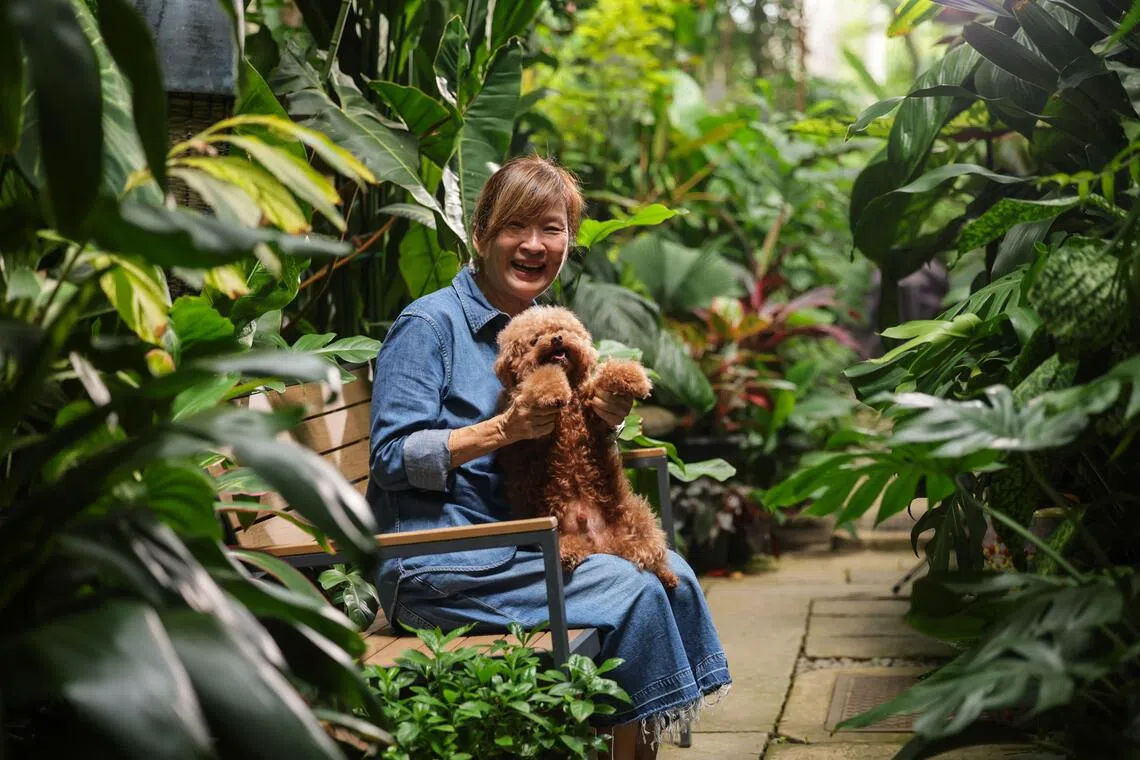
Like her garden, Irene Ngoo is flourishing in a new season of life. Her constant companion is Wiski, a red toy poodle.
ST PHOTO: GIN TAY
Life has become full again, she remarks, but in a different way. “The garden has taught me that growth never really stops, just as a garden is never done. It simply takes different forms.”
Creating a new garden has also changed her as a gardener.
For many years, she was focused on acquiring and growing plants. “This move taught me to become more selective and intentional. I now pay greater attention to how a garden supports daily living,” she says.
“A beautiful garden is important, but so is having places to sit, relax, entertain and connect with nature. I’ve also become more appreciative of simplicity. A single flowering orchid, a bird visiting the garden or a new leaf unfurling can bring just as much joy as a large collection of plants.
“Perhaps age has taught me to slow down and notice more.”
While she misses the mature trees from her former Eden, she has started a herb garden in the past couple of months.
“In our former garden, trees provided structure, shade and a sense of permanence,” she says of the lost giants.
“But gardening is also about adapting to what you have, and I enjoy the challenge of creating layers, height and interest in different ways.”
She estimates that 95 per cent of the plants are rehomed from the original oasis.

The sun-drenched rooftop terrace is a perfect spot for after-dinner lingering, birdwatching and growing herbs in containers.
ST PHOTO: GIN TAY
Newcomers include an edible garden on her sun-drenched multi-sensory rooftop, replete with the all-day soundtrack of cicadas, wind chimes and bird calls.
Here, she is experimenting with laksa leaves, parsley, basil, dill, loofah, red hibiscus for tea, chunky eggplants and “unhappy” rosemary.
“I’m rather enjoying being a beginner again,” she writes in a Sept 2 post on Facebook, where she documents her gardening journey. “Perhaps this is finally the start of the edible garden I have always wanted – one herb, one vine and hopefully one very stubborn rosemary plant at a time.”
And so there is change, but also a luminous continuity.

Irene Ngoo’s original Min’s Garden in Clementi was a “tropical jungle” that she dismantled a year ago.
PHOTO: ST FILE
“All the stepping stones, ornaments and plants came from our former home, so there is continuity,” she tells ST.
Yet the garden also feels fresh and contemporary, retaining “the essence and charm of Min’s Garden, with many beloved plants, features and memories woven into its fabric”, she says.
The garden may look different now. The house is different. “But the spirit that shaped Min’s Garden all those years ago remains very much alive. It simply continues to grow in a new place.”
Overall, she is amazed that the garden is up and running in such a short time.
“It feels authentic. And natural. I wasn’t interested in creating a show garden or replicating Min’s Garden. I wanted a garden that reflected where Ron and I are at this stage of our lives,” she says.
“The courtyard, rooftop terrace and narrow planting strips serve a different purpose. There are places for reflection, for entertaining friends, for observing birds and simply enjoying a morning coffee.”
Joy of journalism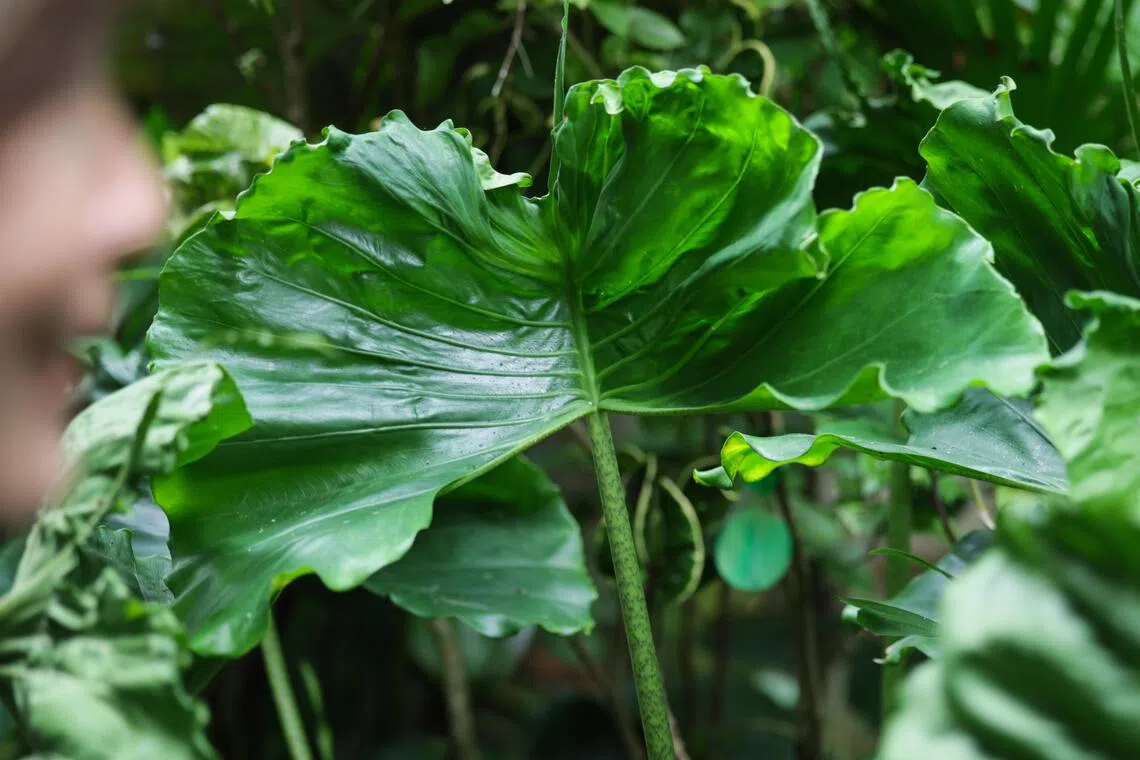
Irene Ngoo’s garden is in every shade of green, from feathery filaments in jade to dark forest-green fronds.
ST PHOTO: GIN TAY
Min 2.0 is not a sequel. It is a new season proving that gardens, and humans, can adapt and bloom afresh.
Ngoo, a high-velocity journalist whose prolific portfolios once included housing, health, education, trade, politics and foreign news, was ST’s first breaking news editor and a London correspondent over the decades.
She also headed the Singapore Press Holdings’ corporate relations department for three years and later helmed ST’s editorial projects unit, where she drove partnerships, special projects and public relations for more than 10 years.
Ngoo, who retired in 2024, confesses to moments of missing the pace, deadlines and sense of professional contribution.
“For much of my life, work provided structure, identity and purpose. Letting go of that role has not been entirely easy,” she says. “Retirement is often portrayed as a destination, but I have discovered it is really another transition that requires adjustment and reinvention.”
What has surprised her most is that fulfilment can take many forms.
“Today, I find myself appreciating a slower pace that I once resisted. I savour small rituals. I spend time creating rather than rushing. I invest more deeply in friendships, family, community and personal growth,” she says.
“And perhaps that is what Min’s Garden 2.0 is really about. Not a smaller version of the original garden. Not a replacement. But an evolution.”
The original Min’s Garden taught her about nurturing living things.
“This new chapter is teaching us about resilience, adaptation and renewal.
“It reminds us that loss and growth often coexist. That endings can become beginnings. The roots can survive transplantation.
“And that even after profound change, life has an extraordinary capacity to bloom again.”
Starting from scratch: What Irene Ngoo did for Min’s Garden 2.0
Starting a garden can seem daunting. Here are some lessons Ngoo has learnt, sometimes the hard way.
Watch before you plant
“Before you buy a single plant, just watch your space for a bit. Where does the morning sun hit? Which areas get blasted by fierce afternoon heat? Where’s the deep shade? Which spots stay soggy after rain? Is it windy? Does rain actually reach your plants or do overhangs and eaves block it?
“A few weeks of paying attention can save you months of trying to force a plant to live somewhere it clearly doesn’t want to be.”
Start with plants suited to your conditions
“It’s so tempting to fall head over heels for a plant and figure out where to put it later. I have done this more times than I care to admit. The smarter move is to look at what you actually have – a sunny balcony, a shaded corridor, a windy high-rise terrace – and pick plants that already like those conditions. Work with your environment – not against it.”
Put in the bones first
“In larger spaces, place your main structural plants before filling the gaps. Think about what they’ll look like years ahead, not just on planting day. That little nursery palm in a bag can become a monster problem. Then add smaller plants around it.”
Think upwards
“Can’t spread out? Go vertical. Walls, trellises, fences, arches – they’re all growing space. Climbers and layered planting make small footprints feel lush and full.”
Get help with the heavy lifting
“The hardest part of the move was digging up paving stones embedded in our old garden for over 30 years.
“We hired nursery workers to prise them out, stack them on three pallets, and crane them to the new space. They installed the primary pathways, turning what was once a muddy track into a proper back garden walk, and I laid the remaining pieces myself.”
Feed your soil first
“Get to know your dirt before you plant. Sandy, clay, loamy? Add compost or organic matter upfront. Healthy soil is the best head start you can give your plants.”
Don’t fill every gap immediately
“This is advice I give out easily and struggle to follow myself. But here’s the thing: Plants grow. They spread. They send out offshoots. And you will almost certainly fall for another plant six months from now and have nowhere to put it. Leave some breathing room – for them and for you.”
Expect to move things
“Put a plant in the wrong spot? Just move it. I have shifted plants two, three or more times before they settle. Gardens evolve. So do our decisions. Observe, adjust and try again.”
Give your garden time
“We all crave that instant lushness. But a garden needs time to become itself. Roots establish. Moss shows up when it’s ready. Birds and insects discover the space. Some plants will thrive. Some disappoint, some die. That’s not failure. That’s gardening.”
Comments are closed.