

Outdoors experts agree: It’s time for us to make peace with the pests in our gardens.
Bugs, raccoons, snakes, iguanas: These critters are so abundant in South Florida that they are almost impossible to eliminate. Nor do we want to, said Chris Maler, senior director of horticulture at Flamingo Gardens in Davie.
“A better option is to learn to respect and live with our animal neighbors,” Maler said. “Snakes are excellent rodent control. Opossums eat deer ticks that carry Lyme disease, but are resistant to the disease themselves. Making your yard friendly to raptor birds like owls and hawks will reduce rodent and snake populations.”
With the exception of iguanas and bufo toads, which the Florida Fish and Wildlife Conservation Commission (FWC) says we have permission to kill humanely, professional gardeners and wild animal specialists say we mostly should forego pesticides and learn ways to cope with the creatures among us, even if they want to devour our beloved flower and vegetable beds. Here are some ideas for dealing with our South Florida varmints.
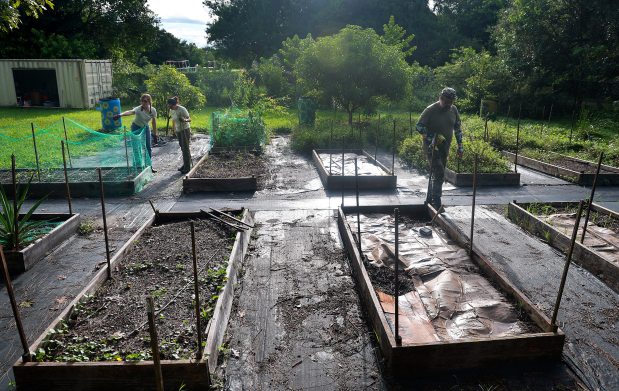 Gina Reichenbach, Vianey Covarrubias and Joey Reichenbach work in the Weston Community Garden at Markham Park on Saturday, Sept. 19, 2026. The community garden features nets around its raised beds to prevent animals from climbing in, while remaining open at the top to allow birds and butterflies to pollinate. (Mike Stocker/South Florida Sun Sentinel)
Snails and slugs
Maler said commercial snail bait is highly toxic to mammals. He recommends planting snail-resistant foliage with tough, hairy or oily surfaces, such as garlic, rosemary or ginger. For native options, he said to plant tropical sage, wild coffee and coontie.
Another possibility is a beer trap, which attracts and drowns snails and slugs with the scent of yeast and sugar. “Refill traps daily for best control,” Maler said.
Yellowjackets and hornets
Fill a spray bottle with a teaspoon of peppermint oil mixed with water and keep it handy to sprinkle areas where wasps or hornets congregate, Maler said. In addition: “Keeping outside areas of patios and porches clear and clean will help reduce places for wasps and hornets to nest around your home,” Maler said.
R.D. BARTLETT/AP
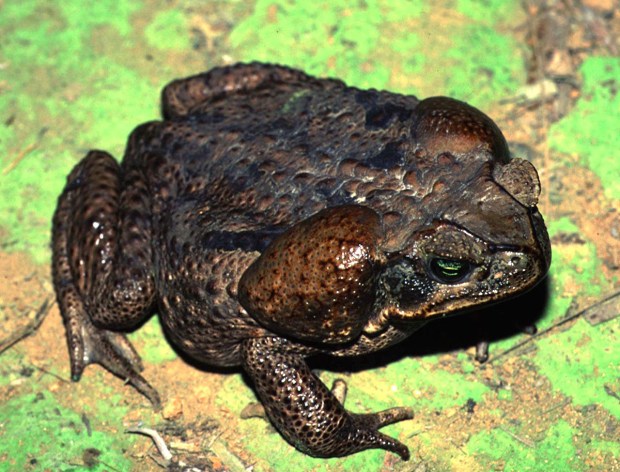
The cane toad, or bufo marinus, has poisonous glands that can kill a dog if the secretion finds its way into the pet’s mouth. The toad is well established in South Florida (R.D. Bartlett/AP)
Cane or bufo Toads
This invasive species, which is attracted to wet areas such as yards, canals and ponds, has spread throughout South Florida and competes with native species for prey. These amphibians have a different look from frogs: They’re 6 to 9 inches long, brown with light beige bellies, and can have dark markings or be uniform in color.
They are poisonous and especially dangerous to pets, which can die quickly from the miky toxin these toads release.
According to the University of Florida Institute of Food and Agricultural Sciences (UF/IFAS): “If you find a cane toad in your yard, report it to the FWC and humanely kill it. Keep in mind that cane toads look similar to several native species, so get a positive ID before taking action.”
 A raccoon “will eat just about anything,” according to Bridget Gerovac, a natural resources agent with the UF/IFAS Extension. (Amy Beth Bennett/South Florida Sun Sentinel)
Raccoons
The best way to keep raccoons away is to remove their food source, said Bridget Gerovac, a natural resources agent with the UF/IFAS Extension.
“Don’t leave dog or cat food outside,” Gerovac said. “They will eat just about anything.”
To protect your garden, install a fence that slopes toward the raccoon so they can’t get a grip. Some gardeners recommend sprinkling strong-smelling substances such as cayenne pepper or ammonia as deterrents.
Snakes
Be kind to snakes; they get a bad rap, Gerovac said.
“They are great at helping to control other pests, like rodents,” she said. “They’re more scared of us than we are of them.”
The snake we’re most likely to see in our South Florida gardens is the Southern black racer, which is a “garden BFF,” as it eats mice, insects, lizards and other snakes, Gerovac said.
She said there are only six venomous snakes in Florida, out of about 50 species. She recommended staying away from them and not trying to capture them.
Mike Stocker / South Florida Sun Sentinel
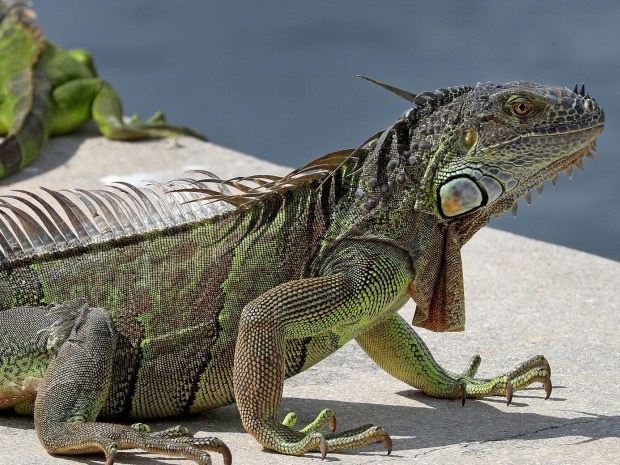
In this staff file photo, iguanas gather on a seawall in a Hallandale Beach neighborhood. (Mike Stocker/South Florida Sun Sentinel)
Iguanas
Iguanas, an invasive species, love flowers and fruit, including mangoes, berries and tomatoes. They are omnipresent and hard to control because they don’t have natural predators and reproduce at a rapid pace.
The FWC offers detailed instructions on how to kill these invaders in a humane way.
For those seeking alternative control methods, Flamingo Gardens’ Maler recommends planting iguana-resistant species such as bananas, palm trees, wild coffee, Jamaican caper, heliconia, and shampoo or butterfly ginger.
To keep them away from fruits and vegetables, Gina Reichenbach, president of the Weston Community Garden Society, bought some loose netting. She placed it around the sides of raised garden beds so they can’t get to the community garden’s tomatoes, eggplant, peppers, herbs, okra, broccoli and mustard greens. She said the netting should be open on top to allow birds and butterflies to pollinate the plants.
“The netting is flimsy enough that it deters the iguanas,” Reichenbach said. “They are more inclined to climb more sturdy structures like a fence.”
Reichenbach said her gardeners tested several types of netting to make sure animals don’t get stuck in its openings.
“We need to coexist with them,” she said. “But we need to stay one step ahead of them.”
 Vianey Covarrubias and Gina Reichenbach do their part to nurture the Weston Community Garden at Markham Park. (Mike Stocker/South Florida Sun Sentinel)
Comments are closed.