
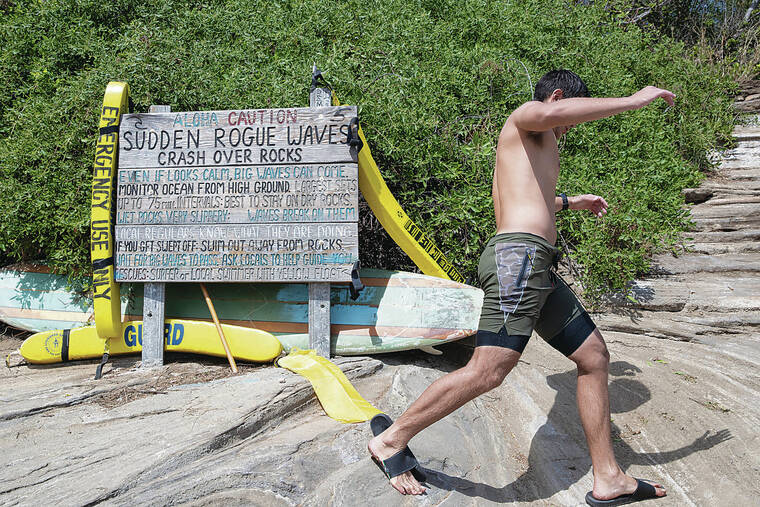
A simple, yellow rescue tube has helped save numerous lives at the treacherous China Walls coastal cliffs in the Portlock neighborhood of Hawaii Kai.
Despite warnings, many inexperienced swimmers and visitors still go to China Walls, where unpredictable, powerful waves and currents can overcome even the most experienced surfers.
When they get in trouble, good Samaritans have used the rescue tubes provided by the Rescue Tube Foundation to reach them or help keep them afloat.
Saving lives is the goal of the foundation, according to Executive Director Branch Lotspeich, which has worked over the past 25 years to install hundreds of rescue tubes across the state. Now, with a $200,000 grant from the state, the Kauai-based nonprofit hopes to install about 300 more rescue tubes across Hawaii to save even more lives.
Hawaii’s resident drowning rate is the second highest in the nation, with an average of nearly 40 drowning deaths yearly, according to the state Department of Health. When visitors are added to the mix, the average annual number of drowning deaths climbs to 83.
“One of the first things a lifeguard is taught is never help somebody without taking a flotation device,” said Lotspeich, a former lifeguard. “The primary purpose of the flotation device is to protect the rescuer.”
Lotspeich estimates there are about 200 rescue tubes posted around the island of Kauai, about 130 on Maui, 50 on Hawaii island and 30 on Oahu.
His goal is to add 300 more across all four islands, but mostly on Maui, Hawaii island and Oahu.
The state Department of Land and Natural Resources will oversee the grant. The Hawaiian Lifeguard Association will help determine where the tubes are most needed, Lotspeich said, in collaboration with the head of ocean safety operations in each county. He expects those decisions to be finalized in the next few months.
Lotspeich does not have data on the number of times the rescue tubes have been used in successful rescues across Hawaii but hopes to use some of the grant money to gather those statistics.
But there have been hundreds of rescues, he said, without any known injuries to users.
East Oahu dangers
In East Oahu, some of the first spots to get rescue tubes were China Walls and nearby Spitting Caves.
Both the Honolulu Ocean Safety Department and state authorities have repeatedly warned the public to stay away from both areas, citing dangerous conditions and deaths. No lifeguards are stationed at either site.
On July 2, bystanders used a rescue tube to help a man who sustained an arm injury after jumping into the ocean. They were able to assist the man back to shore as Honolulu Ocean Safety personnel were responding. Last month, an off-duty lifeguard used a rescue tube to help a surfer in trouble at China Walls.
The Ocean Safety Department at the time warned that Spitting Caves is an extremely hazardous shoreline area with strong currents and powerful surf.
“Entering the water at this location can be life- threatening, and the public is strongly urged to exercise caution and avoid cliff jumping or swimming in hazardous conditions,” said the agency in a news release.
Last year as well as in 2021, DLNR issued public service announcements warning of the jagged reef below China Walls and currents that can overcome even the strongest swimmers and carry someone all the way to Diamond Head.
Past news stories document deaths in 2014, 2019 and 2020 as well as last year.
China Walls was one of the first sites to get a rescue tube, according to Eric Kvick of the Hawaii Kai Lions Club, the foundation’s partner. The club installed one there as early as 2017 after identifying it as a site that needed one.
Most times, bystanders there have helped victims out of the water in emergency situations when seconds matter.
This happened in March 2022 when two men in their 50s got into trouble in two separate incidents — one at China Walls and one at Spitting Caves. About a year later, surfers were the first to help a 24-year-old man from New York get to shore after he hit his head while jumping off China Walls.
In 2024, during a news conference on the rescue tubes at Sandy Beach, lifeguards got a 911 call for a swimmer in distress at China Walls. The swimmer, a 20-year-old man, apparently jumped into the ocean to celebrate his birthday, and a good Samaritan tossed him a rescue tube to help him stay afloat until rescuers arrived.
The incident coincided with an announcement by city officials that 20 more rescue tubes would be added to the stretch between Kawaikui Beach Park in Aina Haina and Kailua Beach Park in partnership with the Lions and Rotary clubs.
Kvick said it took effort to mark that milestone, including the passage of a city resolution in 2019 supporting the installation of the rescue tubes.
The year prior, Hawaii’s good Samaritan law was amended to provide legal protection for rescuers using the tubes in an emergency situation, and for those who house and manage the tubes.
The Lions Club has since installed tubes at Makapuu tidepools, on the military side of Bellow’s Beach in Waimanalo, by the lifeguard towers at Sandy Beach and even near the rock bridge at Hanauma Bay, where a father and son from South Korea are believed to have recently been swept out to sea.
How it started
It all started in 2018, when a Kauai resident hung a rescue tube on a bush at secluded Larsen’s Beach on the island’s northeast shore, according to Lotspeich.
A few weeks later, a bystander used the tube to help save a friend caught in a dangerous rip current.
When Dr. Monty Downs, who at the time was an emergency doctor at Wilcox Medical Center, learned of the story, he thought it could help save lives. He was also president of the Kauai Lifeguard Association.
Downs began talking to the Rotary Club at Hanalei Bay, of which Lotspeich is a longtime member, and the grassroots effort expanded. In 2010, the Rescue Tube Foundation became a 501(c)(3) nonprofit, with Lotspeich and the late John Gillen as co-founders.
The 52-inch-long, yellow foam rescue tubes with a black lanyard strap can support both the weight of the victim and rescuer. They can actually support three people in the water, according to Lotspeich.
At Queen’s Bath, a dangerous spot in Princeville on Kauai, a good Samaritan once threw a rescue tube into the ocean to help a couple swept off the rocks, hoping it would follow the same currents to reach them and keep them afloat. The strategy worked, although it’s not how the tubes are usually used, and lifeguards on personal watercraft rescued the couple. Four rescue tubes are posted there.
The rescue tubes have even been adopted on the banks of North Carolina and in Florida.
Over the years, the foundation has fine-tuned the design of the rescue tubes, which are mounted on a simple stand, at the lowest cost possible. The costs have nevertheless gone up to about $95 per tube, he said. The foundation will put out a request for proposals.
Each tube is imprinted with simple five-step, graphic instructions on their use, which tells people not to use the device if they cannot swim. It also instructs people to call 911 and pull the rescue tube behind them while swimming.
On Oahu, Lotspeich said rescue tubes may be strategically placed at lifeguard towers for use when lifeguards are not on duty.
Comments are closed.