
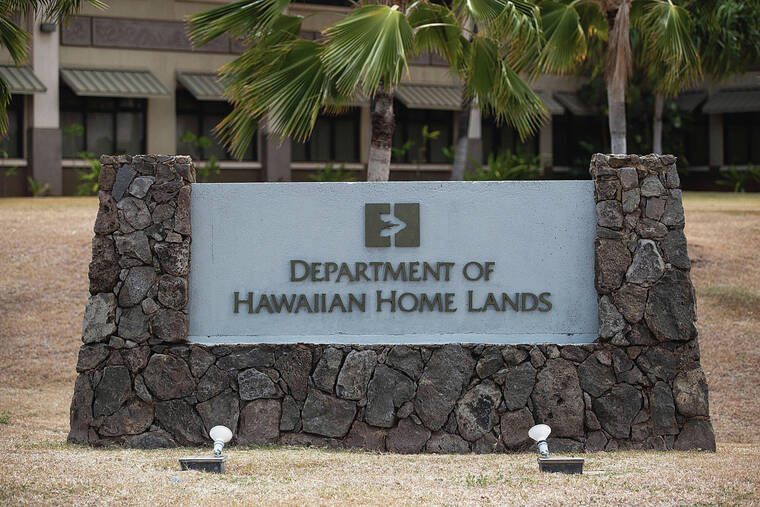
The Hawaii Attorney General will “vigorously defend” the Department of Hawaiian Home Lands from a federal civil lawsuit seeking to invalidate the Hawaiian Homes Commission Act as discriminatory and unconstitutional.
Oahu resident Eric Sean Ryan, 60, a founder of Hawaii Republican Action, filed a lawsuit Monday alleging that the federal government does not distribute public land by bloodline.
“Yet Hawaii continues to administer a public land program that conditions eligibility on whether an applicant can prove that at least 50 percent of his or her ancestry traces to the inhabitants of the Hawaiian Islands prior to 1778. … Eric Ryan, like thousands of other Hawaii residents, is excluded from eligibility because he lacks the bloodline ancestry,” his suit alleges. Ryan did not reply to Honolulu Star-Advertiser’s request for comment.
“The exclusion is categorical. It does not depend on income, need, hardship, residency, or contribution to the community. It turns solely on lineage. Those who lack the prescribed ancestry are barred from even applying,” wrote Ryan’s attorneys, Kevin O’Grady of Honolulu and Caleb B. Trotter with the Pacific Legal Foundation of Sacramento.
Ryan, who once worked as chief of staff for former City Council member Tom Berg, alleges that the ancestry restriction is not “merely a matter of state policy. It is compelled by federal law” and the continued enforcement of the requirement reflects a “joint federal-state statutory scheme.”
“This explicitly ancestry- based requirement establishes a permanent government mandate for state officials to engage in outright racial discrimination, perpetuates stereotypes, and limits housing opportunities for most Hawaii residents,” Ryan’s attorneys claim. “The Constitution does not permit government — state or federal — to distribute public land according to bloodline.”
Trotter, in a statement, said the law violates Ryan’s “right to equal protection enshrined in the Fifth and Fourteenth Amendments to the United States Constitution.”
“In the middle of a housing crisis, the government should be expanding opportunity — not denying it based on ancestry,” said Trotter, a senior attorney with Pacific Legal Foundation. “Homestead leases are a valuable public benefit, and the Constitution does not permit them to be distributed based on blood quantum.”
Pacific Legal Foundation, founded in 1973, is a national nonprofit law firm that “defends Americans threatened by government overreach and abuse,” according to the firm’s website.
O’Grady deferred questions about Ryan and the lawsuit to PLF. The law firm did not reply to a Star- Advertiser request for comment.
Ryan has a long career working to advance conservative candidates and ideals and is unafraid to challenge party leadership. In April 2019 he filed formal complaints with the U.S. Attorney’s Office and the Federal Elections Commission accusing the Hawaii Republican Party of shredding documents to cover up alleged financial improprieties.
He told the Star-Advertiser in a 2017 editorial that it will take an assertive Republican Party in the islands to pave the way for the election of reform-minded “GOP candidates and enactment of reform-minded policies.”
“Without that dynamic, there is no point in pretending a genuine two-party system of checks and balances is right around the corner. It won’t even happen in our lifetime,” wrote Ryan. “Real Republicans — frequently maligned by the news media as “radical right-wing zealots” — know that RINOs (Republicans in name only) only serve the purpose of destroying the GOP from the inside while propping up Hawaii’s Democrat machine and preventing long-needed repeal of failed Democrat policies.”
Ryan was expelled in May 2018 from the Republican Party of Hawaii by a 19-12 vote of its full state committee.
In May 2018, a Honolulu district judge granted former state representative and current City Council member Andria Tupola an injunction against harassment, restraining Ryan from contacting, threatening or harassing her.
Tupola accused Ryan of harassment and cyberbullying, alleging that his social media posts and advertisements about her incited death threats from other people.
In the petition, Tupola said the posts and attacks had been ongoing for more than a year and were “incessant.”
The TRO was in effect for three years. The judge ordered Ryan to refrain from contacting Tupola by telephone, cellphone, mail, email, texts and social networking sites. The protective order came six years after former state Rep. Kymberly Pine secured a restraining order against Ryan for three years, according to state court records.
Hawaii Attorney General Anne Lopez, in a statement, said that the state has both a “legal and moral obligation” to uphold the commitments embodied in the Hawaiian Homes Commission Act.
“This lawsuit seeks to dismantle a program that has provided opportunities, stability and hope to generations of Native Hawaiian beneficiaries.
Lopez said state Solicitor General Kalikoonalani Fernandes, who has “extensive experience handling complex constitutional litigation on behalf of the state,” will lead our legal team in defending this challenge.
“We are prepared to vigorously defend the Hawaiian Homes program and the promises it represents,”said Lopez.
Ryan’s lawsuit names DHHL Chair Kali Watson; Doug Burgum, U.S. Secretary of the Department of the Interior; and the federal government.
On July 9, 1921, President Warren G. Harding signed the Hawaiian Homes Commission Act, 1920 as amended, according to DHHL. The federal government set aside about 200,000 acres of land to establish a permanent homeland for Native Hawaiians, who were identified as “landless and dying” people as the result of disease, intermarriage and loss of lands after their kingdom was overthrown.
Comments are closed.