
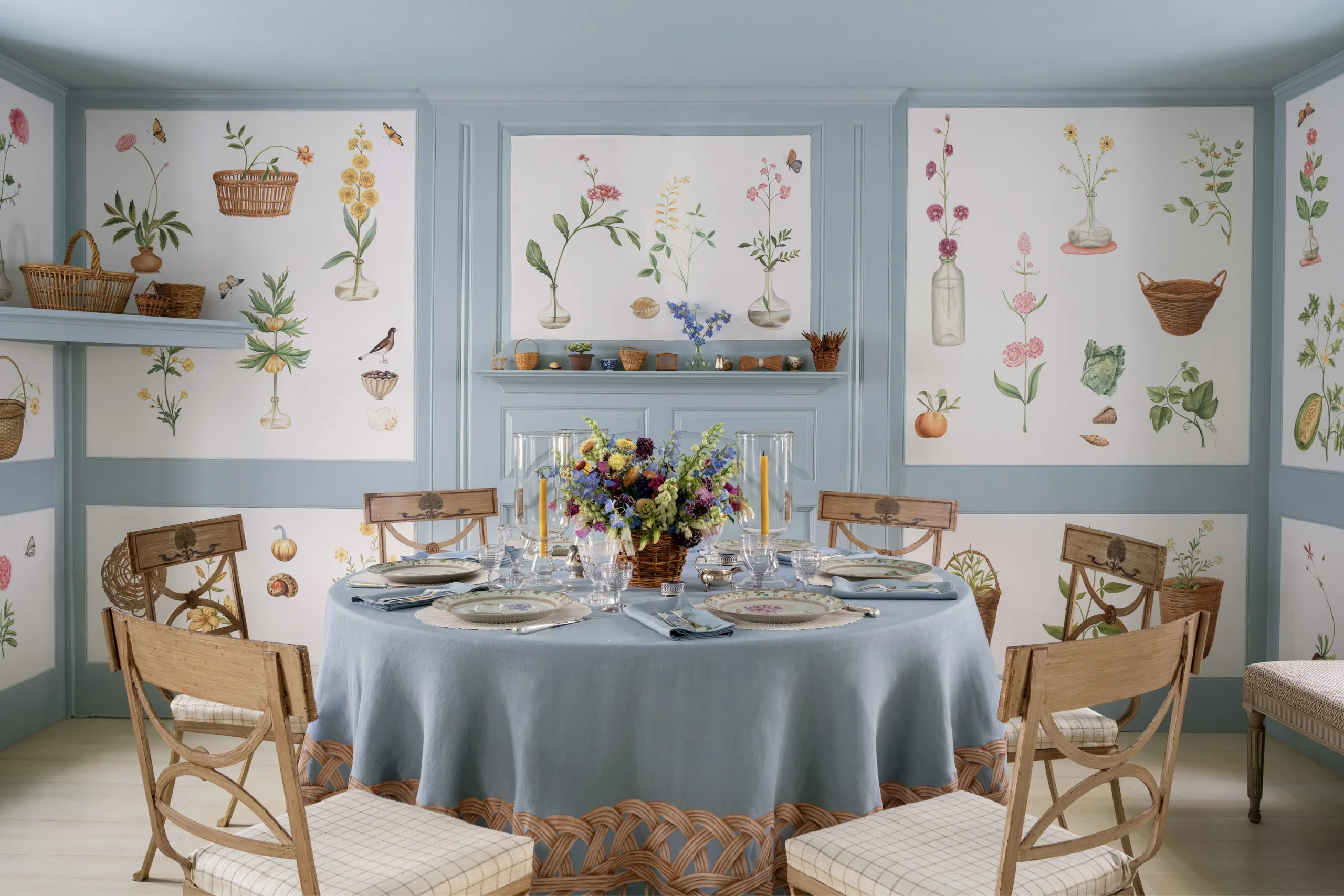
There are gardens, and then there are gardens. And then there are gardens that become legend. Rachel Lambert “Bunny” Mellon’s Oak Spring, tucked into the Virginia countryside near Upperville in Fauquier County, was always more than a home—it was a living archive of Mrs. Mellon’s curiosity, discipline, and devotion to beauty. More than a decade after her death, that world has found a new way to travel beyond its gates—into homes far from Fauquier County that can now carry a piece of Oak Spring onto their own walls.
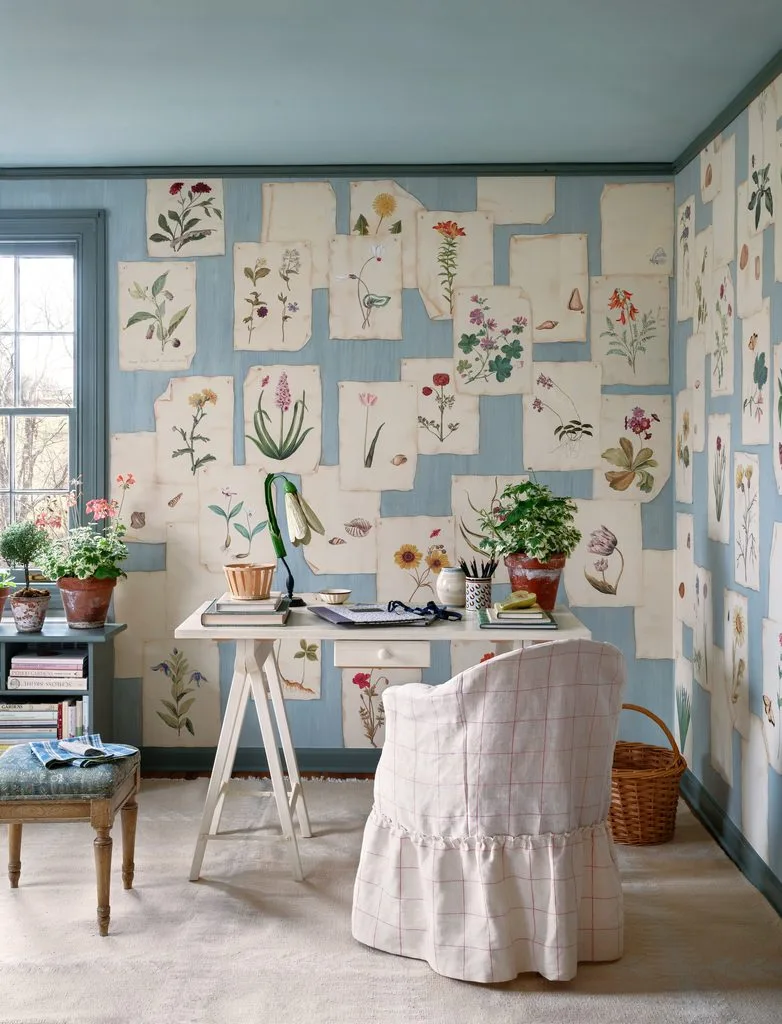 “Florilegium” combines Mrs. Mellon’s favorite artists within the OSG library, including Julius Francois de Geest, Charles Germain de Saint Aubin, and Domencio Buonvicini, and features some of her favorite wildflowers—cornflowers, poppies, and blue flax. Photo courtesy of de Gournay
British luxury wallpaper house, de Gournay, has partnered with the Oak Spring Garden Foundation, which stewards Mrs. Mellon’s estate, to create the Bunny Mellon Collection: six hand-painted and embroidered wallcoverings drawn directly from the gardens she loved and the treasures housed in her celebrated library—a repository holding more than 19,000 objects, books, manuscripts, and works of art collected by Mrs. Mellon over a lifetime. It’s the first collaboration of its kind for either institution, and by all accounts, it began with a spark of pure admiration—one lit, in large part, by Richmond-born interior designer Charlotte Moss.
On Her Own Terms
For Moss, who now divides her time between New York and Virginia, the project is inseparable from her admiration for the woman at its center. Mrs. Mellon, she says, understood something that many would not quite grasp. “Mrs. Mellon, quite simply, was about living comfortably and quietly with art, not paying homage to it,” Moss says.
That philosophy shaped everything about how Mrs. Mellon chose to live. She had homes in Paris, New York, and Antigua, but her Upperville estate, Oak Spring, was the true center of her world because that was where the garden was, where the greenhouse was, where husband Paul Mellon’s stables were. It was a life built around what she loved, not around who might be watching.
 Rachel Lambert “Bunny” Mellon tending her topiaries, circa 1982. Photo courtesy of de Gournay | by Fred R. Conrad
Moss is quick to point out that this quietness was never smallness. “People who live quietly have an intrigue all of their own,” she says. And yet, Moss notes with evident delight, Mrs. Mellon was far from timid: She did wonderfully unexpected things, from her celebrated collaborations with Givenchy and Balenciaga to her embrace of Schlumberger’s jeweled objects. Simply stated, “She was living her life the way she wanted to live her life,” Moss says.
What made that possible, Moss suggests, was the company Mrs. Mellon kept—not a wide social circle, but a devoted few, like her close friend Jackie Kennedy, who mattered deeply and stayed close for life. Mrs. Mellon, Moss says, offered a different kind of model entirely, one rooted in substance over spectacle.
“After 40 years of being in this business, what gives me the most joy is to take what I know and the people I know and to put it all together and create new relationships,” Moss says of her own guiding philosophy—one clearly shaped by watching Mrs. Mellon do exactly that throughout her life.
From Idea to Introduction
That instinct for connection is exactly what set the Bunny Mellon Collection in motion. Moss recalls the moment the idea took shape, in a conversation with Oak Spring President Sir Peter Crane about the Foundation’s future. “I said to Peter, ‘How would you feel about bringing the riches of her collection to a greater audience? It’s an opportunity to understand the beauty and the magnitude of her extraordinary botanical library,’” Moss remembers. Crane, intrigued, asked her to explain. She laid it out plainly: Some ventures generate income quickly, some take longer, and the best ones do both—building critical acclaim and attention while supporting the Foundation financially.
 “Le Bon Jardinier” portrays an exuberant parade of pots that evoke the greenhouse at Oak Spring Garden. Photo courtesy of de Gournay
The idea crystallized around the library itself. “When I think about the riches embedded in the library, I think that there’s a way to share it with the world,” Moss says. She proposed hand-painted wallpaper drawn from the collection’s designs, and from there, she and Head Librarian Tony Willis spent hours poring over the archive together, asking themselves what Mrs. Mellon herself would have thought. “Tony would look at me, and I’d look at him, and I’d say, ‘What would she think, Tony?’” Moss recalls. “He’d say, ‘I think she’d be happy with this, Charlotte.’”
Moss knew exactly where to turn next. She introduced Willis and Crane to de Gournay, calling it simply the finest hand-painted wallpaper house she knew. A meeting in London with de Gournay’s Hannah Cecil Gurney sealed it. “Immediately, Hannah said, ‘Oh, Charlotte, we’re in,’” Moss remembers. “I called Peter. I said, ‘They’re in. And they were thrilled.’”
“Our partnership with de Gournay is just one of the ways we can share the treasures of Mrs. Mellon’s library,” says Crane, “and the funds raised support another objective of which Mrs. Mellon would be proud; encouraging interest in plants among children in our local community.”
Looking back, Moss credits the pairing to instinct and relationships built over years. “I had an idea. I knew the people. It just seemed to me to be a great pairing,” she says. “And look what they have created. It’s so beautiful. It’s so gorgeous.”
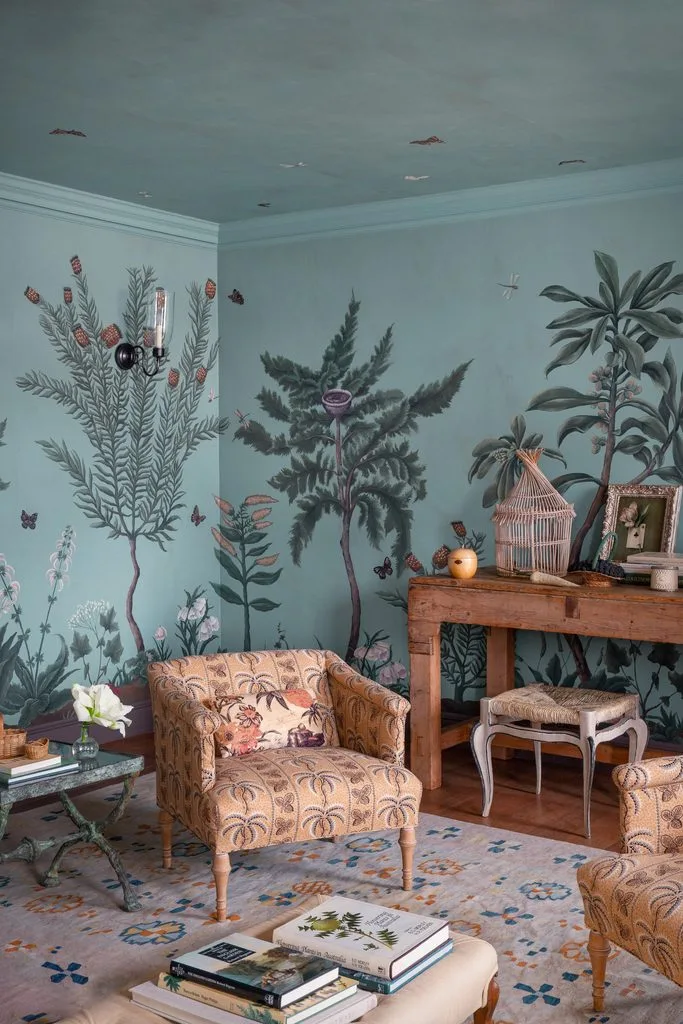 “Hortus Medicus” depicts larger-than-life medicinal plants, inspired by a set of 17th-century oils Mrs. Mellon acquired at the suggestion of her friend Hubert de Givenchy. Photo courtesy of de Gournay
A Fitting Tribute
Sir Peter Crane, reflecting on the collection, frames it as a natural extension of Mrs. Mellon’s life’s work. “Mrs. Mellon’s passions were plants and gardens, combined with her remarkable capacity to create and collect beautiful things,” Crane says. “The library she built here at Oak Spring is a monument to her taste, from the building’s design to the astonishing rare books it contains. The library collection highlights her fascination with the natural world and the ways in which plants have been used in garden and landscape design.”
It is, in the end, a fitting continuation of a life that was never about being seen—only about seeing, deeply, the beauty in the world around her.
Video courtesy of Oak Spring Garden Foundation
This article originally appeared in the October 2026 issue.
Comments are closed.