
DUNSEITH, N.D. – North Dakota must soon make a major investment in the International Peace Garden or risk the viability of the state’s icon, supporters of the unique cross-border park say.
The 2,300-acre site, which straddles the Manitoba and North Dakota line, retains its place of honor on North Dakota license plates, which have declared the “Peace Garden State” since 1956.
But as the Peace Garden approaches its 75th anniversary next July, it is beset by flat visitor numbers, annual budget deficits and nearly $1 million worth of deferred maintenance on its 184 buildings and 11 other structures such as fountains and dams. Roofs leak, basements threaten to collapse, sidewalks split, and gardens and water features deteriorate from age.
In recent years, high gas prices and confusing post-Sept. 11 border regulations have discouraged travelers from visiting the Peace Garden’s isolated location, report its staff and board. They say the Peace Garden not only needs repairs, but also needs more and better offerings to attract and impress today’s visitors.
“We think having a formal garden here isn’t enough,” said Steven Locke, chief executive and development director of the Peace Garden since January. “What we have to do is stay up with the times.”
Locke arranged a flurry of new activities on the grounds this past summer.
Repairs and contemporary activities are just the start of a vision the Peace Garden’s champions have for its future. More importantly, supporters say the U.S. and Canada have in their grasp an opportunity to expand the Peace Garden’s mission and profile to a new level, creating an attractive year-round, world-renowned jewel.
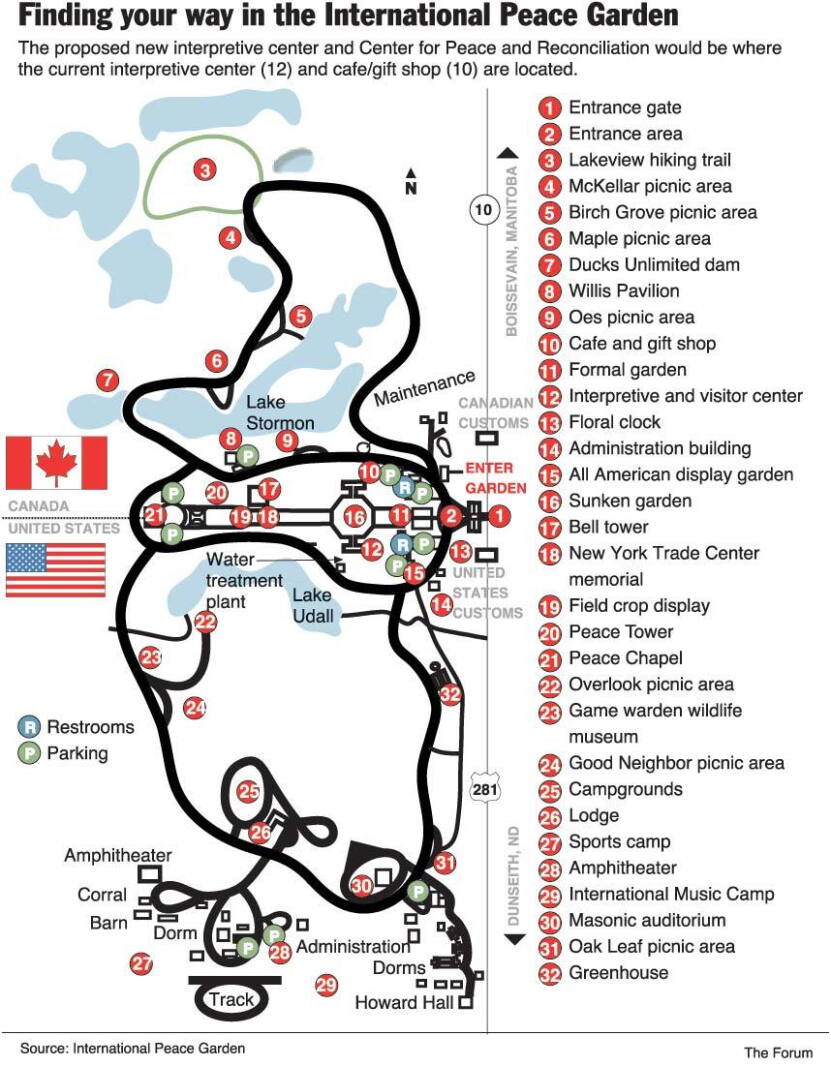
“There’s just simply no other property like it anywhere in the world,” Locke said while giving a walking tour of the heart of the property, where a symmetrical layout of gardens, water features and 120-foot Peace Tower literally hug the border, inviting you to place one foot in each country.
Peace Garden supporters foresee a place where premiers, governors and ambassadors meet in secure tranquility at a special conflict resolution center; where conference-goers and locals alike enjoy fine-dining and first-class meeting facilities; where a conservatory and expanded plantings stretch the park’s botanical offerings and visitor interest well beyond the current limited growing season.
Tapping the potential
Locke and Guy Prefontaine, the Winnipeg architect commissioned about four years ago to study and design a striking new all-season interpretive center and International Center for Peace and Conflict, argue passionately that the Peace Garden’s offerings barely scratch the surface of its potential. To survive and thrive, it must tap that potential, they said.
“It’s got three-season buildings used for a one-season program. It’s underutilized. It doesn’t have program continuity,” Prefontaine said.
He and retired board member David Anderson of Winnipeg, who proposed the ambitious new building projects, say the Peace Garden has a chance to be self-sustaining if it remakes itself with a higher-profile mission.
“It has to start looking after itself,” Anderson said. He said he proposed the new buildings about six years ago when he saw the Peace Garden “slipping” in terms of visitors and vitality.
But for now, turning around a shortage of annual funds and fixing threatened facilities is the most urgent need, Locke and board members say. Otherwise, they fear there will be increasingly little to celebrate beyond the Peace Garden’s diamond anniversary next July.
“I don’t think it’s drastic to the point where there isn’t going to be a Peace Garden,” said former North Dakota Lt. Gov. Rosemarie Myrdal, who joined the Peace Garden’s board last year. “But we’re going to have to think about what kind of place it’s going to be (without financial infusion).”
Meeting halfway
Millions of dollars for Peace Garden improvements are already available. Canadian national and Manitoba provincial governments have jointly pledged $3.7 million in Canadian funds toward a capital project to rehabilitate the formal botanical gardens and build the new interpretive center.
The North Dakota Legislature, which begins meeting Jan. 3, must match it with $3 million next year or the Canadian grant will expire in 2009.
North Dakota Peace Garden board members don’t think legislators will allow that to happen.
Pat DeMers of Dunseith, a former legislator and current president of the Peace Garden’s board, said that with state government anticipating a $526 million surplus by the end of next June, now is the best time to seek an investment in that, which gives North Dakota’s license plate its slogan.
Sen. Ray Holmberg, R-Grand Forks, is chairman of the Senate Appropriations Committee. He agreed the coming session represents a crossroads for the Peace Garden.
“Do we do something to enhance it now, or do we let it go to seed?” he asked. “And if we let it go to seed, what do we have?”
Locke, a former U.S. Olympic Committee board member and past executive director of USA Triathlon, was hired out of Colorado to help bring the International Peace Garden’s new interpretive center and other developments to fruition.
‘It was a shock’
But when he started in January, the first thing Locke and new horticulturist Doug Hevenor did was conduct a complete assessment of the Peace Garden’s facilities, which resulted in Locke’s sobering report to the board about crumbling infrastructure.
The board knew maintenance had been deferred because the previous CEO was ordered to – and did – erase a $300,000 deficit that arose because of an expensive and unforeseen mold remediation project on the International Music Camp’s dormitories. Still, “it was a shock” that things were so bad, said board member Ed Anderson of Boissevain, Manitoba.
Locke has been meeting with legislators to brief them on the park’s condition and to lay out a financial request. In tours, he shows people the rotting logs and buckling floor of the historic CCC Lodge, where a new foundation and other repairs could cost $125,000. The main office building’s basement walls are compromised by serious cracks that could result in collapse during a wet year. The International Music Camp’s $5 million Burdick Center for the Performing Arts and a neighboring dining hall named for longtime Minot legislator Jim Peterson have leaking roofs that together could cost $100,000.
The request to North Dakota lawmakers will be three-fold:
– Substantially increase the biennial state appropriation that funds the Peace Garden’s operations. It received $352,000 for 2005-07, but last year its funds were $88,000 short.
– Approve $933,000 for one-time repairs.
– Commit the $3 million to match the Canadians’ pledge.
Locke believes legislators “are looking at it very positively,” he said recently. “This is a signature property for the state of North Dakota. Their concern is we maintain the Peace Garden State’s icon property at top level.”
Holmberg agreed. He called the response to Locke’s presentation “positive, with questions.” Questions because, when the 2007 Legislature begins meeting in January, it will be weighing the Peace Garden request against competing demands from dozens of other state agencies and groups – all well aware that, this time, the state has money.
Legislators told Locke the Peace Garden project will have a better chance of passing if it appears in Gov. John Hoeven’s executive budget. Hoeven said he is supportive and will include it, but said he has not decided how much he’ll seek.
Rep. Frank Wald, R-Dickinson, who serves on the House Appropriations Committee, is waiting to see how the Peace Garden fares in Hoeven’s budget before he ventures an opinion about how much money it should receive.
As far as taking care of deferred maintenance needs, he said the Legislature should use the state’s surplus to “give serious consideration to all deferred maintenance” on state buildings, including college campuses – not just the Peace Garden.
Rep. Bob Skarphol, R-Tioga, often a tough inquisitor on state budget matters, said legislators will look at the request for funds and compare it to testimony from last session. His recollection was that in the 2005 session, Peace Garden officials testified they were seeking some one-time funds and said they would not be back to ask again.
Locke is not confining himself to cultivating legislators. He’s also approached organizations such as the North Dakota Bankers Association for money and hosted Sen. Byron Dorgan, D-N.D., last month. Dorgan pledged to help secure federal funds.
Meanwhile, Locke stepped up activities this past summer, organizing far more events than the place usually sees, including a motorcycle rally and lawnmower races. He wants the Peace Garden to attract as many visitors as possible by hosting at least one event every summer weekend. He says it also needs a marked hiking path system and he’d like to establish a swimming beach and rent paddleboats on one of the lakes on the Canadian side of the grounds.
‘Sleepy gold mine’
Prefontaine, the Winnipeg architect, said that beefing up the Peace Garden could be a critical boost to the Turtle Mountains region of North Dakota and Manitoba, which is not a prosperous area. By drawing more visitors and attracting them throughout the year with attractive new facilities, the Peace Garden “could be the strongest economic mover in its region. It could stimulate a ton of growth. It’s an absolute sleepy gold mine.”
He and others note a lack of nice restaurants and hotel rooms at or neighboring the Peace Garden, though it does have a campground. Eateries and lodging in the small cities of Dunseith, Bottineau and Belcourt, N.D., and Boissevain, Manitoba, are all at least 15 to 30 miles away.
One business owner in Dunseith who agrees the Peace Garden is an irreplaceable asset in the community says its problems need to be addressed.
“It’s very important to us,” says Wayne Barbot, owner of Wayne’s Food Pride and a native of the area.
Locke spoke to the local business club last spring to apprise townspeople of the situation, Barbot said.
“We’re supportive of the Peace Garden and we know it needs a lot of work,” he said. “I think we need to preserve it.”
Readers can reach Forum reporter Janell Cole at (701) 224-0830
Comments are closed.