
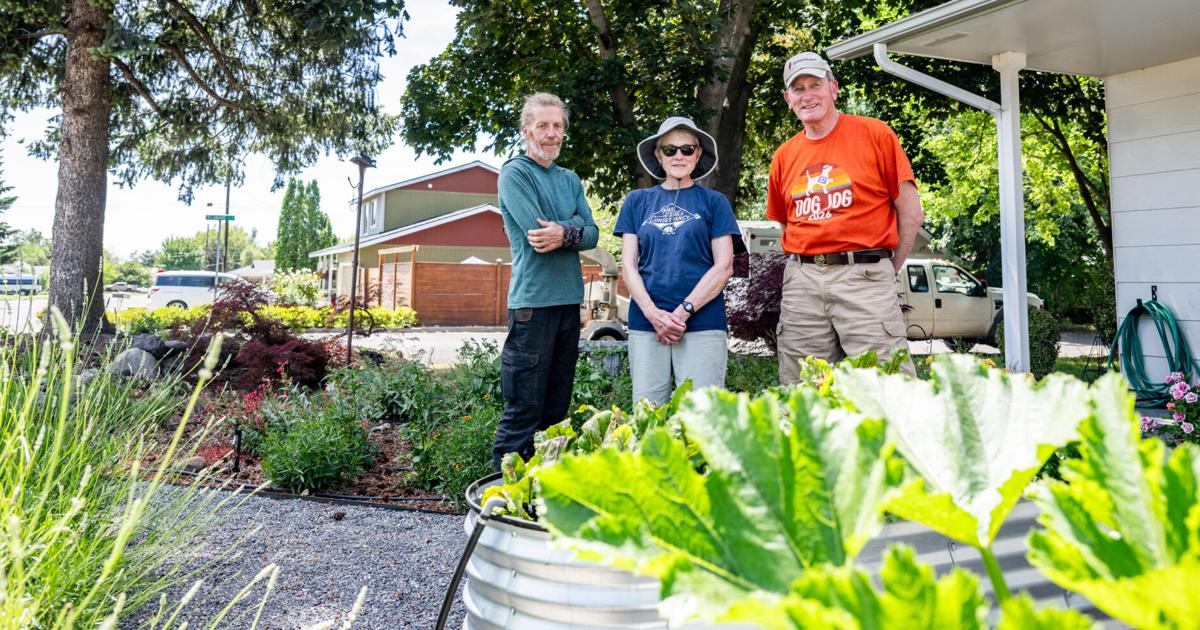
In the front yard of Ruth and Brad Riordan’s Walla Walla home, a rock path meanders through a collage of plants.
Yellow coreopsis with rich red centers burst from green foliage. Bunchgrasses quiver in the breeze. And the low branches of Japanese maples, junipers and manzanita reach to cover the mulched ground. There’s also a bench beneath the taller fir trees.
“It’s so enjoyable, you know. (I) just love going and sitting over there. I never used to sit there to look at the grass,” Ruth said.
That’s what the yard used to be — a grass lawn that, even with intensive watering, would inevitably dry out in Walla Walla’s summer heat.
Ruth was the one that suggested they look at other ways to use the space, and Brad was soon attached to the project, too.
“I’ve always worried about using water for no reason,” Ruth said. “I resented all the water being put on that … To me, I mean, if I want grass, I go to the park. So this bothered me that we were watering here and here, and it’s not a huge yard, but by the time you water it every day, or every couple days, it uses a lot of water, and I don’t see the benefit.”
The Riordans removed the grass from one section of the front lawn, put down black tarp as a weed barrier, and arranged raised planter boxes where the grass used to be. The area around the planters was filled in with rock.
With the help of a local arborist, Christopher Galasso, a self-described plant guy who also grows food and advocates for native plants, the Riordans have spent the last two years transforming the rest of the lawn into a drought-tolerant, water-wise garden.
“We really wanted to cut back on the water, and so we put a request in, and he answered it, and the rest is history,” Brad said.
Perhaps the biggest change to the yard is how inviting it is — to the Riordans, to pollinators, and to neighbors and passersby.
“It’s amazing,” Brad said. “It’s dramatically different.”

The traditional green lawn was replaced with a rock pathway and drought-hardy plants.
Kezia Setyawan,
Walla Walla Union-Bulletin
Water-wise
In working with Galasso to plan their landscaping, Ruth and Brad specifically asked for a vegetable garden and plants that attract pollinators.
The other clear goal was to make the garden water-wise, a method of planting that focuses on conserving water.
Galasso said there are two components to a water-wise garden.
One piece is the introduction of dryland plants that, once established, are drought resistant. The other — sometimes less recognized — piece is to learn how to irrigate effectively.
This includes implementing different watering strategies, knowing how the soil absorbs water, and knowing where the water goes during irrigation and how it will be soaked up by plants.
“Putting in a bunch of dryland plants and running your sprinklers the same way isn’t going to help. Putting drip irrigation in your lawn isn’t going to help. It’s got to be everything, all together,” Galasso said.
Coreopsis blooms in the yard.
Kezia Setyawan,
Walla Walla Union-Bulletin
Plants
Most, but not all, of the new plants in the Riordans’ garden were selected because of how they tolerate drought.
Some, like coreopsis and kinnikinnick, are native to the region. Some thrive in the alpine areas of the Cascades, and others originate in the Columbia Basin.
Other plants are not native but come from drier areas of the world and adapt well to the local climate.
“This is maybe a digression, but cities and towns where people live are not native spaces,” Galasso said. “I think that some people can be quite particular about only wanting native plants, but it’s not a native environment anymore, so we might as well use the plants that are adapted.”
One example of an adapted plant is lavender, which was a special request by Ruth.
“You see this in the Mediterranean, where it’s hot and dry in the summer,” Galasso said. “(It) doesn’t take a lot of water. Bees love it there. Bees love it here.”
Some of the plants, native and not, featured in the Riordans’ water-wise garden:
Coreopsis: Flowering plant native east and west of the Cascades with yellow, red or dual-toned flowers. Other names: calliopsis, Columbia coreopsis
Little bluestem: North American bunchgrass native east of the Cascades named for its blue coloring. Other names: broom bluestem
Echinacea: North American coneflower. Not native to the Pacific Northwest but adapts well to the climate. Western coneflower, Rudbeckia occidentalis, is a native alternative.
Kinnikinnick: Ground cover shrub native to Cascadia with shiny green leaves, pink bell-shaped flowers and red berries. Other names: manzanita, bearberry
Ninebark: Flowering shrub native to the North American west on both sides of the Cascades and the coast. Other names: Pacific ninebark, mallow ninebark, mallow-leaf ninebark
Japanese maple: Native to east Asia but a common accent in gardens throughout the Northwest with delicate, lacy red leaves. Vine maple is a drought-tolerant native alternative.
Lavender: Silver-green foliage with purple flowers. Native to the Mediterranean region, it adapts well to drought and heat.
Roses: Flowering shrubs. There are some roses native to North America. The ones in the Riordans’ garden are non-native.
Juniper: Drought-tolerant, aromatic coniferous evergreen shrub with native and non-native varieties.
Gaura: Delicate flowering plant native to the U.S. South that tolerates heat and drought. Other names: Beeblossom, wandflower, whirling butterflies
Sources: Washington Native Plant Society, Xerces Society, The Plant Native
Still other plants, like the roses that were already in the yard, are not native or drought tolerant — but they are beautiful, so they stayed.
Planting native plants, specifically, was not the driving factor behind the project. But with Galasso’s knowledge of native plants and their natural fit with the other goals, about half the plants in the garden are native.
“There is definitely a correlation between native plants and native pollinators,” Galasso said. “They know what they want, and what they want is what they grew up with, so that plays a role. And plants which are native to the broader Columbia Basin tend to be drought tolerant.”
The garden has already started attracting pollinators, a trend Ruth and Brad are supporting with added features, like native bee hotels and hummingbird feeders.
“Last year we had hummingbirds, all kinds of bees, all kinds of neat, flying insects that were not attracted here before,” Ruth said.
Getting established
The plants and other features in the garden are all designed to be intentional and efficient in how it uses its water.
Galasso removed the in-ground sprinklers that were in the yard and fixed a leak in Brad’s homemade drip irrigation system, a move that prevented water from being expended that wasn’t being used.
“I’ll bet you there’s a lot of people, homeowners, in this county that probably are suffering from these kinds of problems,” Brad said.
Galasso also introduced several new strategies focused on making sure the water is retained in the ground, where it can do its job.
He used rocks for the walking path instead of concrete. The permeable surface means the rain will sink into the ground instead of running off.
“It’s another way of taking advantage of what precipitation we do have,” Galasso said. For the same reason, he used rock and natural material mulch throughout the garden.
Watering habits also impact how water is retained.
Galasso spoke about how watering more deeply but less frequently helps the plants grow deeper roots.
“I’m a big advocate for long duration (watering) and lots of space in between irrigations,” Galasso said. “Soak the ground thoroughly, and then wait a week.”
Watering when the sun is low — morning or evening — is better than watering when the sun is high, when more water will be lost to evaporation. More cover from plants also reduces water loss through evaporation. Several of the plant varieties in the Riordans’ garden were selected for how they act as ground cover or how they will reseed themselves over many seasons, adding more plants to the landscape.
“There’s definitely a relationship between not just the tools you’re using, but how you’re using them,” Galasso said.
With the changes at their home, the Riordans’ monthly water usage reduced by half from May 2025 to May 2026. Brad said their water consumption is likely to keep declining as the drought-tolerant elements of the garden kick in.
Drought-tolerant plants still need regular watering while developing their roots, but the garden was at its turning point at the start of the summer, when it would start requiring less and less water.
“There is kind of an evolution — this garden is now 2 years old, it’s still in its establishment phase, so we’re in that process of winding down water usage and moving towards less and less as the plants get established and they have a better root system and start to take on their drought-resistant qualities,” Galasso said.
One half of the Riordans’ low water demand yard, pictured June 2.
Kezia Setyawan,
Walla Walla Union-Bulletin
Impact
From pollinator visitors to fresh vegetables, the water-wise planting changes have brought big rewards for the Riordans.
For one, they are using the space in front of their home. They sit on the bench and notice new wildlife, and harvest food from the raised planters.
Ruth, Brad, and the birds and bees are hardly the only ones taking notice of the improvements in the garden.
Galasso said he’s often stopped by people walking by while he’s working to say how good it looks and to ask questions. Ruth said their letter carrier stopped to ask about it, too.
“I think that’s a powerful thing that gardens can do if they’re designed well and maintained well,” Galasso said. “If you walk down the street and someone’s mowing their lawn, you might wave, but that’s about it. But if you walk down the street and somebody’s in a cool garden and they’re obviously taking care of it, that’s the beginning of the conversation.”
Ruth and Brad said the change is also inspiring their neighbors. Residents in one other house on their street ripped up their grass and added planters earlier this year.
“Christopher’s work here has absolutely changed the entire feel for the property,” Brad said. “That’s not too big an expression. I mean, everything’s changed. It just feels so much nicer, and you feel more productive by utilizing your resources in a better way.”
Comments are closed.