
It may be one of the region’s best kept secrets.
Many of the historic homes that grace Eastern North Carolina as architectural treasures and trophies to the communities that saved them have well-groomed gardens depicting period floral used for a variety of reasons. Many of the blooming gems are maintained by master gardeners having plans in hand from centuries ago.
In Windsor, Historic Hope is one such place.
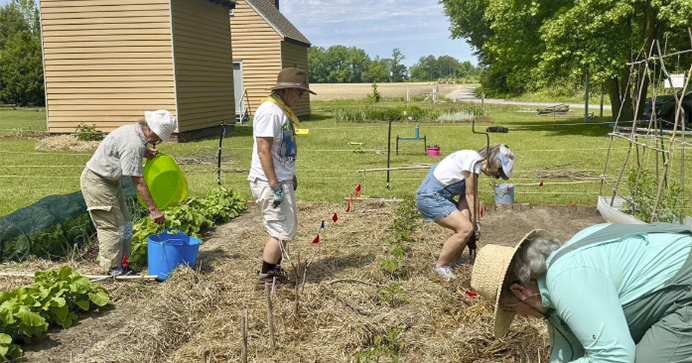
Bertie County Master Gardeners Abbey Sutton and Harriett Stout play an important role in the Historic Hope gardens, along with a team of volunteers contributing hundreds of hours throughout the season.
“The gardens of Historic Hope are supported by volunteers from throughout our region. They come from the Bertie County Master Gardeners, Chowan, Gates and Perquimans Master Gardeners, members of Historic Hope and the general public,” Sutton said. “Currently, we have seven regular garden volunteers with other volunteers helping as their schedules allow.”
The current Hope Gardens were not designed to replicate the gardens once cultivated by the Stone or King families since there is little information on their location, In light of that, the gardens are demonstration gardens.
“Although they certainly would have had gardens in order to produce food, medicine, fiber and dyes for cloths and flower gardens for ornamentals and pleasure, our gardens are demonstration gardens, showing examples of plant varieties that would have been grown in this area during the colonial period — at the King-Bazemore House and the federal period at the Hope Mansion,” said Sutton. “When possible, we try to show examples of techniques that would have been used for production in the time period.”
The tomato table in the King-Bazemore garden could be one of those colonial techniques.
“The tomato table is a form of horizontal trellis. It’s woven of flexible sticks and allows the tomato plants to grow through the top and then supports the plants as they continue to grow and produce fruit allowing the tomatoes to be easily picked,” explained Sutton. “The following year the trellis can be placed vertically to support the growth of other vegetables such as cucumbers or beans.”
During Colonial times, sticks for weaving trellises were produced on plants grown specifically for that purpose. The King-Bazemore Orchard area has trees growing weaving twigs.
The history of the Hope Gardens began over 50 years ago.
“The first garden that was added to the Historic Hope property was the King-Bazemore Flower Garden which was installed by the Bertie County Herb Society in the early 1970s as a mixed herb and flower garden of the Colonial period. This was later converted to an all flower garden in order to decrease redundancy after the Mansion Herb Garden was installed,” said Sutton. “The Mansion Herb Garden was added in the 1980s by the Bertie County Master Gardeners to contain medicinal and culinary herbs grown in the Colonial and Federal periods.
“The Fiber and Dye Garden was added around 2016 by a group of volunteers from the Bertie County Master Gardeners, Chowan, Gates and Perquimans Master Gardeners, Historic Hope and the local community,” she added.
Interest from the community for more examples of plants that would have been used to produce and dye cloth was the catalyst for the fiber and dye garden. Flax fiber was found in the kitchen floor during the original renovation of the home, indicating they were growing flax to produce linen.
Other garden highlights include the King-Bazemore tea beds.
“The King-Bazemore tea beds were added in 2017 to demonstrate plants that were grown to make tea, particularly during the Revolutionary period when traditional tea leaves were scarce. The King-Bazemore Smokehouse Beds were also added at that time for growing culinary garlic and onions of the period. The King-Bazemore vegetable garden was added in 2018 by Bertie County Master Gardeners and Chowan, Gates and Perquimans Master Gardeners in response to visitor requests for examples of food that would have been grown,” added Sutton.
The vegetable garden represents vegetable varieties that would have been grown by the colonists, Native Americans and the enslaved population. The garden also offers muscadine grapes and fruit trees added over 50 years ago.
Those who have ever wondered where ‘Pot Marigolds’ got their name may want to visit Historic Hope.
“Plants that were grown exclusively for flowers can be seen primarily in the King-Bazemore Flower Garden and vegetable plants can be seen in the King-Bazemore Vegetable Garden, but the line between vegetable plant and flower plant is a bit blurry,” explained Sutton. “Some plants like the pot marigolds in the King-Bazemore Flower Garden produce edible flowers which were regularly added to the cooking pot, hence their name.
“The herbs in the Mansion Herb Garden also have beautiful flowers that were used both medicinally and for culinary use as well as for scent and decoration,” she continued. “The fiber plants such as flax, cotton and yucca produce both cloth fiber and lovely flowers. Essentially beautiful flowers can be found throughout the growing season in all of our gardens.”
The Historic Hope Gardens are a seasonal attraction from visitors who travel specifically to tour and view the gardens. Locals walk the gardens daily to see what is in bloom. The gardens are open for viewing from dawn to dusk daily 365 days a year. Self-guided tours are free and informational brochures are available at all the gardens at no charge. Paid guided tours are also available and may be scheduled by calling the Historic Hope Heritage Center at (252) 794-3140.
Comments are closed.