
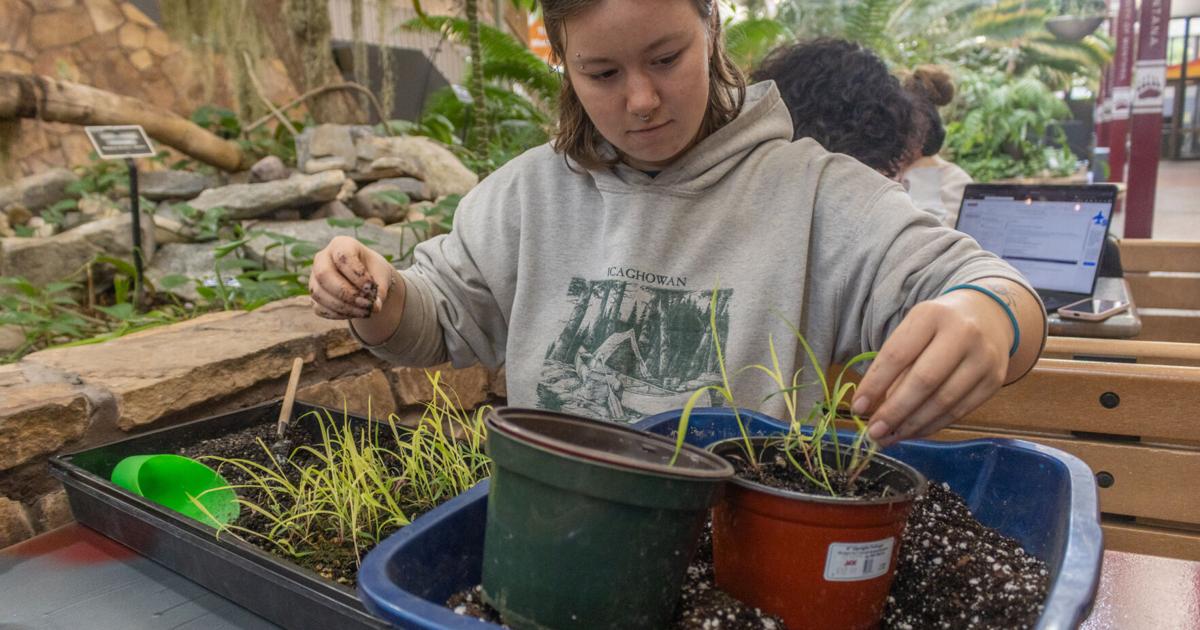

Ruby Boles transfers lemongrass from soil into pots in the UC on Nov 7. This is Boles’ second year working for the gardens.
Will Ladyman / Montana Kaimin
Hues of green and brown have long surrounded students sitting in the University Center’s plant-filled atrium, but few know the history of the three-story conservatory.
The University of Montana’s University Center originally opened in 1969 as a garden to house plants and trees native to Montana. During the first year, the plants died due to the indoor climate not being cold enough to continue growing. A change was needed.
The UC’s tropical garden houses more than 200 different species of plants. The Fiddle-leaf fig tree stands tall at the center on Nov. 7.
Will Ladyman / Montana Kaimin
Over the next 50 years, the UC gardens transformed into a lush green space, where sounds of running water echo throughout the space with over 200 different species of tropical plants and two fish, creating a calm study spot for students.
“A lot of people come through here for coffee in the morning and leave, but one of my favorite things is when I’m walking through and I see people looking up at the plants and pointing at things or just sitting and enjoying themselves,” Sean Helms said.
Big Boy Pete, the goldfish, and Hi Ho Silver, the Koi fish, swim in the pond inside the UC gardens on Nov. 7.
Will Ladyman / Montana Kaimin
Helms is the University Center garden manager, overseeing all botanical maintenance inside the UC.
In 1972, shortly after the start of the tropical switch, the University of Texas donated the focal point of the garden: the three story tall Ficus lyrata, the Fiddle-leaf fig tree at the center of the garden. But it had one minor flaw. It was too big.
“We have to prune it a couple of times a year, because the leaves touch the windows and it’s to prevent the sprinkler system from going off,” Helms said.
In the four years Helms has worked at the UC, the ficus has triggered the laser-activated sprinkler system multiple times.
Ruby Boles is a senior environmental science major working for the UC gardens. Boles has been working at the gardens for two years, helping with planting, reseeding and testing.
Sean Helm looks over a plant on the railing of the UC stairs on Nov. 7. The plants hang from the railings and latch on to light fixtures.
Will Ladyman / Montana Kaimin
“I have always liked plants. I worked at a greenhouse right out of high school and I did the PEAS farm internship,” Boles said. “I saw this job and it was right up my alley.”
The beauty of the plants contrasts against their natural defenses.
In the north planter, the peace lilies are toxic to ingest. The Fiddle-leaf fig tree produces sap inside the tree that is harmful for humans to touch.
“There are quite a few plants you need to be careful about. I get worried sometimes when dogs walk through, I hope they don’t nibble on them,” Helms said.
Helms’ big focus on the garden is the theme. There are four main planters, all with their own region: Asia, Africa, Central and South America, Australia and the Pacific Islands.
Built in 1972, the University Center houses over 200 different species of tropical plants species ranging from Africa to Australia.
Will Ladyman / Montana Kaimin
These unique plants all have a purpose in the gardens, whether it’s medicinal importance, cultural significance or botanical uses.
“It’s not just ‘you got your hands on this thing and you planted it,’” Helms said. “It’s detailed and calculated.”
Comments are closed.