

 AngieC333/Shutterstock
Barrenwort
Epimedium spp., Zones 4 or 5 to 8
In the spring, many small orchid-like flowers bloom on wiry stems above the arrowhead shaped leaves, swinging like Calder mobiles. Foliage can be green, maroon, or bronze with changing fall color. Flower colors vary from white or yellow to shades of pink and red.
Why we love it: Deer and drought resistant, barrenworts are great for dry shade locations such as underneath trees.
 skymoon13/Getty Images
Cheddar Pink
Dianthus gratianopolitanus, Zones 4 to 8
A summer bloomer, cheddar pinks have five-petaled, fringed pink flowers with a darker eye ring that attract bees and butterflies. Drought, heat, deer, and salt resistant, the gray-green foliage can form a mat-like ground cover. Cheddar pinks can be used in the front of the border, along the walkway, in rock gardens, or even on stone walls.
Why we love it: You can pick the spicy clove-scented flowers for small, tabletop arrangements.
 GALUMPHING GALAH/GETTY IMAGES
Ice Plant
Delosperma spp.
Zones 4 to 10, depending on species
Low-growing perennial ice plants are named because they have small glistening dots on their foliage that resemble tiny ice crystals, but these drought-tolerant succulents thrive in the summer’s heat. On sunny days, they bloom daisy-like flowers in bright pink, red, purple, yellow, or orange.
Why we love it: Deer-resistant ice plants are maintenance free — no need to water, deadhead, fertilize, or prune.
 skymoon13/Getty Images
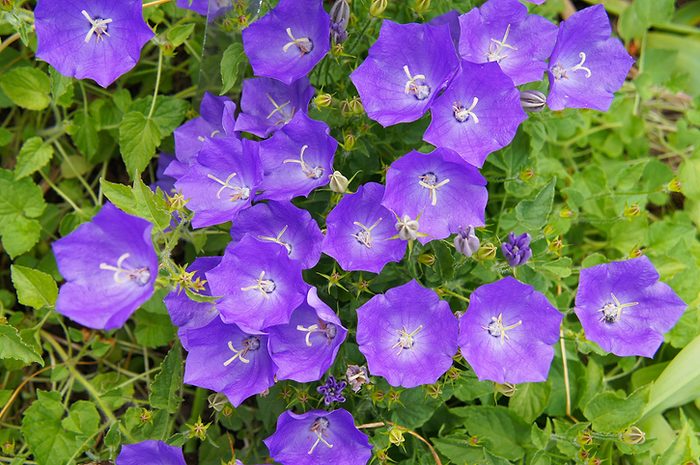
Carpathian Bellflower
Campanula carpatica, Zones 3 to 8
Native to the Carpathian Mountains in Europe, Carpathian bellflowers are very cold hardy, thriving in cool weather. They bloom large showy cup-like flowers in blue, lilac, or white. After the flowers fade, deadhead the plants by shearing to create small green mounds of foliage.
Why we love it: Deer-resistant Carpathian bellflowers are garden showstoppers that attract pollinators and hummingbirds.
 Iva Vagnerova/Getty Images
Biokovo Geranium
Geranium x cantabrigiense ‘Biokovo’, Zones 5 to 8
In early summer, this hardy geranium blooms masses of small cream-pink flowers with long pink stamens that rise above the large green foliage. No need to deadhead; the blossoms will eventually melt away leaving the aromatic deer- and rabbit-resistant foliage. Plant ‘Biokovo’ in full sun to part shade.
Why we love it: Hardy geraniums are moderately drought-resistant once established, and they bloom reliably every year.
 Monrovia/Doreen Wynja
Marcus Meadow Sage
Salvia nemorosa ‘Marcus’, Zones 4 to 8
From summer to fall, ‘Marcus’ meadow sage is flush with deep purple flower spikes that stand above the long green leaves. This is a petite form of the popular salvia ‘May Night,’ making it perfect for walkways, paths, and mixed borders. Drought and salt tolerant, ‘Marcus’ prefers full sun and well-draining soil.
Why we love it: The flowers attract butterflies, pollinators, and hummingbirds or can be cut for floral arrangements.
 White Flower Farm
Montrose White Lesser Calamint
Clinopodium nepeta (formerly Calamintha nepeta) ‘Montrose White’, Zones 5 to 9
A member of the mint family, lesser calamint has fragrant foliage but does not spread aggressively. A full sun loving, drought-tolerant plant, ‘Montrose White’ produces clouds of small white flowers over gray-green foliage.
Why we love it: These low-growing perennials bloom for months, attracting bees and butterflies all summer long.
 Karel Bock/Getty Images
Millenium Allium
Allium ‘Millenium’, Zones 4 to 8
Small, round flowers rise above the clumping, grass-like foliage in the summer. The showy rose-purple blooms last for weeks, attracting bees and butterflies but repelling deer.
Why we love it: In the summer you can cut the flowers for fresh arrangements, and in the fall you can cut the tan globes for dried arrangements.
 www.provenwinners.com
Cat’s Pajamas Catmint
Nepeta hybrid, Zones 3 to 8
‘Cat’s Pajamas’ is a compact, 12- to 14-inch catmint cultivar that blooms from summer to fall with spikes of showy purple flowers. Butterflies and pollinators love the nectar-rich flowers while rabbits and deer steer clear of the aromatic foliage.
Why we love it: Low-maintenance ‘Cat’s Pajamas’ thrives in urban areas and public landscapes.
 aimintang/Getty Images
Sea Thrift
Armeria maritima, Zones 4 to 8
In spring, low-growing perennial sea thrift blooms white, dark rose-purple, or light rose-pink flowers in round clusters on top of slender stalks, rising above the grass-like foliage. Each five-petaled floret is delicate, almost translucent, and eventually drops off revealing a globe of tan, paper-like bracts. Sea thrift is drought and salt tolerant, so it does well in coastal areas.
Why we love it: Easy to grow from seed, this plant can be planted in containers, borders, or rock gardens, attracting bees and butterflies.
Comments are closed.