
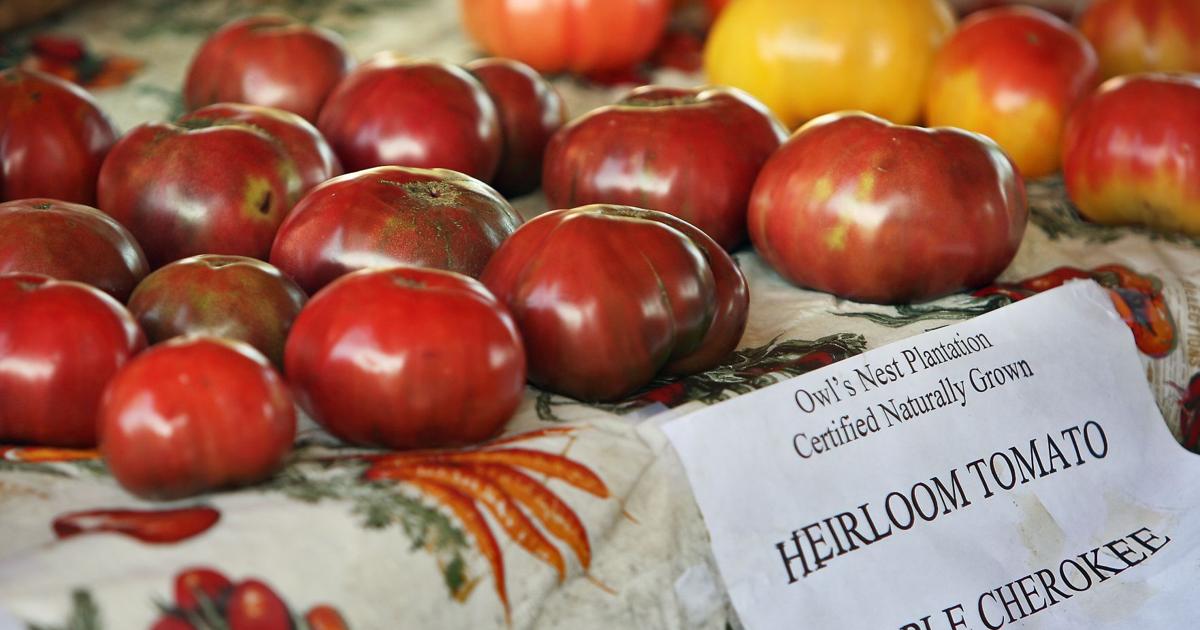

Vendors pile fresh produce on their tables at the Charleston Farmers Market.
File/Grace Beahm Alford
“Heirlooms go beyond looking pretty — heirlooms are the survivors,” said Farmer. “There were, and have been, tons of vegetable cultivars over the centuries. Many of them failed for good reason, and what’s left are the ones we love.”
But in some corners of the state, community members report a growing interest in heirloom produce — in part, by growing it themselves. Across six Richland Library branches, the Seed Library allows guests to “check out” gardening seeds, with the expectation that they’ll return some seeds from the produce that they grow from them.
Kelsey Andrus, director of the Seed Library, said the library saw 8,200 seed packet checkouts in 2023 — a record number since its founding in 2018. So far this year, gusts have checked out over 4,000 seed packets. Based on trends for previous years, she projects that the total number of checked-out seed packets will reach 10,000.
“I used to have no choice in what seeds we got. Now I get to curate the entire collection and base it on what people request,” Andrus said. “It has severely evolved over time.”
Andrus also believes that the patrons of the Seed Library have demonstrated a connection to local heirlooms.
“People are excited about are heirloom vegetables, particularly ones that are very traditional for our area,” she said. “Onions and lettuces developed here are the ones that fly off the shelves well before anything else does.”
Some agriculture experts suspect that the people who are drawn to heirloom produce are especially attracted to the story behind each crop.
“There’s that connection to the past,” said Eva Moore, communications director of the South Carolina Department of Agriculture. “If you’re growing an heirloom variety, it automatically makes you think about the history of that produce — who’s grown it and who they grew it for — which you don’t necessarily get with all crops.”
Comments are closed.