
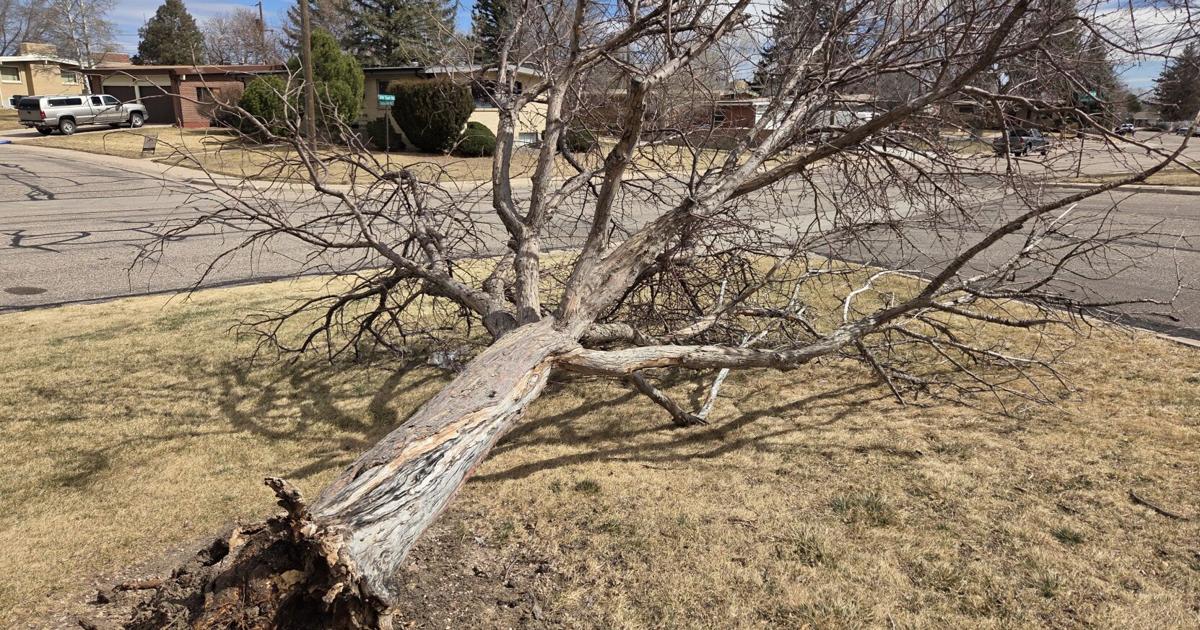
March 12, 2026, is a date that Cheyenne will remember as the day the trees tipped over. The wind sounded and felt like a jet engine parked overhead every time I let the dog out.
We realized it was more than the usual wind when our power went out for six hours. Thank goodness for already-cooked leftovers for dinner, the wind-up radio in our tornado-preparedness closet, and the logs and kindling out back in case we needed to start up the wood stove. At least it was a warm, sunny day.
While we barely lost a branch on our four big old trees, our neighbor across the street had two medium-sized trees blow over. Their loss feels a little personal to me, since these were the trees I could see out my office window. One was an ancient mountain ash, parent to the ones in our front yard (courtesy of the birds), so rotten that the red-breasted nuthatches had been nesting in a cavity in the trunk the last three or four years. The other, a volunteer chokecherry that sprouted in a corner, was also half-dead, but popular with perching birds.
The day after the windstorm, I raked our sidewalk and front lawn, and filled boxes, bags and buckets with tree debris from the cottonwood up the street, and drove out to the city compost facility. My Subaru was out of place in the lineup of dump trucks, dump trailers and pickups all filled with limbs destined for the evergreen mountain ahead of us. It was at least two stories high, spruce limbs mostly. The boys from the pickup dumping a trailer-full next to me asked to help me unload my sticks, and I was out of there two minutes later.
But, driving around town over the next week or so, there wasn’t as much damage to be seen as I’d expected. An awful lot of mature trees are still standing. While the record-breaking gusts of 92 mph were recorded at the airport, you know that there were more — we just don’t have official anemometers measuring the wind elsewhere in town.
Replanting
Cheyenne is in a treeless prairie. Naturally, you will find a few trees along the creeks. But if you are going to build homes and businesses close together, trees are almost a necessity. They shade the otherwise sunbaked terrain, break the onslaught of the wind, offer some privacy between neighbors, and invite wildlife by offering food and shelter. Science shows that an urban landscape with trees has a humanizing effect on people and results in less crime.
It is worthwhile planting a tree in Cheyenne. I wouldn’t plant many this spring, as it seems we are heading for water shortages this summer after a dry winter, and there may be watering restrictions.
If you do plant a tree, plant the right one. The best trees for Cheyenne are being offered June 6 at the High Plains Arboretum plant sale at the Cheyenne Botanic Gardens (not at the Arboretum this year). Contact Jessica Friis at jfriis@cheyennecity.org for the plant list and more information.
Plant your tree in the right place — not where the utility companies are going to hack away branches every couple of years.
Plant your tree the right way. Bare-root trees are the best, but you must keep their roots moist until you get them in the ground.
If your tree comes in a container or in a ball of dirt wrapped in wire and burlap, the best you can do is carefully remove everything — including the dirt — just before planting. The hole you dig should not be treated with soil amendments — you want the roots to grow out searching for food, not hang out in the little “ice cream parlor” you dug.
The next most important move is to make sure the trunk-to-root transition of the tree is right at ground level — you don’t want to bury the trunk, and you don’t want the roots exposed. Make sure the roots aren’t crossed or folded under.
Soaking the hole you dug with water before planting and keeping up with watering over the summer is important, as is staking the tree for the first year. But don’t stake it so tight that it can’t move several inches in the wind. It is regular movement that helps build the strength of the trunk.
Mulching a three-foot radius around the tree protects it from mower injuries, but make sure the mulch isn’t touching the trunk.
I interviewed a Cheyenne tree-planting expert, Steve Scott, a few years ago. At cheyennegardengossip.wordpress.com, search “How to plant a tree in Cheyenne, Wyoming.”
Comments are closed.