
 A tiger swallowtail in the wild. (Photo by Pamela Grundy)
A tiger swallowtail glides above my backyard creek, held up by yellow wings with coal-black tiger stripes. It heads toward a clethra bush festooned with spikes of nectar-filled pink flowers. It settles and sips. I never tire of watching.
Late summer is butterfly season here in the North Carolina Piedmont. Since butterflies love sun and heat, late August and September are ideal times to watch for them. Tiger and Black Swallowtails, lemon yellow cloudless sulphurs, bright orange Gulf fritillaries, dozens of tiny skippers and many, many others spend their days nectaring, mating and laying eggs. Monarchs will soon pass through, traveling to their hibernation grounds in Mexico.
Creating butterfly gardens has been one of the great pleasures of my life. Fifteen years ago, when my son attended Shamrock Gardens Elementary, I worked with other parents to fill the school’s courtyards with butterfly plants. We looked after nectar plants whose flowers fed adult butterflies, and host plants whose leaves fed caterpillars. A dazzling array of butterflies showed up. A few years later, every Shamrock classroom had a caterpillar-raising cage, filled with caterpillars we found in our own gardens. The students were enchanted.
 The former butterfly garden at Shamrock Garden. (Photo by Pamela Grundy)
We lost those gardens when our beautiful building was demolished to make way for a new one. But I still grow many of the same plants in my yard, and the butterflies have found them. If you plant it, they will come.
With a sunny patch of ground, or even just a couple of pots, you can create your own butterfly haven. Free yourself from those sterile, high-maintenance, chemical-laced lawns! Butterfly gardens are more beautiful, better for the planet and easier to maintain.
A couple of new books can help you get started.
Butterfly Gardening in the Carolina Piedmont, written by yours truly and beautifully designed by Little Shiva, describes some common area butterflies and offers suggestions about planting for them. It’s currently available from Amazon and Park Road Books, and can be read for free on the Nerve’s issuu site. It should be in other local shops soon, with a Spanish translation also in the works.
If you’d like to dive more deeply. UNC Press has just published a terrific new field guide, Butterflies of North Carolina, South Carolina, Virginia, and Georgia. Put together by the region’s most enthusiastic and knowledgeable butterfly enthusiasts, it has pictures of most of the 202 species sighted in these four states — swallowtails and fritillaries; sulphurs and skippers; buckeyes, painted ladies, hairstreaks and so many more.
It also includes detailed descriptions of each species, overviews of the region’s butterfly habitats, maps that show where each species can be found, and the months in which each species is likely to appear. If you want to go out butterflying, this is the book for you.
Enjoying this story?
Queen City Nerve is reader-supported.
Memberships help us pay freelance journalists and continue independent reporting in Charlotte.
Become a member →
There are plenty of good butterflying sites in Mecklenburg County. Latta Prairie at the Latta Nature Preserve and McDowell Prairie at the McDowell Nature Center and Preserve are great places to start. The Carolina Butterfly Society, including its Greater Charlotte chapter, sponsors field trips and other events.
Also look for moths. While butterflies get most of the attention, moths are far more abundant. Some, such as the ethereal green lunas, are larger than butterflies, and just as gorgeous. Many moths are small and brown, but a close look at their wings reveals remarkable patterns.
In summer, organizations that include the North Carolina Wildlife Federation and the Nature Resources Division of Mecklenburg Park and Recreation holds Moth Nights, with lights and bait that draw dozens of different moths. There are Moth Nights coming up on Aug. 15 in Marvin and Aug. 22 at Reedy Creek Nature Preserve. There is so much out there in the dark.
Enjoying this story?
Queen City Nerve is reader-supported.
Memberships help us pay freelance journalists and continue independent reporting in Charlotte.
Become a member →
Planting for and watching butterflies draws you closer to the natural world that surrounds us. You’ll come across many other fascinating creatures. I love to watch big, furry native bees, who live alone and make nests underground.
If you see neat circles cut into the edges of leaves, that’s a leafcutter bee gathering material for a nest. They’ll hang out in flowers all night long, then get up late. If you get out in the garden early you’re likely to find flowers full of sleepy bees. They’ll only sting if you grab or squish them.
You’ll also learn more about the workings of our planet. Animals, insects and plants have developed close, complex relationships. Most caterpillars eat only one or two kinds of leaves — basically because their ancestors won the evolutionary battle for that particular plant. Monarch caterpillars, who only eat milkweed, are a prime example, but plants also nourish other creatures.
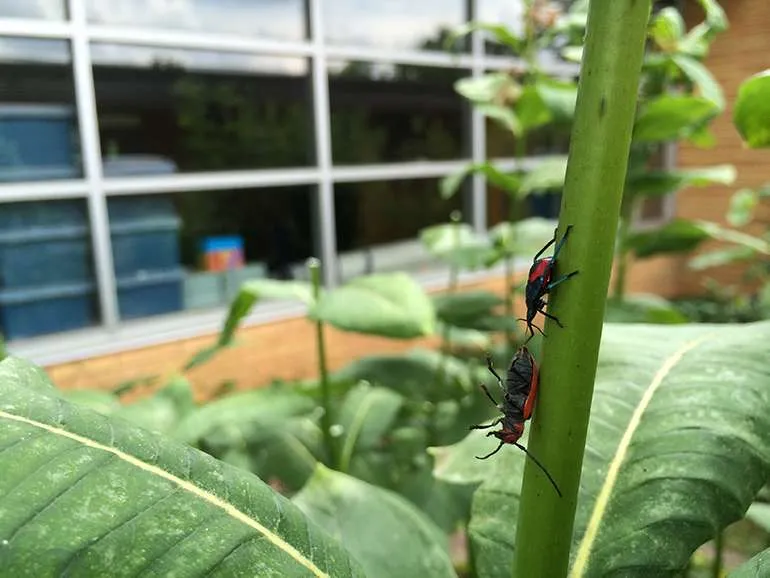 Assassin bugs in the garden. (Photo by Pamela Grundy)
In addition to feeding monarch caterpillars, milkweed beds host a varied interdependent community — aphids suck sap, ladybugs eat aphids, milkweed bugs eat milkweed seeds, assassin bugs eat milkweed bugs. As they eat and grow, caterpillars transform the leaves they eat into food for birds and other creatures.
The plight of monarchs and honeybees have been well publicized, but many other species need help as well. The same pesticides and rampant development that have sharply reduced the monarch’s milkweed supply have also affected hundreds of native plants that nurture a wide range of other caterpillars. North Carolinians don’t see nearly as many butterflies as we used to — I’ve noticed the difference in the fifteen years I’ve been looking.
If you want to start a butterfly garden, look first for native perennial wildflowers. Plant them in groups to create masses of bloom. To feed the greatest number of butterflies, you should have flowers blooming from early spring through late fall.
Enjoying this story?
Queen City Nerve is reader-supported.
Memberships help us pay freelance journalists and continue independent reporting in Charlotte.
Become a member →
Prepare your garden in full or partial sun — butterflies love sun! Include flowers of different colors, shapes, heights and bloom seasons. A variety of plant species will attract a variety of butterfly species. Fill in with annuals that have long bloom times.
Natives work especially well because they’re adapted to the area and because they also nurture other creatures, but plants from other places can play starring roles in your garden as well. Zinnias, marigolds and lantanas are all native to Mexico, but they bloom all summer, feeding butterflies with their flowers and birds with their seeds.
 A zinnia butterfly in the garden. (Photo by Pamela Grundy)
You should also plant host plants for caterpillars: spicebush, parsley, senna, paw paw, passion vine, coral honeysuckle, on and on. Since most caterpillars eat only a specific kind of leaf, a female butterfly must find the right plant to lay her eggs.
If you see a butterfly flitting from one leaf to another, it’s probably a female looking for a host plant. Many butterflies have scent glands in their feet; they judge a leaf’s suitability by giving it a gentle tap.
You can start with just one or two host plants — parsley, the host for eastern black swallowtails, is the easiest. But the more host plants you grow, the more caterpillars you’ll discover. I’m always looking to add new host plants and raise new cats.
 Bees in the garden. (Photo by Pamela Grundy)
I’ve shaped my gardens through trial and error, trying out all sorts of different plants to see how they’ll fare. I’ve also had help from local butterfly enthusiasts.
Braedon Shelton and Bailey Griswold run Bring Back the Butterflies, a backyard nursery where they focus on butterfly-friendly plants. They periodically have a stall at the Saturday Uptown Market and I’ve added lots of things from them to my garden, including coneflowers, a hard-to-find Dutchman’s pipevine and most recently a Chickasaw plum tree.
Will Stephens has a small gardening business, Grow Better: Gardening and Eco Landscaping, that focuses on native and butterfly-friendly plants. He’s recently helped me spruce up and improve my garden. He’s also the son of my dear friend Beth Henry, whose enthusiastic love for butterflies and other creatures has inspired me since I first started down this path. I still grow many of the plants she shared with me, and the butterflies still love them.
Read more: Adventures in Bureaucracy: The Bradford Pears of Shamrock Gardens
There are plenty of other resources on the web. Back in 2013, Angel Hjarding shaped a Butterfly Highway program for North Carolina. It was subsequently taken over by The North Carolina Wildlife Federation, which sponsors a useful website.
Located in New Hampshire, The Caterpillar Lab has amazing pictures of caterpillars and sells beautiful educational materials. The companion website to my book, ncswallowtail.org, also has more information as well as educational materials.
It’s not quite time to start planting; it’s better to wait until the heat subsides. But it’s a swell time to start planning. Be sure to look out for the fall plant sales held by Wing Haven and the UNC Charlotte Botanical Gardens — they sell all sorts of native plants.
Happy butterflying!

Comments are closed.