


March Madness is underway, on the college basketball court and in the garden. Either way, you need to be “in the zone” to score points.
To be in the zone, first, you need to know your zone.
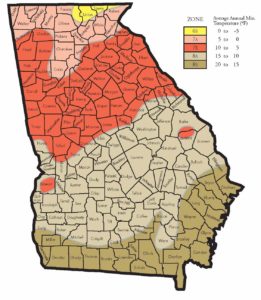 In 1960, the United States Department of Agriculture published a map of the U.S. that delineated eleven “minimum winter temperature” zones. North Georgia was set in Zone 7, with winter lows between 0 and 10 degrees. In 1990, the map was revised and the former “10-degree difference” zones were divided into two sub-zones. Cobb county and above became Zone 7a and everything below that point down to Macon became Zone 7b.
And then in 2003, the USDA and the American Horticultural Society undertook yet another map revision, based on more recent weather data. According to that map, most of Georgia falls into Zone 8 with only mountainous north Georgia remaining Zone 7.
Are you confused yet? If it helps, most plant labels refer to the original 1960 USDA map. For safety’s sake and the best results in your garden, you can assume a plant marked Zone 7 will work successfully for you.
Why this “zone” thing is important
What we need to be most concerned about is the average last spring frost date. Zonal maps help guide us in the right direction. More than 100 years of records from the National Climatic Data Center show that the average date is between March 18 – April 16. That is not carved in stone, it could happen in late April but it’s a pretty good guideline for when to plant.
Tender plants might not make it or will surely struggle with a late spring hard frost. I have gone to great lengths to protect newly planted flowers and vegetation over the years with blankets and other coverings.
So what’s next on the to-do list in our zone
 Photo courtesy of Marty Barr/Barr Studios
Don’t forget to mix up your hummingbird nectar and hang the feeders. They are migrating now and if you haven’t seen one yet, you will soon.
Get a soil test if you haven’t already done so
Right now is a great time to remove winter protection from any perennials you had in place.
Fertilize grapes, raspberries, and blueberries before growth resumes.
In a few more days, we will have moved past the average frost date and you can really dig in, planting hanging baskets, containers and filling in with annuals in your flower beds including impatiens, geraniums, verbena, and some of those other fillers, thrillers, and spillers.
Happy planting!
Print Article
Don’t miss what everyone in town is talking about.
Join 4,000+ locals and choose our free newsletter covering news, events and the stories shaping our region.
Comments are closed.