
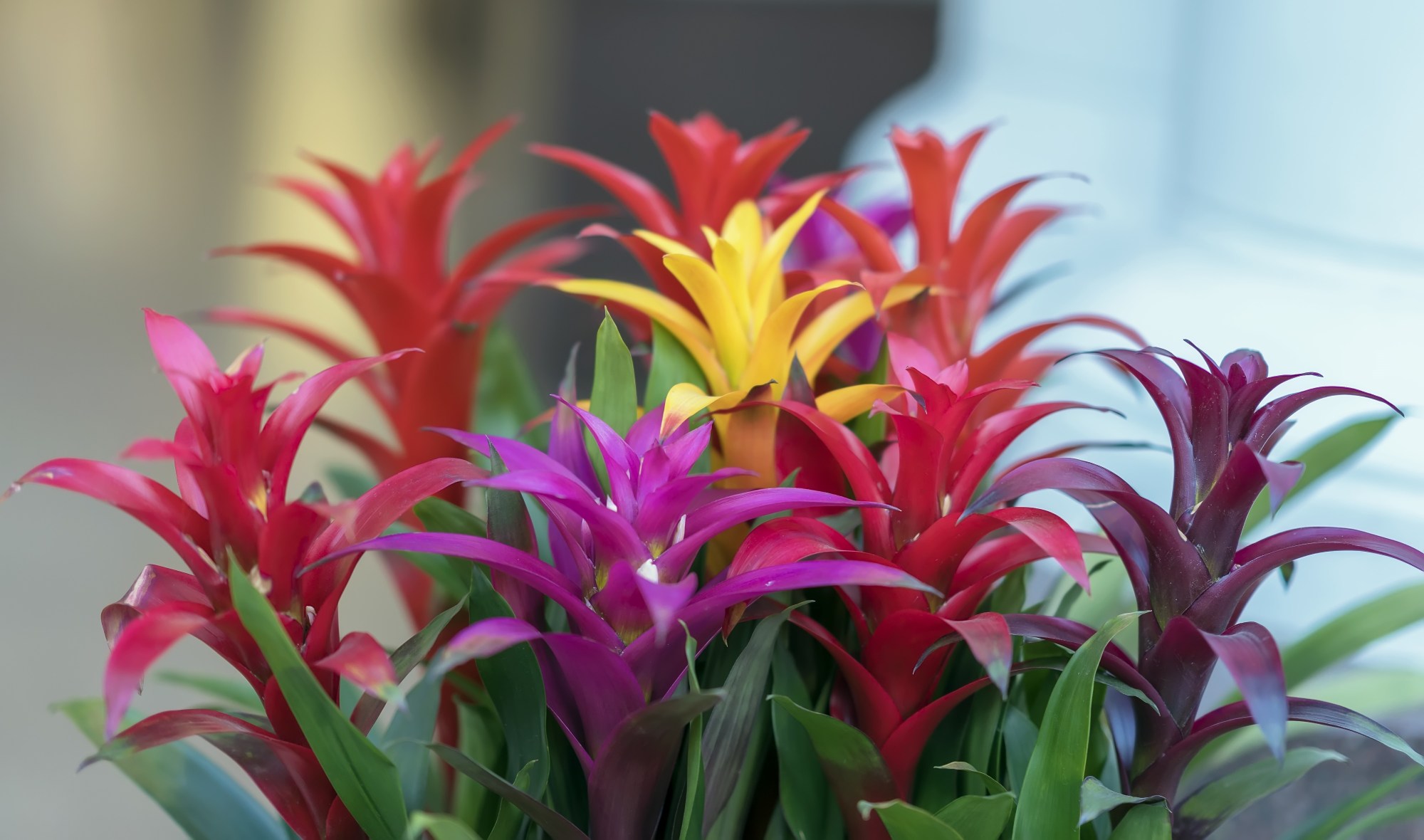
If you’re looking to grow your own tropical paradise island, consider adding bromeliads to your plant collection.
Even if you’re not, consider adding bromeliads to your plant collection anyway.
The bromeliad family includes over 3,000 species. Its two best-known members, pineapples and Spanish moss, give you an idea of this plant group’s diversity.
I know, it makes no sense. As I have mentioned in earlier articles, botanists (scientists who study plants) see things differently. They’re from another galaxy. They’re the same people who say avocados and bananas are berries, but strawberries are not.
These perennials are native to the Americas and the Caribbean, according to SmithsonGardens.com.
Also, according to Smithson, there are three types: Epiphytic, which absorb water and nutrients from the air and rainwater; Lithophytic, which grow on rocks; and Terrestrial, which grow in soil and take in water and nutrients from their roots.
According to Bromeliads.info, they live for two to five years, and their blooms last from three to six months.
 Clarence Schmidt (Clarence Schmidt)
They bloom once when they hit maturity, and then slowly die off as they put all their energy into producing new plants, called babies, offsets, pups, pooches, little doggies or whatever. (Some things are best said with just an eye roll.)
Bromeliads are known for their multicolored, sword-shaped leaves in red, green and yellow. The “blooms” are not actually flowers, but modified leaves called bracts.
Bromeliads are not toxic to people, cats or dogs.
Tillandsias (aka “air plants”) are the largest group of epiphytic bromeliads. An epiphyte can cling to trees, logs, wood or even be glued to objects. Their firm, greyish leaves need misting every two to three days. You can also immerse the entire plant in room-temperature water for 30 minutes every 10 days.
Indoor bromeliads like humid air, so mist your plants regularly. You could also run a humidifier during the winter to keep the humidity level consistent in the room.
You could grow your bromeliad houseplant in more humid rooms, like a bathroom with enough fluorescent light or sunlight, or in the kitchen close to the sink.
Bromeliads that turn yellowish might be getting too much light, while dark green or elongated plants might receive too little light. Situate it in a south-facing window in winter.
When grown indoors, bromeliads prefer a mixture of peat-based potting soil, orchid mix, sand and other organic amendments.
You can grow bromeliads outdoors, but they do best in tropical environments. Bromeliads prefer shade and temperatures in the 60℉ to 85℉ range. Soil pH should be acidic.
You will need to bring them indoors during the colder months.
While they are slow growers, some plants can get as large as 30 inches tall. As it grows, bromeliads add new leaves to the center of the plant. The center will eventually become too crowded, at which time they will start producing pups. You can cut back the flower once it becomes unsightly.
Bromeliad care varies from genus to genus. Their bloom cycle is affected by day length, temperature, humidity, water and feeding.
While bromeliads can be grown from seed, you can propagate them from their pups. When the pups are one-third the size of the parent plant, cut them off with a knife and pot them up separately. The baby plants will need two to three years to reach their full maturity. They will eventually flower if the environmental conditions are just right — just like any other plant — and if you have a magic wand.
During the growing season, feed monthly using an organic liquid houseplant fertilizer diluted at half strength and poured on the soil. For epiphytic bromeliads, spray a diluted liquid fertilizer onto the leaves several times during the growing season. Don’t put the fertilizer into the cup, as it could burn the plant.
Avoid fertilizing plants when they’re in bloom or dormant.
In the home, too much or too little water, aphids, mealybugs, (spray with water & dish soap mixture) and scale (use neem oil) are the most common problems. Organic insecticidal soap also works well. Brown dry spots on the leaves or tips of the leaves mean that the bromeliad is being scorched by too much direct sunlight.
Once the flower bract starts to turn brown or the color fades, it’s a sign that the plant is starting to die.
They only bloom once and unfortunately, you can’t save them. It can take anywhere from a few weeks to several months for them to die completely.
Prune dead or dying leaves at any time. Trim off the flower spike after it dies back, but keep the plant growing as long as you can so that it will have sufficient time to grow those puppies.
To water a bromeliad, fill the plant’s “cup” or “vase” or “tank,” urn, or whatever. These tanks, along with the plant’s colorful leaves also help to lure the plant’s pollinators such as the Big Three — bees, butterflies, and hummingbirds.
They are very sensitive to the chemicals in regular tap water. Rainwater, distilled or filtered are the best types to use. They’re also sensitive to metal so avoid metal watering containers and metal pots.
Some varieties include Ananas comosus “Champaca,” which has miniature pineapples on top of the flower spike. Guzmania bromeliads are the most common houseplant variety and the easiest to grow for beginners. They get as tall as 2 feet. Neoregelia is the most diverse and colorful of all the bromeliad genera. They stay under a foot tall.
In catalogs, I think the pictures of bromeliads are all photoshopped. They don’t always look that way in nurseries. Or at my house. The leaves are not shiny. Their leaf tips often appear like they’re brown or browning, and have curling, brittle leaf tips.
Sorry, I’m not doing a very good job at marketing bromeliads.
But the truth is that bromeliads are attractive plants and very resilient. If they are showing signs of problems, they can be easily salvaged with a little troubleshooting, professional advice and fervent prayer.
Schmidt is a Poway resident with over 40 years of gardening experience.
Comments are closed.