

Dear Master Gardener: I live in a neighborhood with a home owners association. We have a 1.4-acre hillside with lots of buckthorn and other undesirable plants. We would like to restore our buckthorn-degraded woodland to native plantings. A friend used goats to get rid of their buckthorn. Is that really effective?
Answer: Yes, in the short term the use of goats to get rid of buckthorn is very effective and can be effective in the long term with ongoing management. Goats are increasingly being used to manage invasive buckthorn in woodlands and new research shows when and how they are best used. Professors from the University of Minnesota Department of Veterinary Population Medicine and the Department of Fisheries, Wildlife, and Conservation Biology have been investigating nearly every aspect of goat browsing, including goat droppings for viable buckthorn seeds after grazing. Most importantly, they have spent years observing grazed areas to watch for the long-term ecological effects of goat grazing. The researchers performed field experiments in eight sites. All vegetation (including buckthorn, other invasive species, and native species) was sampled before, immediately after and at least one year (and up to three years) after browsing ended. The research team published their findings recently in Restoration Ecology.
The University of Minnesota study found: “Targeted grazing is one more potential tool for woodland restoration. Situations when it may be most useful include limited availability of human labor, prevalence of stakeholders that are strongly opposed to herbicide use and steep or rugged terrain. Conversely, use of goats may be ill-suited where there are key native species at high risk of negative impacts, such as threatened or endangered plants, high-priority shrubs or juvenile trees, or other sensitive organisms.”
Sara Nelson, a natural resources specialist at Dakota County Parks, believes it is one potential piece of a restoration puzzle that often includes activities like canopy thinning, seeding and re-establishing regularly controlled fire. She manages several sites where the use of regular goat browsing is opening up space in the understory for appropriate understory plants to get a toe-hold.
To summarize the team’s latest research — goats are effective in the short term at quickly reducing buckthorn-invaded habitats or as a maintenance tool, but not as a stand-alone management strategy because buckthorn regrows within a year of goat browsing. Goats can help clear the way for native plants, but rebuilding healthy ecosystems requires sustained effort, active native vegetation restoration efforts, and ongoing management. Professor Daniel Larkin sums it up, “Our ultimate goal is restoration, and that is a multi-phase, multi-year process.” Researchers recommend other strategies in addition to goat browsing such as, herbicide treatments (especially for resprouts), cutting and mechanical removal, and repeat browsing over several years.
The Minnesota DNR says the most effective time to cut and chemically treat buckthorn stumps is in late summer and throughout the fall. If chemical control is being used it is important to treat the stumps immediately after cutting the trees down (within two hours) with an herbicide containing triclopyr or glyphosate to prevent re-sprouting. Herbicides can be applied to cut stumps with a paint brush. Always follow herbicide label instructions.
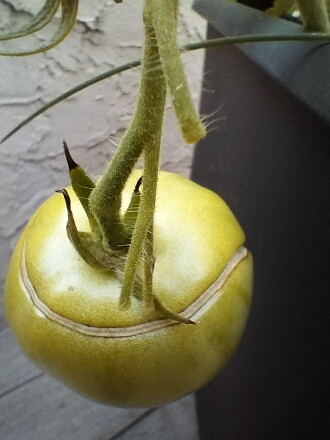
Maintaining even moisture by watering regularly and mulching the soil around the tomato plant can help reduce growth cracks.
Contributed / Jennifer Knutson
Dear Master Gardener: Some of my tomatoes have cracks. What is causing it and is there anything I can do?
Answer: According to the U of M, growth cracks in tomatoes result from extremely rapid fruit growth. This may be brought on by periods of abundant rain and high temperatures, or can occur when water is suddenly available to the plant through rain or irrigation after a period of drought (which is probably the case this year). Cracks may radiate from the stem end of the fruit or may encircle the fruit. Secondary fungi and bacteria that further rot the fruit often invade cracks. Maintaining even moisture by watering regularly and mulching the soil around the tomato plant can help reduce growth cracks.
Dear Master Gardener: My African Violet is flowering, but keeps getting taller and taller and leans to one side. Do I dare repot it?
Answer: Yes! African Violets are a long-time favorite houseplant because they need minimal care and less light than many plants. Violets come in many colors, different leaf shapes and foliage colors, and range in size from miniature to large. However, when they have a bright spot, are well-fed, and carefully watered they will outgrow their pots and need to be repotted. It’s important to know that African Violets prefer to be root bound and usually won’t flower until they are, so don’t just do the typical move into a larger pot. If your plant is starting to look like a fuzzy version of a palm tree with a bare stem and all the leaves at the top, it’s time to do some surgery. If you spot any baby plants, carefully cut them away and root them in small pots. Save a few healthy bottom leaves to root in water or damp vermiculite — it takes several weeks, but it’s always nice to have extras to enjoy or trade. For the main plant, cut the stem a little below the first set of leaves you want to keep. Lightly scrape the stem with your knife – the slight irritation will help it start root production. A dusting with rooting hormone will help too. Then set the whole plant into fresh African Violet potting mix and water thoroughly, making sure excess water drains out. Keep the soil moist but not soggy. Plastic or ceramic pots with good drainage are recommended – clay pots dry out too quickly and salts collect along the top rim. When your plant starts putting out new leaves again, begin to fertilize at a very low concentration every time you water. Keep water off the leaves and periodically brush them with a soft brush to remove dust. Remove faded flowers. Water carefully from the top or bottom making sure there is no standing water in order to avoid root rot. Rotate the pot a bit every time you water.
Comments are closed.