

By Jennifer L. Warren
BEACON – Mount Gulian Historic Site carries a deep, rich history, including; a reconstructed 18th-century manor adorning the Hudson River which served as quarters for General von Steuben during the Revolutionary War, 1730s Dutch barn, and the distinction of being the locale of where the Society of the Cincinnati was founded. That treasured encasing of the past also features another gem: a gorgeous, restored garden, laden with a colorful bounty of diligently arranged flowers.
Originally encompassing six acres of land, the bustling garden was started in the Early Victorian Era when geometric shapes were common. Meant to showcase beauty, the gardens of those times were intended to create a relaxing ambience, accompanied by gazebos and pergolas. True to those features, the Gulian garden was first overseen by family member, Maryanna Verplanck, a “trailblazer,” of the time who owned property while never marrying or having children.
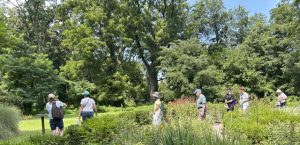 Guests explore the 50 feet by 50 feet gardens surrounding The Mount Gulian Home this past weekend where four tours took place, providing guests with the background on the gardens as well as their Master Gardener, James Brown, an escaped slave whose freedom was purchased by Gulian owner, James F. Brown.
These prized tidbits of information were relayed by Gabriel Byrne, Operations Manager, Mount Gulian Historic Site, during weekend tours of the garden. Starting at the Site’s porch, Byrne provided guests with intricate garden maps, outlining the 91original locations of vines, borders, perennials and annuals. He then delivered a brief overview of the Site before proceeding to walk attendees over to the nearby gardens. Here, surrounded by the well groomed, now 50 feet by 50 feet construction whose chief contents include; yucca, roses and peonies (each which “have stories”), Byrne went on to reveal intriguing facts about the man: James F. Brown, who assisted Maryanna with the garden’s meticulous upkeep.
“James-born into slavery- was an escaped slave who met Daniel Verplanck, and takes him in,” Byrne said to attentive guests. “He works for the family and eventually emancipates James, buying his freedom, as he was always against slavery.”
Brown, who displays a genuine talent for and love of tending to the garden, soon moves on to become the Master Gardener. What follows is to become a 37 year time period during which the literate( very rare for a slave of the time) Brown keeps a prized, detailed journal of his days’ happenings. Whether it was the pending rain approaching, the still existing, sweet-smelling Akebia (Chocolate Vine) he planted all around the garden to provide priceless shade, or other garden details, Brown loyally and diligently captured each of his days as the Master Gardener on paper. To this day, the journal remains one of the most beloved artifacts associated with the Gulian Site.
In addition to learning information about the original garden, people attending the tour further gained insight into its dynamics following the house’s fire in September of 1931. Overgrown in the aftermath of the blaze, the garden was restored in 1995. Reduced in size, it maintained many of its original attributes, including the exact spot of a water pump which was surreptitiously discovered during the restoration.
Additionally, after discovering during a late 1950’s visit with her grandmother to the Site that the three main flower types were still flourishing on their own in the garden almost 30 years after the fire, Anne Durland, a direct Verplanck descendent, brought them to her Connecticut home, looking after them. She then donated them back to the Mount Gulian garden in the late 1990’s. And, of course- the Akebia (woody vine) which Brown planted hundreds of years ago and serves as a living reminder of his powerful impact- still prevails.
It’s a lasting effect which was highlighted in a 17 minute film on Brown’s remarkable life, including his purchase of Beacon land and with it right to vote, shown inside the home as the concluding part of the tour. After reading some passages from Brown’s journal entries, Byrne played the video featuring now City of Newburgh Mayor as well as Newburgh Free Academy History Teacher, Torrance Harvey, in the lead role. Toward its conclusion, the narrator leaves listeners with the imprint Brown, the Master Gardener, left…not only on the gardens but the entire site as well as local and national history.
“What he planted mattered; it’s a symbol for what he applied to his own life and what he reaped,” the narrator says, reminding us of the precious nature of his journal recordings. “The life he cultivated was one worth noting.”

Comments are closed.