

Garden designer Tabi Jackson Gee says: ‘The most elegant shade solution is always a tree.’ ‘Even a small garden needs trees,’ she says. ‘It’s the starting point for every single one of our designs.’ Alisdair, meanwhile, warns against anything with heavy coverage, though he adds: ‘Dappled shade is far more cooling and atmospheric than dense shade. Deciduous canopy trees are one of the best investments you can make in a hot garden. They provide shifting shade in summer while allowing light back into the garden in winter.’
If you’re wondering how to choose trees for your garden, Alisdair recommends magnolia soulangeana and cornus kousa or for their silver foliage, and the santolina, artemisia and cistus which reflect heat. ‘Trees like amelanchier or field maple will outperform almost any awning,’ he adds.
Acers (or Japanese maple trees) also make for a lovely choice, not only for their pretty red and green leaves but for the delicate and unobtrusive shade they bring. Tabi explains: ‘In a recent North London project we’re planting an acer palmatum to cast shade over a seat in a Japanese garden. We’re also planting an orchard of Malus Mokum – one of my favourite crab apples, as it grows in such a beautiful, unpredictable way. They’ll be grown close to each other so their crowns knit together and form a single canopy to sit under on hot summer days. You have to be more conscious of shape and leaf colour, (rather than relying on perennials that give you lots of colour but need full sun), but the beautiful effect of light shade on plants is more nuanced and delicate.’
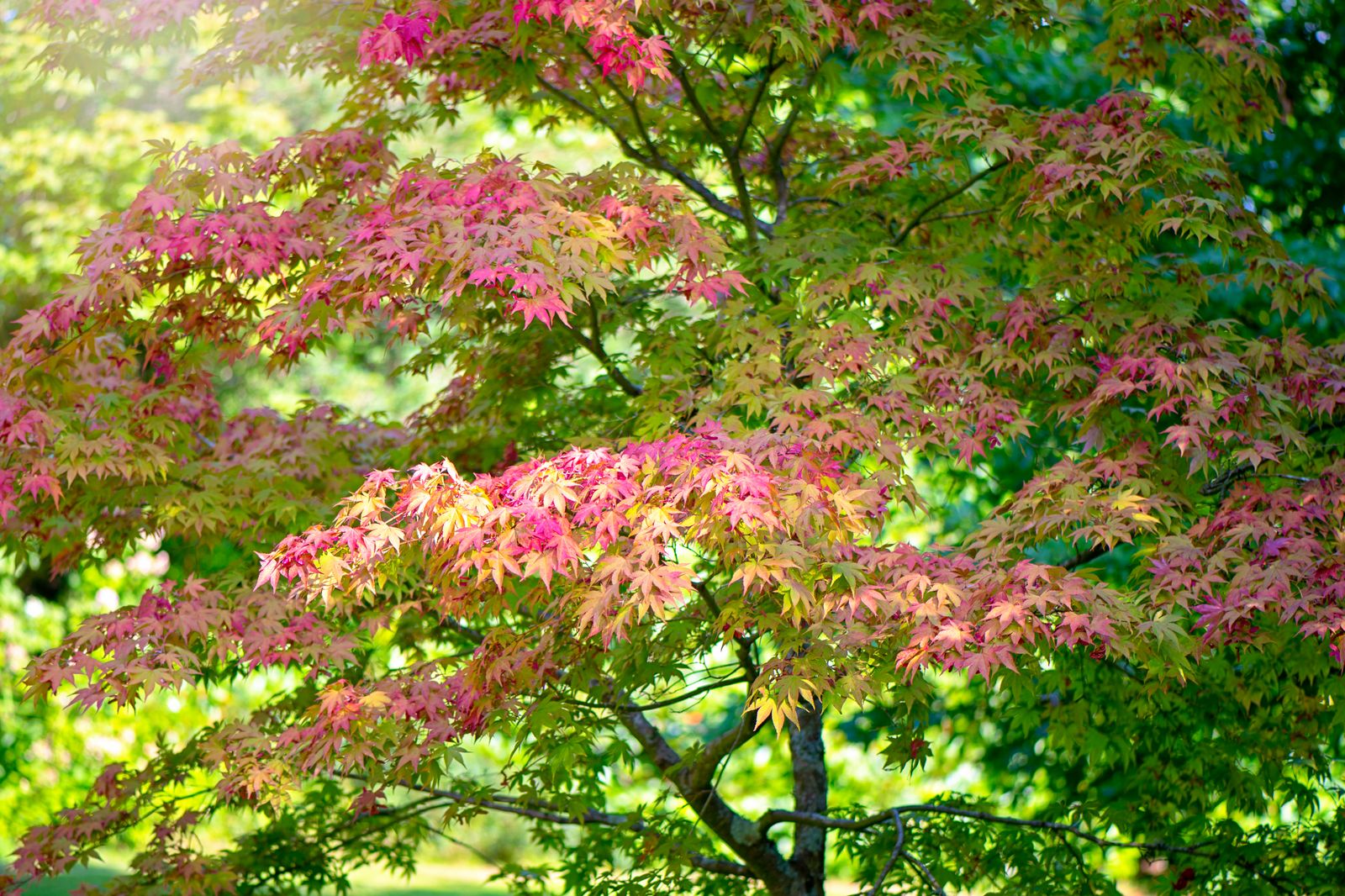
Acers are the perfect tree for year-round colour and dappled shade in the height of summer.
Jacky Parker Photography
There is even some science behind the cooling effect of trees that goes beyond simply creating shade. Tom Massey, founder of award-winning garden design company Tom Massey Studio, explains: ‘Trees are by far the most effective way of cooling a garden. Shade can reduce perceived temperatures dramatically and, through evapotranspiration, trees actively cool the surrounding air.’
For award-winning garden designer Ann-Marie Powell, a tree is ‘the single best cooling tool’. ‘A large, well-established tree pumps hundreds of litres of water vapour into the air around it every day, and that alone can drop the air temperature beneath its canopy by several degrees. It also shades the soil, enabling it to hold moisture.’
Ann-Marie recommends choosing trees for resilience as much as aesthetics: ‘Crataegus persimilis prunifolia for glossy, waxy leaves that cut water loss in heat, [provide] wonderful flowers and glorious autumn colour.’ For smaller gardens, she suggests cercis siliquastrum, the Judas tree. ‘It’s a genuinely drought-tolerant tree once established, and while it will eventually become a proper tree, it grows slowly enough that it stays manageable for years.’
Comments are closed.