
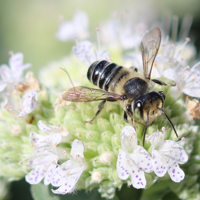
Do you look forward to delicious fresh peaches, golden zucchini and luscious tomatoes every summer?
Then thank the bees and other insect pollinators! They pollinate over 85% of wild flowering plants, more than 75% of agricultural crops and are essential to maintaining a balanced ecosystem.
Why is pollination so important?
Pollination allows plants to develop seeds, which then produce flowers, fruits or vegetables. It requires the transfer of pollen from the male flower part (the stamen) to the female flower part (the ovule), which then forms the seed. The problem is that some flowers may have only male or female parts, so they require pollinators to move pollen. Research shows that a single flower requires eight separate pollinator visits to develop properly shaped fruit. Talk about busy bees!


Anne Wiskind
IMAGE PROVIDED TO APPEN MEDIA
Flowers produce both nectar and pollen. Nectar is a sugar-rich fluid packed with energy to attract pollinators. Pollen is a protein-rich powder that contains the plant’s male genetic material. Bees are considered the most efficient pollinators because they collect and transport both pollen and nectar. They are also “fuzzy,” and pollen collects on their hair or on special collection structures on their legs. Wasps, flies, butterflies, beetles and ladybugs are more accidental pollinators. They are primarily after the nectar and may transport pollen collected on their legs, but their true benefit is as predators that eat harmful insects such as aphids, mites, thrips, leafhoppers and insect larvae. Most insects are not aggressive and are just interested in the nectar or pollen, but it is best not to touch them. Using the magnifying feature on your phone may help with insect identification.
Insect populations have been declining since the 1930s. This trend is widespread, not only in developing areas of the world but also in remote locations. Scientists believe this insect decline is due to habitat loss, light pollution, microplastics, pesticide use, disease and climate change. The U.S. Fish and Wildlife Service currently lists more than 50 species of pollinators as threatened or endangered. The loss of insect communities may have a disastrous effect on food webs.
The University of Georgia Extension developed and launched the Great Georgia Pollinator Census in 2017 to track insect pollinator populations in Georgia to measure the effects of pollinator habitat restoration. The initiative has since expanded throughout the Southeast to include South Carolina, North Carolina, Florida, Alabama, and, for the first time this year, Mississippi. Now known as the Great Southeast Pollinator Census (gsepc.org), it is the nation’s largest pollinator counting effort. The project also features an educational component designed to augment STEM curriculum in elementary schools.
Anyone can participate in the GSEPC on either Friday, Aug. 21, or Saturday, Aug. 22, and all ages are welcome! Participants simply pick a pollinator plant and count the number of insect visits to that single plant in a 15-minute window. Participants can complete multiple counts using a separate tally sheet.
The census tracks insects across eight different categories: bumble bees, carpenter bees, honeybees, small bees, wasps, flies, butterflies, moths and others, such as beetles, ladybugs, dragonflies and lacewings.
The tallies are then loaded onto the GSEPC website for analysis. A pollinator plant is any blooming native or nonnative plant that shows insect activity. The GSEPC tally sheets feature pictures of the different insects to assist with identification, and an identification guide on the website helps participants understand differences between the pollinator groups.
This year, the Fulton County Extension Office is hosting census events at four locations on Saturday, Aug. 22, 2026:
Autrey Mill Nature Preserve, Summerour House Garden, 9770 Autrey Mill Road, Johns Creek, 10 a.m. to 2 p.m.
Chastain Park Native Plant Garden, 4001 Powers Ferry Road NW, Atlanta, 9 a.m. to noon.
GROWL Garden at Camp Truitt, 4300 Herschel Road, College Park, 10 a.m. to 1 p.m.
Little Diggers Booth at Sandy Springs Farmers Market, 1 Galambos Way, Sandy Springs, 8:30 a.m. to noon.
Fulton County Master Gardeners will be at these locations and will host free, family-friendly educational activities to help everyone learn about the importance of pollinators in nature. You will find everything you need to participate in the census, including tally sheets and insect ID guides.
You can also participate in your own yard or local park, any place with flowers! You will find all the necessary information and forms at gsepc.org. Consider joining their Facebook page: Southeast Pollinator Census or follow on Instagram @SoutheastPollinators.
So Bee on the lookout for pollinators!
Happy Gardening!
North Fulton Master Gardeners, Inc. is a Georgia nonprofit 501(c)(3) organization whose purpose is to educate its members and the public in the areas of horticulture and ecology in order to promote and foster community enrichment. Master Gardener Volunteers are trained and certified by The University of Georgia Cooperative Extension.
Learn more at nfmg.net. Previous Garden Buzz columns are featured at https://appenmedia.com/opinion/columnists/garden_buzz/.
Come visit us at the Alpharetta Farmer’s Market on the 2nd and 4th Saturdays through October or the Sandy Springs Farmer’s Market the 3rd Saturday of the month through October.
Appreciate the work?
Help us keep this reporting available to all by joining the Appen Press Club. Your support makes all the difference.
Chip in!
Comments are closed.