
Looking out over my flower beds here in mid-July, I see a city of floral skyscrapers. But instead of being populated by city-dwellers, these spires are humming with pollinating insects: honeybees, several types of bumblebees, beetles, wasps, flies of all colors, and other insects I don’t recognize at all.
I can’t imagine having a garden without tall plants that grow as spires. The visual punctuation they offer as a design element is indispensable. I think of them as exclamation points down the length of an otherwise ordinary flower bed — and unlike exclamation points in prose, I don’t think you can have too many in the garden.
 Ivory white ‘Wedding Candles’ verbascums begin a parade of tall plants that punctuate the long flower border. (Photos by Stephen Orr)
When I say spires, I mean plants anywhere from three feet to around my height, a little over six feet, or even taller. Because of their stature, these plants have a more dramatic, in-your-face personality than something that would grow in a loose, rounded shape or bloom low to the ground, though I love those plants, too.
It’s fascinating to walk among these kinds of spires. You can almost feel the life force of the plants as you walk through a group of them. With their human scale, they seem to act as if they were a crowd of people, some looking at you, others looking away. There are times all I want to do is have a staring contest with a hollyhock blossom.
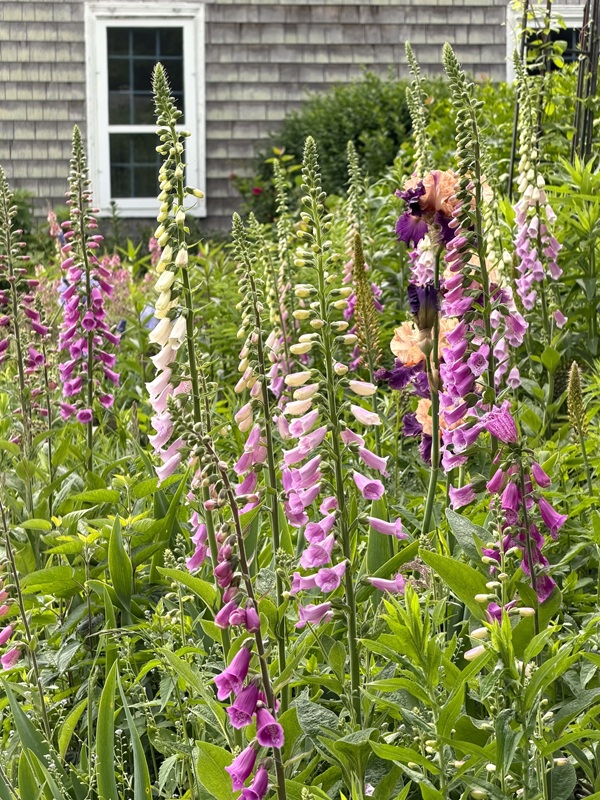 Self-seeded foxgloves return year after year. If dried seed heads remain on this year’s plants, midsummer’s the time to sprinkle them into your border.
For some reason, a lot of spire plants like hollyhocks and foxgloves are biennials, meaning they form seeds one year, make a low rosette, and then bloom in their second year, after which they expire, scattering seeds (usually liberally) to start the process all over again. But some plants listed as biennials, like angelica and certain verbascums, might also be short-lived perennials. It can be confusing, once again proving that though we gardeners keep trying to classify and name nature’s handiwork, she still does what she wants and ignores our attempts at categorization.
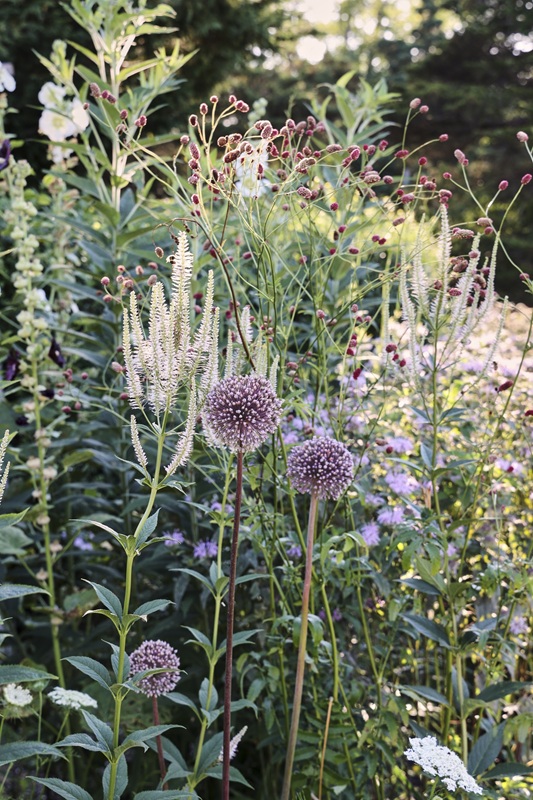 Five-foot-tall ‘Summer Drummer’ allium with Culver’s root (Veronicastrum virginicum) and Sanguisorba officinalis ‘Red Thunder.’ The latter reaches seven or eight feet tall.
Verbascums are in my garden right now, mainly the shorter Verbascum phoeniceum and the hybrid ‘Southern Charm’ with their beautiful dusky colors in a range of plum, copper, rust, and peach. As I develop the gravel garden, I plan to include many more of the larger types that can reach 10 feet tall, such as the common mullein (V. thapsis) or the giant silver mulleins (V. bombyciferum or V. olympicum). I look forward to having my own verbascum party to walk through. A new favorite this year is V. chaixii ‘Wedding Candles,’ with its steeples of ivory white flowers dotted with purple and orange centers.
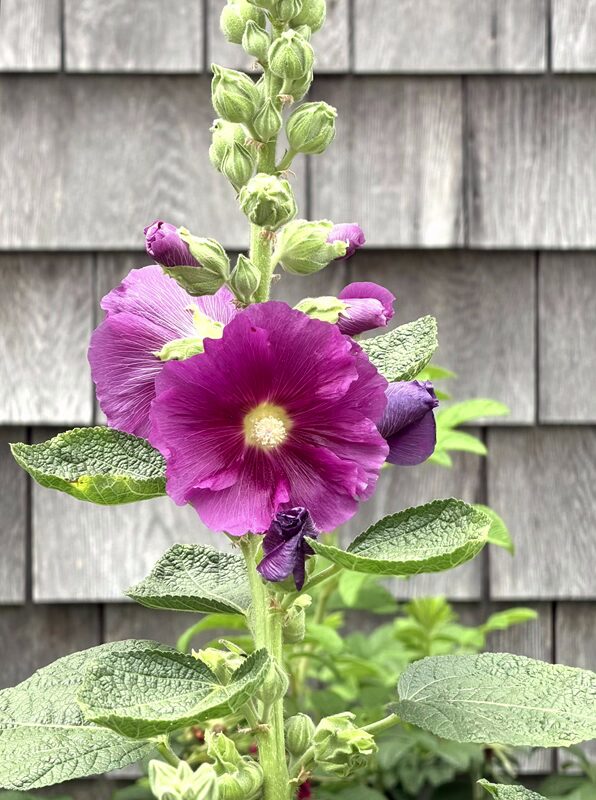 I would be happy if Hollyhock ‘Purple Rain’ would self-seed itself all around the garden.
I’ve written about my love of foxgloves in these pages before. Though I’ve bought full grown ready-to-bloom plants several times, I’ve grown these biennials successfully from seed for over 20 years. My usual technique is to scatter the seeds around wherever I think they might grow, even in our sunny, sandy situation on the Outer Cape. I usually sow the seeds in June or early July, around the same time the blossoms would be naturally fading and scattering theirs. As biennials, they make a rosette of leaves the first year and then bloom the next before dying. But most of them each year self-seed very effectively, so they function like perennials.
Hollyhocks and foxtail lilies have always been plants I’ve wanted to grow, but I never had luck with them until I gardened on the Cape. Both of these old-fashioned flowers come in a pastel rainbow of colors worthy of the Edwardian costumes shown on The Gilded Age. Two of my favorite hollyhocks are the eggplant-black ‘Nigra’ and the butter-yellow ‘Rugose’; the latter appears to be fairly rust-resistant. Fingers crossed the fungus won’t show up here; some people swear off hollyhocks because of it. Foxtail lilies look like tall bottlebrushes in a range of tropical fruit shades. They are big and bold but never too much, because their bloom period is only a few weeks.
 Foxtail lilies (Eremerus) are planted in fall as odd, octopus-like roots that require sharp drainage so they don’t rot over the winter.
Some of my most graceful tall plants are American natives. Culver’s root (Veronicastrum virginicum) has candle-like spires made up of hundreds of tiny white flowers. It provides a less showy but elegant rhythm to a flower bed as it forms more of a quiet screen than an emphatic stalk. Other towering screen plants in my garden that aren’t as spire-like include our native sanguisorbas: great burnet (Sanguisorba officinalis ‘Red Thunder’), which grows to about eight feet. Its delicate tracery of garnet-colored thimbles dance on wiry, curving stems to every sea breeze. Sanguisorba ‘White Brushes’ is covered with dangling fuzzy white flowers that resemble feathers. In its second year, the stalks of mine reached nine feet tall. Nursery listings say it likes being in moist soil near a wetland, but both plants have thrived through several summer droughts with infrequent irrigation.
 A see-through screen of Culver’s root, foxtail lilies, ‘Purple Haze’ agastache, and verbascum.
I’ve recently come around to liatris, which is a bit shorter for the front of the border but still spire-like. I especially like the white variety (Liatris spicata ‘Floristan White’). Taller native types like meadow blazing star (L. ligulistylis) and button blazing star (L. aspera) have flower stems with looser clusters of purple flowers that look more graceful than the ordinary purple one that’s tightly packed.
Upright plants such as these can add an unexpected design feature planted at the front of the flower border as see-through plants among the shorter edging plants. I think any garden, no matter how small, is made more visually exciting with at least a few of these spires.
 More of a screen than a spire, native Sanguisorba ‘White Brushes’ grows to seven feet next to a purple ironweed (Vernonia).
As for the all-important staking of these tall plants, I’ll admit I’m not always the best practitioner. But I’m trying to do better. Last summer I didn’t tend to my spires, and by midsummer many plants were lolling about. Everything looked overly messy — even for me, and I have a high mess threshold. I like to use natural stakes such as bamboo or branches so you notice the upright plants and not their supports.
Another practical consideration for spire plants is their feet. Some of them have attractive mounds of leaves at the base; others, especially alliums, can have unsightly leaves below. It’s a good idea to plant mounding perennials such as hardy geraniums or salvias in front of these to hide anything you don’t want to see. It would be a travesty to let them detract from all the glory towering above.
This an expanded version of an essay that appeared in The Gardener’s Mindset (Clarkson Potter, 2025).
Comments are closed.