

Linnea Bird has travelled from across the Pacific to help restore Tasmania’s fast-disappearing giant kelp forests.
The 25-year-old Masters student from the United States is one of six participants taking part in a live-in internship program run by the Eaglehawk Dive Centre, an hour’s drive south of Hobart.

Linnea Bird felt drawn to the Tasmanian reforestation project. (ABC News: Ebony ten Broeke)
“Growing up in California and seeing the kelp forests there, it’s always been something that I’ve been interested in,” Ms Bird said.
“Being able to go across the world and see very similar ecosystems, but also just different biodiversity, has really drawn me to Tasmania.”
Tasmania’s giant kelp forests have been rapidly deteriorating since the 1940s.
Warming waters and overgrazing by invading sea urchins have led to the decline of what were once abundant marine forests.

The restoration project takes places at selected sites around the Tasman Peninsula. (Supplied: Ocean Imaging/Stefan Andrews)
Dive instructor Pauline Nuttens heads up the centre’s newly established internship program, which is part of the larger Tasmanian Giant Kelp Restoration Project.
“The loss of the kelp has a massive impact on our ecosystem. For people who understand that, and want to do something about it, that’s great,” Ms Nuttens said.
“The ecosystem behind a kelp forest is huge. It’s habitat protection, provides food and is a nursery as well for many, many marine species.”
Pauline Nuttens says she witnessed first-hand the decline of the marine forests. (ABC News: Ebony ten Broeke)
Ms Nuttens said that in 2015, she worked as a dive instructor at the centre, guiding groups through the giant kelp forests.
When she returned the following summer, she said the area’s kelp was gone.
“It was gone in less than a year, a big forest … that was a big shock to me. This is when I realised how catastrophic this was,” she said.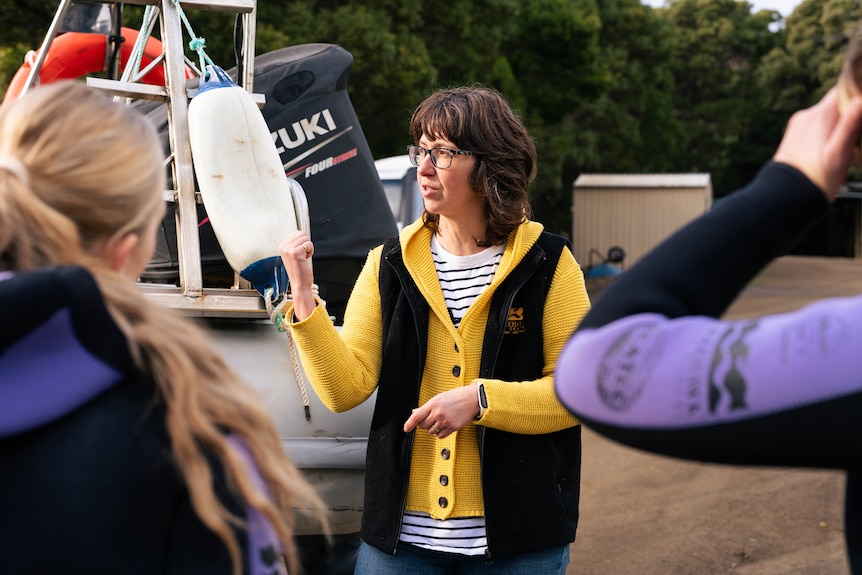
Pauline Nuttens manages the dive centre’s live-in interns. (ABC News: Ebony ten Broeke)
Reforesting under the waves
The technique used by the interns to restore the kelp forest was developed by Scott Ling from the University of Tasmania’s Institute of Marine and Antarctic Science (IMAS).

Kelp forests provide much-needed habitat for many marine creatures. (Supplied: Ocean Imaging/Stefan Andrews)
The kelp spores are grown in a laboratory on a spool, which the divers then wrap around the base of existing seaweed at protected sites off the Tasman Peninsula.
Scott Bennett is a marine ecologist at IMAS and co-founder of the national marine charity Great Southern Reef Foundation.
“Our best estimates are that we’ve lost about 95 per cent of giant kelp forests across Tasmania, and those numbers are probably even higher now,” he said.
Scott Bennett is leading the IMAS project to grow healthy pockets of giant kelp forests. (ABC iview: Back Roads)
Dr Bennett said the internship program was an opportunity to access more hands for restoration work.
“They can train these people up to a really professional standard, and that just increases our capacity to plant kelp and help look after the reefs,” he said.
Dr Bennett said results from the project have been a “mixed bag” due to changing conditions in Tasmanian waters.
“When conditions are right, you can regrow a forest within a year,” he said.The tragedy of Tasmania’s underwater kelp forests
“Often we’ll get hit by warm summer temperatures or a kind of herbivorous fish that moves in and finds the kelp really tasty, or big storm events, and all these things just really knock the restored patches around.”
The current focus has been on choosing the right sites to restore.
“Increasingly, we’re realising that site selection and picking the places that really are still amenable to giant kelp forest growth is really crucial to the ongoing success of restoration, as well as just looking after the remnant forests that we do still have in Tassie,” Dr Bennett said.

The kelp spores are grown in a laboratory on a spool, before being transferred to the seabed. (ABC News: Ebony ten Broeke)
Cold water plunge for interns
The internship takes place over Tasmania’s winter months, which is the optimal time to plant the kelp spores.
‘Hope’ for giant kelp forests
Ms Nuttens said over their month of diving, the interns are trained to handle the cold water.
“Diving in Tasmania can be a bit challenging,” she said.
“Because of the cold water, we need to use thick wetsuits and that changes the buoyancy control, the techniques.”
Ms Bird said it was a shock coming from the warm waters of California to the chilly Tasman Peninsula.
“In between dives, we’ll pour a thermos of boiling hot water into our booties, and that helps tremendously,” she said.
The first groups of interns have come from across the world to take part in the program. (ABC News: Ebony ten Broeke)

The program fee covers the cost of board, food and diving equipment for a month. (ABC News: Ebony ten Broeke)
Immersive experience
To take part in the program, interns pay about $3,000, which covers board, food and dives for the month.
“I think the fact that they come and live in the dive centre, it is really immersive,” Ms Nuttens said.
“You wake up, you dream kelp. You wake up, you dive kelp … the only thing that we talk about the entire month is kelp.”
For the program’s first intake, six participants took part over two months, with three interns in June, and another three in July.

Two groups of three interns were selected for the 2026 program. (ABC News: Ebony ten Broeke)
As well as Ms Bird, the July interns included 27-year-old Hugo from Sweden and 20-year-old Paige from Perth.
Ms Bird said giant kelp was the subject of her master’s project, so being able to participate in hands-on restoration was a great opportunity.
“We also do something called underwater gardening, which is a great term, and it was super fun,” she said.
“We’re basically cutting around the kelp restoration sites, so where we’re out planting the juvenile giant kelp, we’re cutting about a metre around all of the other kelp that could out-compete the juveniles.”
For Ms Nuttens, she said she hoped the internship would allow more people to contribute to the restoration project, while giving young people valuable diving time and experience in the water.
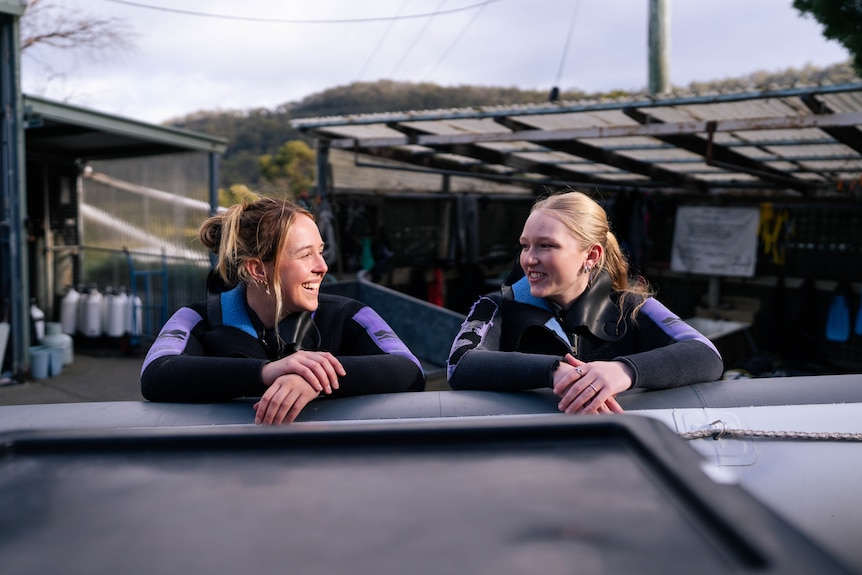
As well as interns, the reforestation project relies on commercial divers to hand-plant kelp. (ABC News: Ebony ten Broeke)
Comments are closed.