
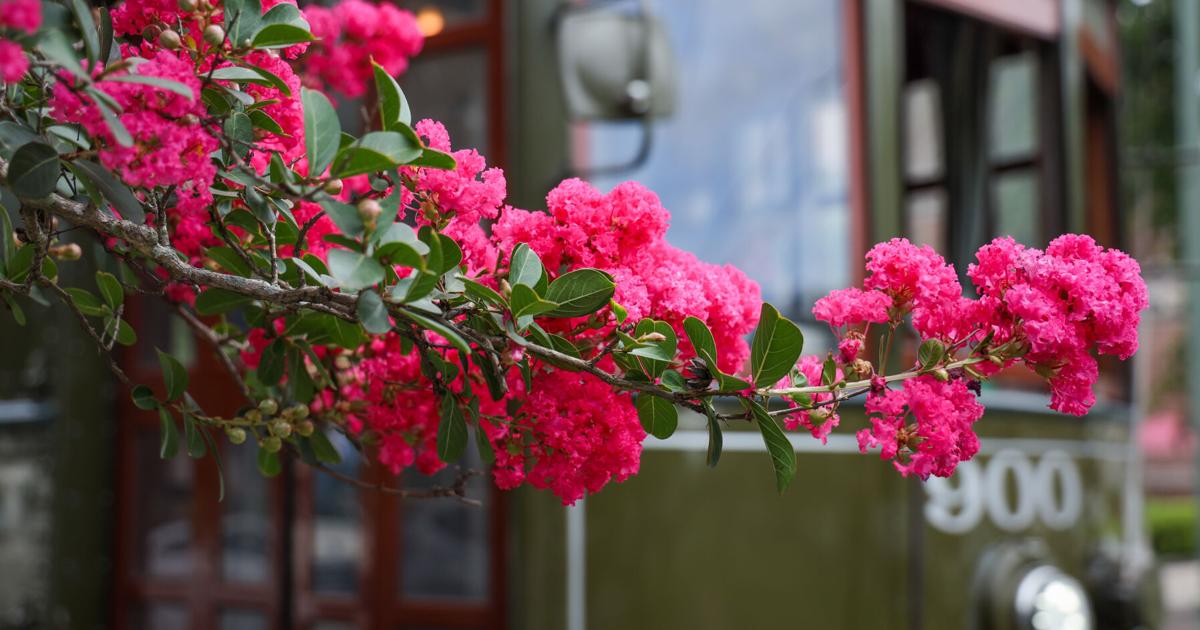
I would like to know if I need to cut the green seed pods off my crape myrtle. Looking online, I see two answers. Some say to cut them off, and others say leave them alone. — Christopher
After the flower clusters of crape myrtles fade and the flowers drop off, you will see clusters of green balls. These are the seed pods of crape myrtles. Cutting them off is optional.
Most gardeners consider deadheading crape myrtle trees more trouble than it is worth, and many trees are too tall to make this practical anyway. But it is certainly something you may do.
Pruning off the seed pods may be recommended to encourage another flush of late summer blooms. But crape myrtles generally produce a smaller second flush of flowers, whether they are deadheaded or not.
Some people may not like the way the clusters of green balls look and prefer to remove them. And for crape myrtles that are sending out abundant new growth, the weight of the seed pod clusters can make the branches bend down. Pruning them off alleviates the drooping branches. Again, this is only practical in younger or smaller growing crape myrtles where the seed pod clusters are easy to reach.
Basically, when it comes to pruning off the seed pods, there is no wrong decision.
There is one more point I need to make about crape myrtle seed pods. Every year, I get numerous inquiries in late summer from gardeners asking why the flower buds on their crape myrtle are not blooming. They think the clusters of green balls on their trees are flower buds, but, in fact, they are seed pods formed during earlier blooming and will never produce flowers.
Is there any selective herbicide that will control Virginia creeper vine growing in and on shrubs? The vines are growing in and covering my dwarf yaupon holly and juniper hedges. — Herb
Unfortunately, I’m not aware of any selective herbicides for controlling Virginia creeper (Parthenocissus quinquefolia) when it is growing in shrubs. Anything that will kill Virginia creeper will also damage or kill yaupon hollies and junipers.
So, spraying an herbicide to kill the Virginia creeper vines in this situation is not practical. The herbicide will get on the foliage of the shrubs and injure or kill them. Instead of spraying, use this technique.
Get down at ground level and find where the vines infesting the shrubs are growing from. You will have to reach under a vine-infested shrub to do this.
Cut off the vine a few inches from the ground and immediately treat the surface of the freshly cut stump with undiluted triclopyr (Cut Vine and Stump Killer, Brush Killer, Brush B Gon and other brands). Applying the herbicide to the fresh cut is necessary because it kills the stump and prevents it from resprouting. This will not endanger the shrubs.
The vines growing up in shrubs will die because they have been cut off from their roots. The foliage will wither and turn brown, and the vines may be physically removed (you could also remove them right after cutting the base of the vines). The treated stump will die because the herbicide gets absorbed by the freshly cut surface and is translocated to the roots.
This method is very effective and may be used at any time of the year. It also works well for getting rid of undesirable tree seedlings and saplings growing in beds.
GARDEN TIPS:
A SUPPORTING ROLE: Some of the taller gingers, such as Hedychium, Alpinia and Costus, may get top-heavy when they bloom and lean or fall over. A little graceful leaning is generally not an issue, but you should consider supporting the shoots if they fall too much or lay on nearby plants. Also, each shoot only blooms once. After a shoot blooms, you may cut it back down to the ground to help manage the plant.
IRRIGATION IMPORTANCE: Although we have been getting plenty of rain, caladiums need irrigation if the weather gets hot and dry. This can help keep the foliage in good shape through the summer. Apply a light application of fertilizer now to encourage vigorous growth if plants seem to be slowing down.
IF THE SHOWERS STOP: Soaker hoses are an excellent way to water flowerbeds and vegetable gardens, should the weather turn dry. Keeping the foliage dry helps stop fungal diseases from attacking.
WEB WATCH: Fine, silvery webbing appearing on the bark of area trees and large shrubs is completely harmless. The webbing is produced by tiny scavenging insects called bark lice or psocids. There is no need to apply insecticides. If the webbing bothers you, sweep it off with a broom or remove it with a strong spray of water.
SLIME IS FINE: With rainy weather, slime molds can show up on area lawns. Look for bluish gray to black patches, a few inches to a foot in diameter, growing on the grass blades. Although it looks alarming, it is completely harmless.
Comments are closed.