
Piet Oudolf is a world-famous Dutch landscape designer who focuses on re-creating natural landscapes in urban environments by using an incredible assortment of native plants.
I was first introduced to his work in the documentary film “Five Seasons: The Gardens of Piet Oudolf” shown by the Charleston Horticulture Society some years ago. Oudolf has designed five public gardens in the United States in Chicago, New York City (two), Delaware and Detroit. His best-known U.S. work is Manhattan’s High Line Park, a garden planted on a decommissioned elevated train track.

The red cardinal flowers draw the eye in to the rain garden.
Anthony Keinath/Provided
His most recent U.S creation is Oudolf Garden Detroit, situated in Belle Isle Park on Belle Isle, an island in the Detroit River. My wife and I visited it in August 2022. The garden claims to be the only one in North America that Oudolf not only designed but also personally selected the plants.
Because of the low-lying site, which is typical of eastern Michigan, the main garden has 15 raised beds. I recall reading that part of the newly planted garden flooded, so it is now protected by a low wall on two sides. A rain garden was added to hold runoff from the main garden. The blue (Lobelia siphilitica) and red (Lobelia cardinalis) cardinal flowers in full bloom were stunning focal points in the rain garden when we were there.
Other showy flowers in the main garden when we visited were:
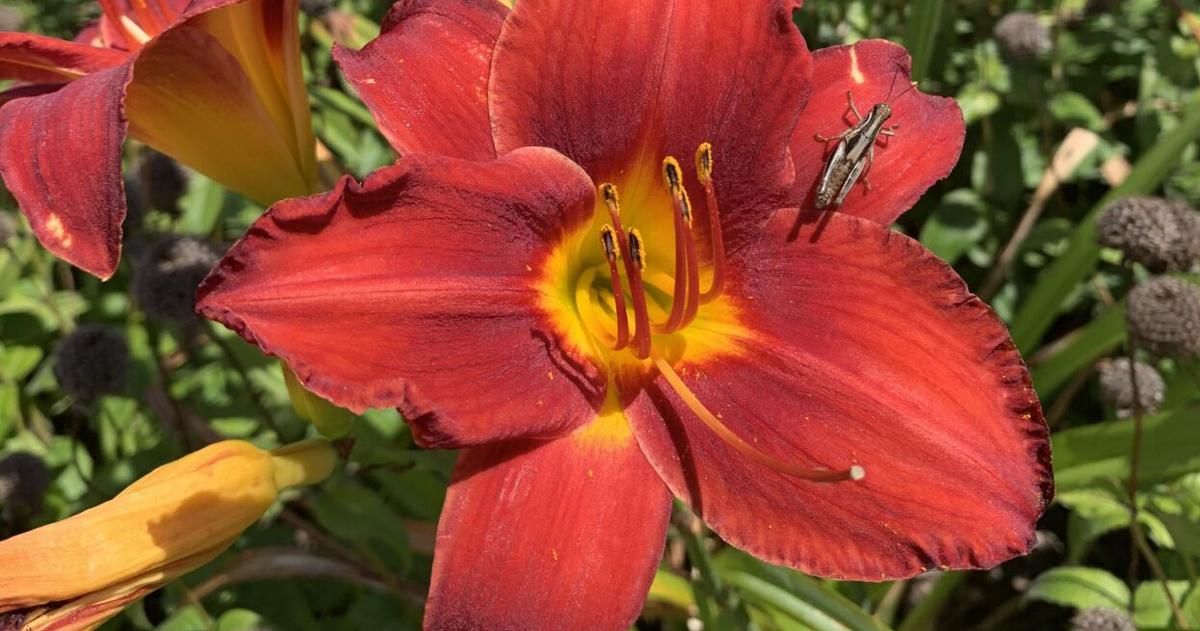
Red daylily was used in several beds in the main garden.
Anthony Keinath/Provided
Branching centaury or lesser centaury (Centaurium pulchellum), an introduced European native that tolerates moist soil
One of the “true” geraniums, or cranesbill (genus Geranium)
Skullcap (Scutella) with delicate violet flowers in a well-branched flowerhead
Some of the common ornamentals I recognized included:
Stokes aster (Stokesia laevis), a reliable, heat-tolerant perennial in South Carolina
A true red daylily
White coneflower, a staple butterfly plant
Note that, unfortunately, none of these three flowers are deer-resistant.
Oudolf is known for his unique ability to use plant textures to add variety to his designs. Take, for example, the contributions of the red daylilies. The bright red flowers were focal points amid the greens of foliage and tans of early maturing grasses. The dark green, perfectly straight leaves, darker and more erect than on typical cultivated daylilies, provided that necessary vertical accent in a well-designed arrangement.
In his overall design, Oudolf considers all parts produced by the plants over their life cycles, not just the flowers (like most of us). For example, fat yellow-green iris buds contrast with slender blue-green leaves. To give his gardens year-round interest, he selects plants for their persistent eye-catching seed heads or seed pods that add to the overall picture long after their flowering period ends.
Native cranesbill was in full bloom in early August in Michigan.
Anthony Keinath/Provided
Finally, his gardens are designed with “drifts” of plants, sizeable groups of the same plant that touch each other when mature. Drifts alongside one another have different colors, heights, textures and blooming times, each one with its own “time to shine.”
Clearly, these planting schemes require space; Oudolf Garden Detroit occupies three acres. A similar look can be created in a smaller backyard by limiting the plants to three or five types so there is room for multiples of each, all grouped together. Another design feature is no obvious gaps between different types of plants, similar to the way they arrange themselves in nature.
For lovers of native plants, an Oudolf garden is worth the trip.
Comments are closed.