
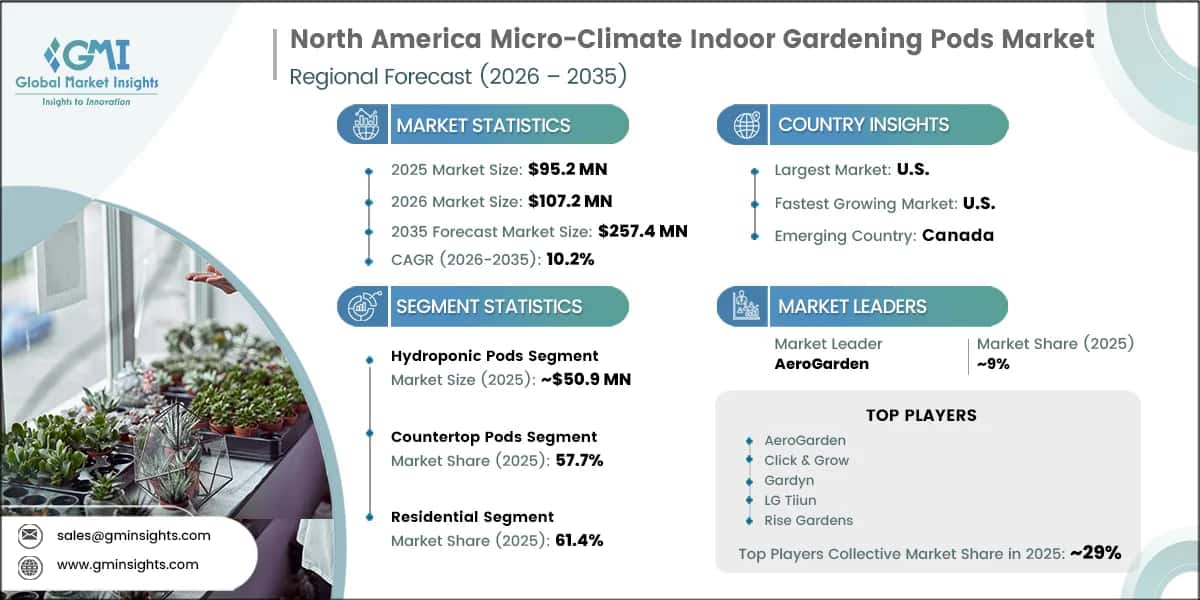
Market Size & Growth
Base Year2025
Market Size in 2025USD 95.2 Million
Market Size in 2026USD 107.2 Million
Forecast Period 2026-2035 CAGR
10.2%
Market Size in 2035USD 257.4 Million
Key Market Trends
DriversImpactRising urbanization and limited outdoor spaceWith increasing urban living in North America, many consumers lack access to traditional gardens. Indoor gardening pods offer a compact, soil-free solution that fits apartments and small homes.This convenience has driven adoption among city dwellers seeking fresh herbs and vegetables without needing outdoor spaceGrowing demand for fresh, organic, and home-grown produceConsumers are becoming more health-conscious and prefer pesticide-free, organic produce. Indoor pods allow users to grow fresh food year-round with full control over inputs. This aligns strongly with sustainability and wellness trends, boosting product appeal across householdsTechnological advancementsIntegration of IoT, LED grow lights, and automated watering systems has made indoor gardening simpler and more efficient. Many pods now connect to mobile apps, providing real-time monitoring and plant care guidance. These innovations reduce the learning curve, attracting even first-time users
Pitfalls & ChallengesImpactHigh initial cost and maintenance expensesMicro-climate gardening pods often come with a relatively high upfront cost compared to traditional gardening tools. Additionally, recurring expenses such as seed pods, nutrients, and electricity can deter price-sensitive consumers. This limits penetration in budget-conscious segmentsLimited crop variety and yield capacityMost indoor pods are optimized for herbs, leafy greens, and small plants, restricting the range of crops that can be grown. The yield is also comparatively lower than outdoor or larger hydroponic systems. This can reduce long-term value perception for users looking for more diverse or bulk production
Opportunities:ImpactExpansion into smart home ecosystemsIntegrating indoor gardening pods with smart home platforms (e.g., voice assistants, home automation systems) presents a strong opportunity. Seamless integration can enhance user convenience, making these systems part of everyday connected living environments.Commercial and institutional adoptionBeyond households, there is growing potential in offices, restaurants, and educational institutions. Restaurants, for example, can grow fresh herbs on-site, enhancing freshness and customer experience. This B2B expansion could significantly widen the market and create recurring revenue streams.
Market Leaders (2025)
Market Leader
AeroGarden
Market share of ~9%
Top Players
AeroGarden
Click & Grow
Gardyn
LG Tiiun
Rise Gardens
The collective market share in 2025 is ~29%
Competitive Edge
The North American micro-climate indoor gardening pods market is moderately fragmented, with a mix of established consumer electronics brands and specialized indoor gardening startups competing for market share. Key players such as AeroGarden (Scotts Miracle-Gro), Click & Grow, Rise Gardens, and Gardyn dominate the space by offering differentiated product designs, smart features, and proprietary seed pod ecosystems. These companies focus heavily on user-friendly systems that combine aesthetics with functionality, appealing to urban consumers and tech-savvy households
Competition is largely driven by innovation in smart technology, design, and ecosystem lock-in strategies. Many players are integrating app-based monitoring, automated nutrient delivery, and AI-driven plant care to enhance user experience. Additionally, brands are building recurring revenue streams through subscription-based seed pods and nutrient kits, creating customer stickiness and long-term engagement. This has intensified competition around proprietary consumables and platform ecosystems rather than just hardware sales
Strategic partnerships and retail expansion also shape the competitive dynamics. Companies are leveraging e-commerce platforms like Amazon, along with direct-to-consumer channels, to broaden reach. At the same time, collaborations with chefs, influencers, and sustainability advocates are being used to strengthen brand positioning. Despite growing competition, barriers such as technology development costs and brand trust continue to limit the rapid entry of new players at scale.
Regional Insights
Largest MarketU.S.Fastest growing marketU.S.Emerging countriesCanadaFuture outlook The future outlook for the NA micro-climate indoor gardening pods market appears highly promising, driven by increasing adoption of smart home technologies and sustained interest in self-sufficiency and sustainable living. As urban populations continue to grow, demand for compact, efficient food-growing solutions is expected to rise. Advances in automation, AI, and energy-efficient lighting will further enhance product performance, making indoor gardening more accessible and mainstream across diverse consumer segments Looking ahead, the market is likely to witness expansion beyond residential use into commercial applications such as hospitality, corporate offices, and educational environments. Additionally, declining hardware costs and improved scalability of production may help reduce price barriers, enabling wider adoption. Companies that invest in product innovation, ecosystem integration, and value-added services are expected to gain a competitive edge as the market matures
Comments are closed.