
In the aftermath of Guam’s recent near pass of a super typhoon, many homeowners, farmers and communities are facing the same challenge: what to do with the enormous number of fallen trees, broken branches and piles of leaves scattered across the island.
The most common response is to haul this material to a green waste facility. While that may seem like the simplest solution, there is another option that can turn storm debris into a valuable resource for years to come. A gardening technique known as hügelkultur, German for “mound culture,” uses downed logs, branches, leaves and soil to create productive beds for vegetables, herbs, spices and fruit crops.
Rather than viewing fallen trees as waste, hügelkultur treats them as the foundation of a living garden. It provides our local soils with one of their greatest needs: increased organic matter. Organic matter is the foundation of healthy, productive soils because it improves the physical, chemical and biological properties that plants need to thrive.
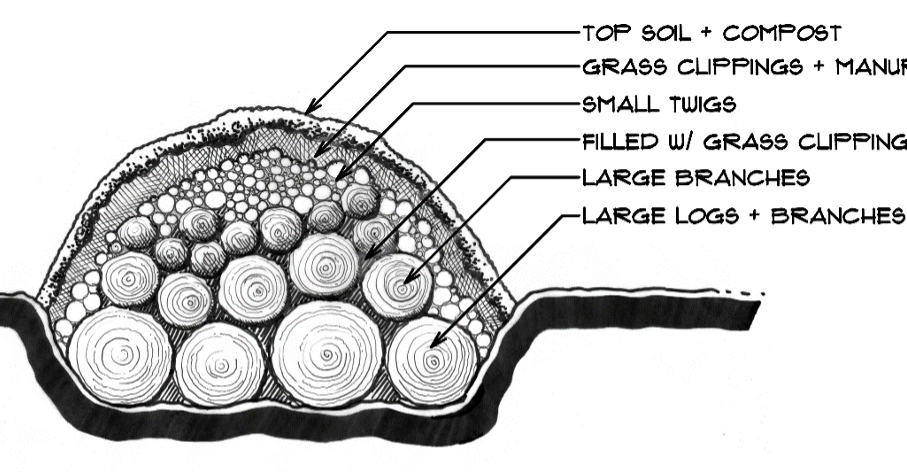
Building a hügelkultur bed is surprisingly simple. Start by digging a shallow trench. Place larger logs in the bottom, then add smaller branches, leaves and other plant material. Next, add manure, compost or fertilizer as a nitrogen source. Finally, cover everything with soil to create a raised planting mound.
As the wood gradually decomposes, it becomes a long-term source of organic matter, providing nutrients while helping the soil retain moisture and supporting beneficial microorganisms. It will also act much like a sponge, absorbing water during heavy rains and releasing it slowly during dry periods. This can be especially useful in Guam, where intense rainfall can be followed by weeks of dry weather.
Some gardeners worry that rotting wood will rob plants of nutrients. Adding manure, compost or fertilizer when the mound is built solves that problem. Additionally, on sloping land, hügelkultur beds can also be built along the contour to help slow runoff, reduce soil erosion and keep more water in the landscape. Over time, the mound becomes an increasingly productive place to grow vegetables, herbs, spices and fruit crops.
A properly constructed hügelkultur bed can remain productive for many years. For homeowners and small farmers, this creates an opportunity to develop diversified food-producing areas using materials that would otherwise be discarded.
One practical design for Guam is a small food forest. Papayas can be planted along the top of the mound, where their fibrous root systems adapt well to raised beds. Bananas can be planted along the sides or lower shoulder of the mound, where moisture is more abundant and stability is greater. Between these fruit crops, growers can establish vegetables, such as eggplant, tomatoes, peppers, okra and beans. Along the lower edges, leafy greens, herbs, bunching onions, sweet potato tips and other quick-maturing crops can be grown. This allows taller plants, medium-sized crops and ground-level vegetables to thrive together in the same space.
The benefits of storm debris do not stop with logs. Leaves and small branches can be used as mulch around fruit trees, ornamental plants and landscape beds. Mulch suppresses weeds, conserves moisture, moderates soil temperatures and adds organic matter as it breaks down.
In a time when food security, soil health and sustainability are increasingly important, yesterday’s storm debris can become tomorrow’s harvest. So instead of making a trip to a disposal facility, consider leaving some of that organic material on-site. A few logs, branches, leaves, soil and a little labor can create a growing area capable of producing vegetables, herbs, spices, papaya, bananas and other crops for years to come.
Guam residents have long demonstrated resilience and resourcefulness following natural disasters. Every major storm leaves behind damaged vegetation, but it also leaves behind an opportunity.
L. Robert Barber Jr. is a specialist in agricultural economics and sustainable agriculture with the University of Guam Land Grant. He can be reached at bbarber@triton.uog.edu. Mark Acosta is an extension agent specializing in horticulture and sustainable agriculture. He can be reached at 671-735-2080 or macosta@triton.uog.edu.
UOG Horizons is a weekly column on agriculture, food, nutrition, health and wellness, and natural resources written by faculty from the University of Guam School of Health and from UOG Land Grant.
Learn more about hügelkultur
• Texas A&M AgriLife Extension Master Gardener Video: https://www.youtube.com/watch?v=WudQjXpPCGo
• University of Arizona Extension Publication: https://extension.arizona.edu/sites/default/files/2026-05/Hugelkultur.pdf
• Oklahoma State University Extension Fact Sheet: Sustainable Landscapes: Creating a Hügelkultur for Gardening with Stormwater Management Benefits
https://extension.okstate.edu/fact-sheets/sustainable-landscapes-creating-a-hugelkultur-for-gardening-with-stormwater-management-benefits
• University of Minnesota Extension Soil Health Resources: https://extension.umn.edu/soil-and-water/soil-management-and-health
Coming up from UOG Land Grant:
• Soil Sampling Workshop
10 a.m. – Noon on Saturday, July 18
UOG Yigo Research & Education Center
Free registration: https://url.uog.edu/soil-sampling-workshop
More info: 671-735-2134 or oladoyec@triton.uog.edu
• Hotnu Heals: A Gathering for Guam’s Farmers
10 a.m. – 1 p.m. on Sunday, July 26
Valley of the Latte Adventure Park
Free registration for farmers and their families: https://url.uog.edu/hotnu-heals
More info: santosd15571@triton.uog.edu
Subscribe to the UOG Land Grant mailing list at https://url.uog.edu/landgrant -subscribe to stay posted on all upcoming events, or follow @uoglandgrant on Facebook or Instagram.
Comments are closed.