

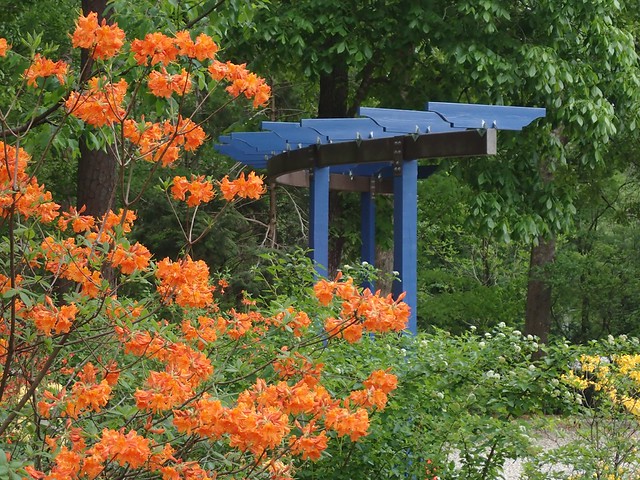
The Donald E. Davis Arboretum’s azaleas are one of the core collections alongside its collection of Alabama’s native oaks.

The Donald E. Davis Arboretum features three main water features, including a pond, a winding natural stream and a rocky waterfall.
Just steps away from the busy College Street corridor on the edge of campus, Auburn University’s Donald E. Davis Arboretum can feel like a portal to a world far from the noisy road.
As visitors walk into the 16-acre botanic garden, the whoosh of passing cars is slowly replaced with birdsong and the trilling of insects.
On a recent day, children and their parents excitedly walked the winding paths connecting native plant exhibits while Auburn students busied themselves studying local bee populations. Oblivious to it all, a turtle sunned itself on a rock just below the arboretum’s waterfall.
As the oldest collegiate botanical garden in the Southeastern Conference, the Davis Arboretum is not only a valuable educational resource on Alabama’s native plant species and biodiversity but a serene escape for its over 80,000 annual visitors.
“This place allows people to experience nature on their own terms,” said Morgan Pendergrass, arboretum director. “Not everyone wants to forge their own path into the woods with a machete. Visitors can come out here and listen to the birds or take a walk while listening to a podcast.”
The arboretum’s backbone is the collections of oaks and native azaleas, both of which are nationally accredited. Located in a state known for its diversity of oaks, the Davis Arboretum boasts an impressive 39 of Alabama’s 40 native oak species (the bottomland post oak remains elusive).
While preservation, conservation and display of Alabama’s native plant species is a cornerstone of the arboretum’s mission, it also serves as a living classroom for Auburn students. It’s one of the most widely used academic resources on Auburn’s campus after the Draughon Library.
“There are 16 departments at Auburn that regularly have classes here at the arboretum,” Pendergrass said. “There’s a big presence from horticulture and the sciences, of course, but we also support the humanities, education and human development and family science.”
As part of the College of Sciences and Mathematics, the arboretum receives a healthy budget earmarked by the college, which is supplemented through facility rentals and other means of revenue.
Comments are closed.