
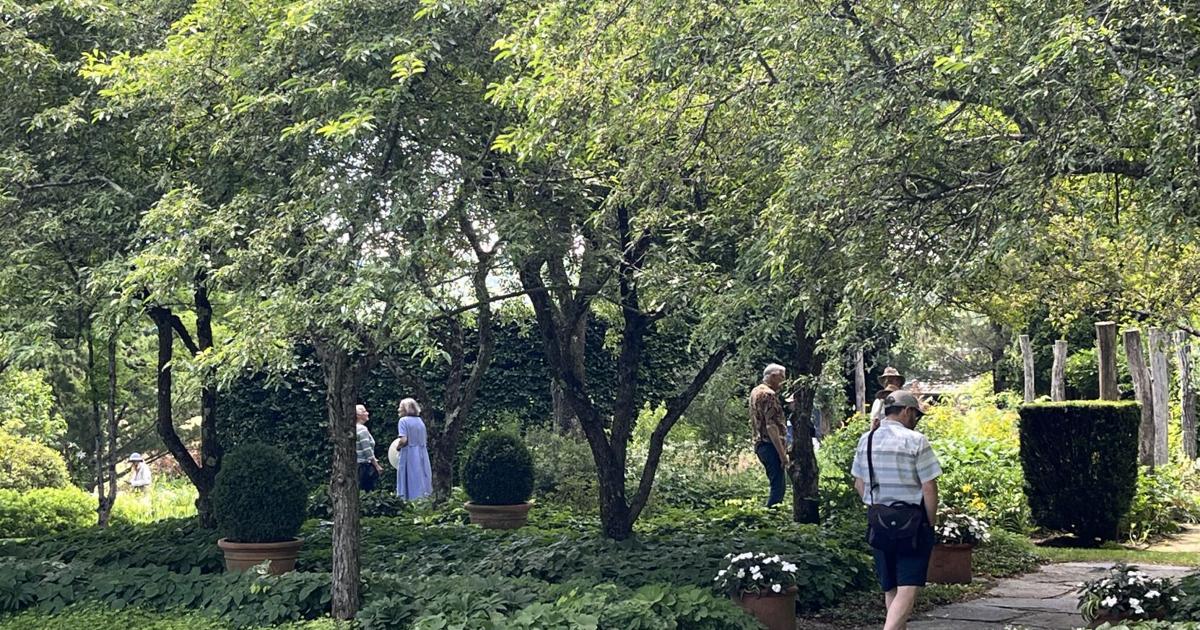
WESTMINSTER — Mary and Gordon Hayward’s garden brings visitors from all over to see its beauty and find inspiration.
“Mary and I are committed to community,” Gordon said. “From the start, we’ve been committed to this strong sense of community in southeastern Vermont.”
Over the last weekend of June, the couple welcomed the public as part of The Garden Conservancy’s open tours. The organization’s mission is to “preserve, share, and celebrate America’s gardens and diverse gardening traditions for the education and inspiration of the public.”
On Saturday and Sunday, July 11 and 12, the Haywards will open up their property for the Westminster Garden Tour organized to raise money for Westminster Cares. Tickets can be purchased for $20 for one admission or $35 for two, with children 16 and younger attending free, at westminstercares.org.
Other stops on the tour include the Westminster Center School, Hawksong East and Signal Pine Gardens. Gardening talks and demonstrations are included with admission.
This will mark the 23rd event held for the organization, Gordon said.
“It’s been a very important weekend for raising money to enable them to look after the elderly in the Westminster community,” he said. “It’s about community. It’s a community celebration.”
Starting as a tour of just the Hayward Gardens, Gordon said the event has “grown enormously” and includes other local gardens. More than $10,000 is being raised each time to support elderly people.
Hayward Gardens serves as the center of the event, Gordon said, and Westminster Cares brings tents and serves lunch on the property. He estimates about 40 volunteers are involved in running the event each year.
Donna Dawson, who retired several months ago after serving as director of Westminster Cares for 14 years, said the tour has become “the main fundraiser” for the organization.
“We serve seniors in our town and provide Meals on Wheels and other services so it’s a hugely important fundraiser for us, and it’s also a way that we get the word out about our programs and services,” she said. “Doing this has helped raise a lot of money for Westminster Cares.”
Dawson estimates the event has brought in more than $200,000 over the course of its existence.
“It’s hard to put into words how important this has been for us,” she said. “And they have been so gracious to allow us to do this fundraiser every year.”
Dawson said the Haywards have opened their gardens for other organizations to do fundraising as well.
“Their spirit of wanting to give back to the community is very strong and it’s important to them,” she said. “It’s just a testament to the kinds of people they are. Their garden is just incredible. People often come back to the garden year after year, not just from Vermont but Connecticut, Massachusetts, Maine, New Hampshire. We get people coming who know about the Haywards.”
For about 30 years, Hayward Gardens has been part of The Garden Conservancy tours.
“We volunteered to open our garden as one of the early open gardens to support them — it was a young effort,” Gordon said. “The content of the beds has developed over the years, as different plants have become available certainly over 30 years.”
Mary and Gordon began working on the garden in 1984 in the year after they bought the derelict property, which had been a house and farmyard created by the Ranney family starting in the late 1700s. Gordon said the initial house was built in 1797 then remodeled in 1832 following the success of the family’s farming enterprise.
“The garden is limited to 1.5 acres, which was the land we bought initially, and all the stone walls on the south and the east sides all date from probably the early 1800s when they were clearing the land for farming,” he said.
All the stone walls have been kept in tact. If a stone rolls off a wall, Gordon said, “I put it back.”
A mound in the center of the garden was likely built in the late 1800s to allow horses to haul maple sap, Gordon said. He estimates nearly 90 percent of the garden is based on the foundation of a barn off the northeast corner of the property. An herb garden is based on the dimensions of the garden shed that arrived on site in the 1870s.
When the Haywards bought the property, Gordon was getting into garden design. Mary had grown up across from the Hidcote gardens in the North Cotswold Hills of England. The couple led garden clubs in the northeast to England for two-week tours of gardens.
All of that influence seeped in their design work, as they sought also to keep with the architecture left by the Ranney family, who came from Scotland in the 1640s. Gordon said the stonework, buildings, house, garden shed and remnants of the barn “really gave us direction of how to develop the garden in light of the history of this place when it was a farm.”
Around 1985, Gordon quit teaching English at Brattleboro Union High School. He went on to write for Horticulture magazine for about 25 years. He said he developed his skills and published eight books on garden design.
As a former teacher, Gordon knew how to lecture in front of a group. He said he ended up giving a little more than 250 lectures across America for Horticulture and other magazines.
The Haywards both grew up on farms, Gordon on an orchard in Connecticut and Mary on a diversified farm in England.
“So we understand work but we also understand the natural world,” Gordon said. “Really the garden is coming out of our joint celebration of nature.”
Gordon said 14 pairs of swallows come back to the property each year from South America.
“So we could have upwards of 25 young born in the barn,” he said. “That’s been going on way before we bought the place.”
The couple also works with Real Bazin, who agrees not to mow their meadows until after July 20, to enable bobolinks and redwing blackbirds to nest and hatch their young. Gordon called the effort “an indication of our love for the natural world,” coming from their work as children on two different farms.
Comments are closed.