
While she modestly avoids claiming expertise, her results demonstrate a clear understanding of the principles that underpin effective composting.
In contrast to large-scale or highly technical systems, Coleman’s approach emphasises adaptability.
On smaller sections where green waste is limited, she supplements her compost inputs by sourcing materials such as coffee grounds from local cafés and horse manure from nearby properties.
During autumn, she collects fallen leaves, recognising them as a valuable carbon-rich component.
To accelerate their decomposition, she spreads leaves across her lawn before mowing, allowing the mower to shred them into smaller pieces.
This is an efficient technique that increases the surface area for microbial activity.
Central to her system is the use of bokashi composting to manage household food waste.
Rather than relying solely on traditional composting methods, Coleman incorporates bokashi fermentation as a preliminary step.
Using a simple two-bucket system, where one bucket with drainage holes sits inside another, she collects kitchen scraps and layers them with bokashi bran.
This bran introduces beneficial micro-organisms that initiate the fermentation process.
For optimal results, she applies approximately one tablespoon of bran per colander-sized volume of food waste.
Once the bucket is full, the contents are sealed and left to ferment for at least two weeks.
During this time, the waste undergoes anaerobic breakdown, often producing a white fungal growth indicative of successful fermentation.
After this period, the material can be buried directly into soil or added to a compost heap, where it acts as an effective activator and accelerates the overall decomposition process.
Coleman’s composting system also demonstrates an understanding of temperature management, an essential factor in producing mature, pathogen-free compost.
She uses a compost thermometer to monitor internal temperatures, aiming for levels above 60°C.
At this temperature, most weed seeds and harmful organisms are destroyed.
In her 400-litre compost bin, this thermophilic phase typically lasts several days before the pile begins to cool.
To maintain microbial activity and prolong the high-temperature phase, she regularly aerates the compost using a corkscrew-style tool.
This introduces oxygen into the pile, supporting aerobic decomposition and preventing compaction.
Proper aeration not only sustains heat but also reduces the likelihood of unpleasant odours commonly associated with poorly managed compost.
While partially decomposed material can be applied as mulch, Coleman allows her compost additional time to mature fully.
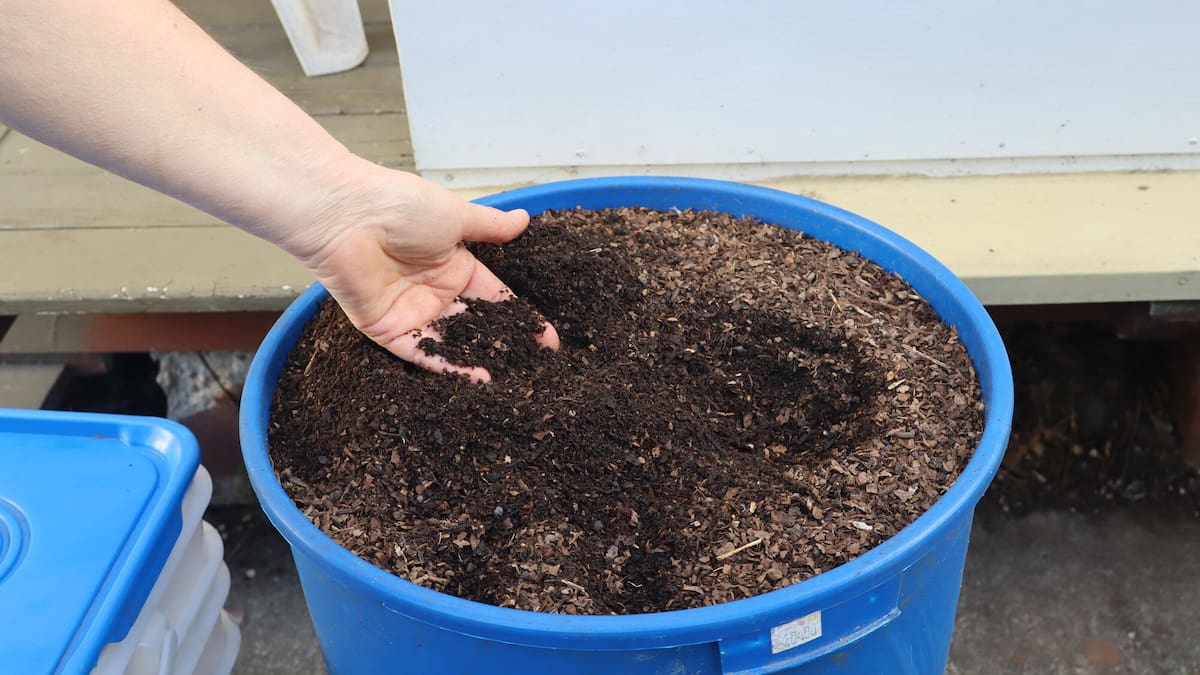
The end product is a fine, dark, crumbly substance rich in nutrients and organic matter.
A final sieving process removes larger, undecomposed fragments, ensuring a consistent and workable material for garden application.
Complementing her composting system is a well-maintained worm farm.
Composting worms process selected food scraps into nutrient-dense castings and liquid fertiliser, often referred to as worm tea. However, not all organic waste is suitable for worms.
Items such as meat, citrus, and onions are excluded and instead directed to the bokashi system.
This integrated approach allows Coleman to maximise the use of household waste while respecting the limitations of each method.
Interestingly, Coleman did not purchase her worm population.
Instead, she attracted local worms by burying bokashi-treated material within netting.
Over time, the site became populated with worms well-suited to her conditions, demonstrating that effective composting does not always require specialised inputs.
Ultimately, composting is much like baking a cake.
Success depends on achieving the right balance of ingredients, maintaining appropriate conditions, and allowing sufficient time for the process to unfold.
With careful attention and consistency, what begins as kitchen scraps and garden waste can be transformed into a valuable resource, benefiting both the garden and the environment.
Kem Ormond is a features writer for The Country. She’s also a keen gardener.
Comments are closed.