
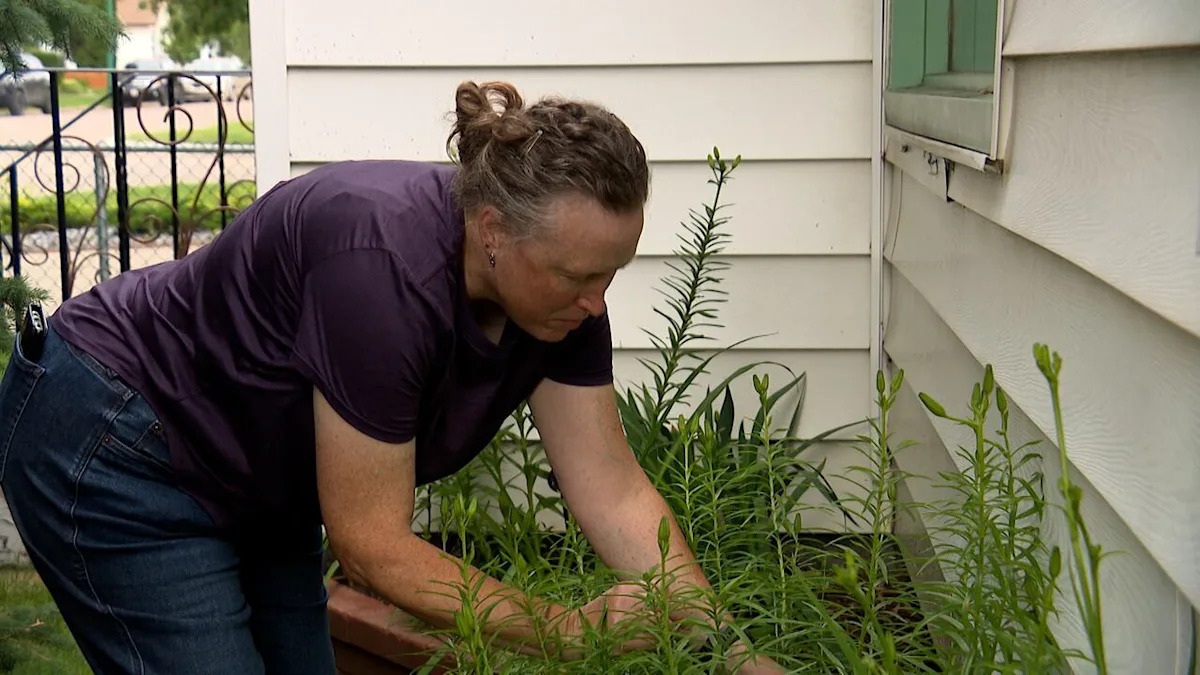
Jennifer Woodcock has to check her lily beds every single day if she wants her lily flowers to stay alive.
“I hate them,” she says of the small, bright red beetles chewing through gardens across the province.
“They’re annoying, you have to check for them every day, and if you let them eat your plants then you don’t get the reward of the flower.”
The bug is called the lily leaf beetle. It’s smaller than a fingernail, but it can strip an entire lily plant bare — flowers, stems and all.
An invasive species
The lily leaf beetle isn’t native to Saskatchewan or Canada.
Tyler Wist, an entomologist and a research scientist with Agriculture and Agri-Food Canada, says the beetle first showed up in Saskatoon around 2015, coming from Asia.
Since then, it’s spread through Saskatoon, Regina and other cities across Western Canada — anywhere people grow lilies.
“I’ve heard a lot of people who are just tearing out their lilies because of this issue,” he said.

Lily leaf beetles can take down an entire lily plant. An entomologist says the beetles are an invasive species that must be stopped. (Aishwarya Dudha/CBC)
Wist said the adult beetles are easy to spot, but the stages before that are sometimes hard to catch and kind of gross.
“You have to make sure that you don’t have eggs laid on the leaves. And so the eggs are bright red or orange, I guess just like the Lily beetles are,” he said.

(Submitted by University of Saskatchewan)
If you don’t crush the eggs, out come the larvae.
“They are rather destructive as well. So the larvae will eat all of these holes in the leaves. And that’s kind of how they start off there, eating these, these little spots in the leaves. And then they just move on to completely destroying it,” he said.
What can you do?
For now, there’s no easy chemical fix. Because of the beetle’s hard shell, most pesticides strong enough to kill it will also kill beneficial insects in the garden.
That leaves gardeners like Woodcock doing the work by hand — checking every leaf, top and bottom, for adult beetles, eggs and larvae, and crushing what they find.
“I pick them up and stomp on them,” she said. “That’s pretty satisfying.”
She’s killed around 50 lily beetles so far this year, and she’s expecting more as the flowers bloom.
Wist says he and other researchers are working on a more permanent solution: a tiny parasitoid wasp that targets the beetle’s larvae.

(Aishwarya Dudha/CBC)
The approach has already worked elsewhere, according to Wist. He said that in Ontario, introducing the wasp crashed local lily beetle populations. But Saskatchewan is still struggling to find enough parasitoid wasps to release into the area.
Wist said Agriculture Canada is working with the University of Saskatchewan to get those wasps all the way from Europe. He’s hoping to start a small colony in Saskatoon using larvae collected so far.
“So the jury is still out on that one,” he said. “But hopefully we’re going to get more wasps so we can keep moving on this.”

(Submitted by University of Saskatchewan)
Until then he says, in order to stay ahead of the bugs, check your lilies often — every day once the plants emerge in spring. Crush any bright orange eggs you find on the undersides of leaves before they hatch, and pick off adult beetles and larvae by hand. A spray of soapy water can also help with the larvae.
Comments are closed.