
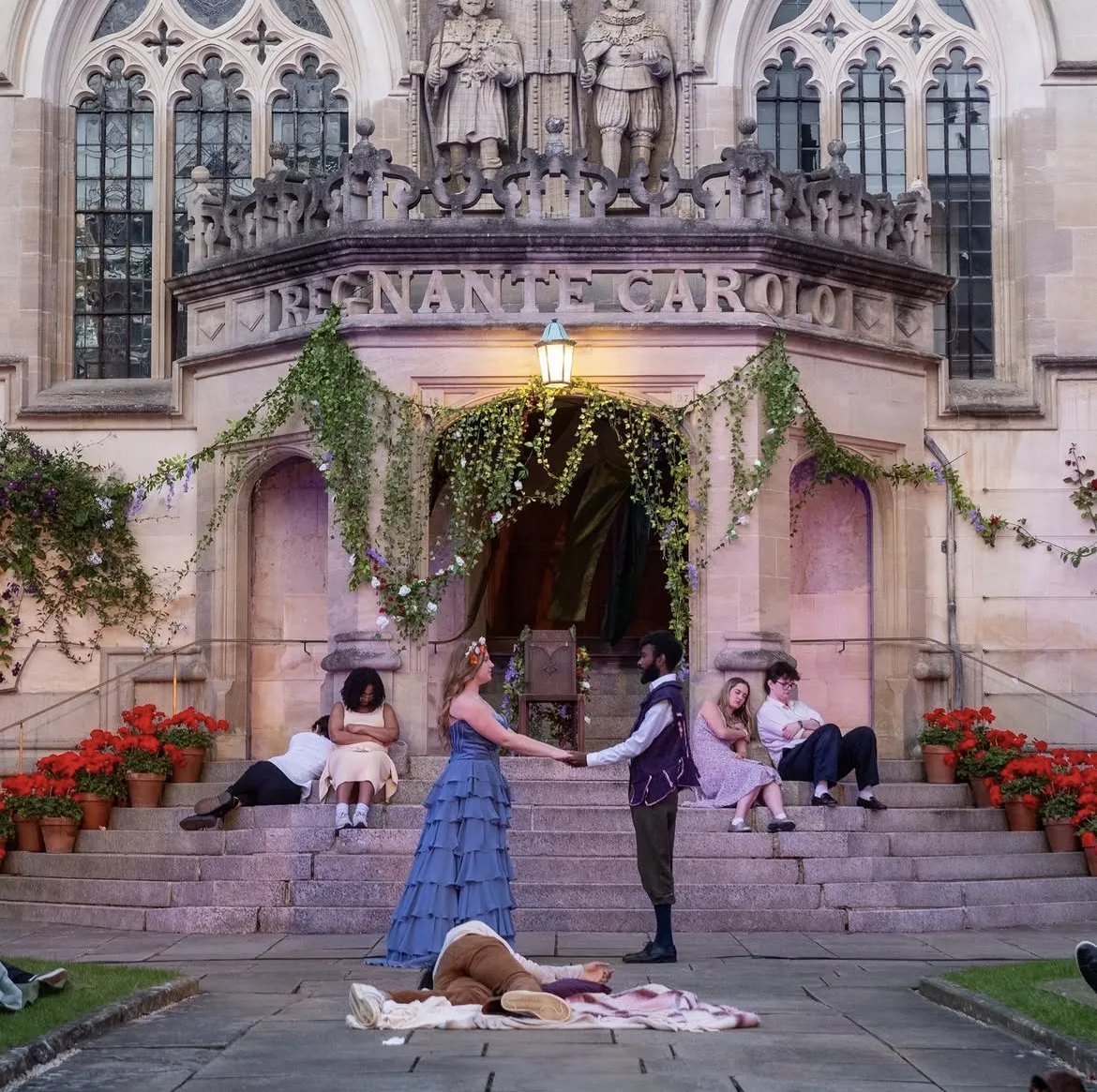
There are strict rules in Oriel College: no stepping on the grass of First Quad, that is, unless it’s the Trinity Term Garden Play. Though an annual privilege and tradition, then, to settle on the grass to spectate, this year the space was particularly transformed – bounteous ivy dangling from the arches, roses and wisteria interspersed, a foliaged throne on top of the steps. On a breezy mid-June evening, this was clearly the epitome of setting for A Midsummer Night’s Dream, Shakespeare’s iconic comedy and chosen performance for 2026. Under the direction of Maggie Kerson, all of the acting and production also came together to form nothing short of a Midsummer Night’s Treat.
A characteristic part of Oriel’s quad and ‘stage’ for the garden play is the grand, semi-circular steps. This year they were especially creatively used, like how some already sat there in character ‘chatting’ away while we audience funnelled in. Then, signalling the real start of the play, were Theseus (Noah Rudder) and Hippolyta (Sophia Valmalette-Wright), marching down the middle passage from behind, commanding silence. These two were a strong, regal pair, with an air of power throughout, joined briefly by Egeus (Owen Mulford), who was also surprisingly authoritative. I also appreciated the pointed body language, particularly of Hippolyta, who despite having to exit the first scene with no responding lines, walked out alone with her hand raised in defiance to Theseus instead of expected quiet obedience.
The four main lovers were also well cast and had great chemistry, though perhaps this was only solidified in their later scenes. What was successful throughout though was the attention to detail, such as in Hermia (Niara Milsap) and Lysander’s (Esther O’Neill) first scene alone when a red geranium flower is passed between them, the same kind that adorns the steps in pots. Helena’s (Alex Coupland) first entrance with her despairing tone was the strongest in grabbing me emotionally from the start – still exaggerated, but more and more understandable as the events unfold. Again, some of the most effective moments were when she was darting up and down the steps, back and forth in the arches, chasing Demetrius (Camille Branch) in a frenzy.
Under the direction of Maggie Kerson, all of the acting and production also came together to form nothing short of a Midsummer Night’s Treat.
Both Demetrius and Lysander particularly came into their own when enchanted by the flower within the play, “love-in-idleness”, to love at first sight of Helena. Lysander’s intensity was brilliant and compelling, almost a little scary; Demetrius brought out the comedy. The two wooers’ verbal bickering soon extended into physical combat: here, the choice of staging a duel with flimsy tree branches was a humorous highlight. It was only a happy accident and a cherry on top when one of these twig-swords ended up breaking.
But the true comedic standout was, of course, Bottom, for which I have to commend Amaka Ihejirika. It is not an easy role to pull off, requiring much melodrama and buffoonery, but Ihejirika shamelessly leaned into this. She managed to deliver the unanimously most memorable scene: the wooing of Titania after being transformed into a donkey, warbling Shakira’s ‘Whenever, Wherever’. Still singing while being carried out, this was a genius creative decision and the loudest laugh from the audience for sure.
Bottom’s sub-plot group of characters were all generally very funny, culminating in the play-within-a-play of the final scene, which was the only scene to take place after the interval. I found this slightly odd pacing, as the lovers’ tumult was all tied up before a break, but it really did emphasise the separateness of the fictional performance, since, by this point, the sun had gone down and the spotlights turned on. The on-stage audience of the Athenian characters was also imaginatively done, with the lovers scattered on the steps in their now harmonious pairs and Theseus and Hippolyta on their central, raised thrones.
These so-called “rude mechanicals” who then performed were the source of many impressive props throughout – most mechanically hand-made. These ranged from Bottom’s moving donkey-mask earlier, to now annotated scripts, costumes for their roles and real leaflets handed out to us for “The most lamentable comedy and most cruel death of Pyramus and Thisbe”. Snout (Harriet Wilson) as Wall, for example, was cleverly done by having a painted sheet hanging over her and the player-lovers made to converse through her legs, particularly generating laughs whenever she kept jumping to turn around. It was thoughtful that each character here still retained their clear personality below their role, like Starveling (EA Farrand) as Moonshine, and Snug (Abigail Fernandez-Arias) as Lion cheering each other on after their small parts. Flute (Ella-Mae Hylton) as Thisbe was also a perfect match for Bottom as Pyramus here, echoing his “die, die, die, die, die” with an equally hyperbolic “adieu, adieu, adieu”.
The four main lovers were also well cast and had great chemistry
These actors should also be commended for the doubling that they needed to perform, most also playing Titania’s train of fairies, or Mulford also playing the mechanical character Peter Quince. The most impressive doubling though came from the royal pair, with Rudder as Oberon and Valmalette-Wright as Titania, of which I think both played these fantastical counterparts better. Valmalette-Wright as Titania was particularly enchanting, in a beautiful, layered periwinkle ballgown which she practically floated onto stage with. The same partnered dance in both these fairy roles and mortal roles between Rudder and Valmalette-Wright emphasised such duality nicely, to beautiful live music composed by Felix Thomson.
Such a dance was also a magical way to end the performance, with other characters joining in, as was the famous epilogue with everyone gathered on the steps. Here, an honourable mention deserves to go out to Jess Phillips as Puck, who delivers the “If we shadows have offended” closing speech and other iconic lines like “Lord, what fools these mortals be!”. She nailed his elfish, mischievous energy, with a likewise whimsical costume and boots. His sinister edge as puppet-master of the lovers was also nicely layered in, just close enough to questioning but never shattering the comedy completely.
All of the above led to, overall, a marvellous performance and night indeed. What emerged the clearest to me by the end was just how much of a labour of love this show was, particularly of Kerson and the crew. This was visible from not only the details of the finished product and marketing, like the beautiful programme, posters and interviews, but also in the creation of a fun working environment for the cast. Many members told me that this was the most enjoyable theatrical experience they have had at Oxford from start to finish. A Midsummer Night’s Treat then, for cast, crew and audience alike.
Post Views: 240
Liked this article? Why not share it?
Related
Comments are closed.