
Where pleas’d and wond’ring as we thrid the maze,
We doubt what beauty first demands our praise
The river bounded by the impervious shade,
The smooth green meadow, or the enamel’d glade…”
A masonry home is believed to have been built on the plantation, too, during Garden’s ownership, though it’s possible he modified an existing structure on the property.

Artifacts found on the grounds of the former home of Dr. Alexander Garden in what is now the Otranto neighborhood Thursday, April 23, 2026, in Hanahan.
Grace Beahm Alford/Staff
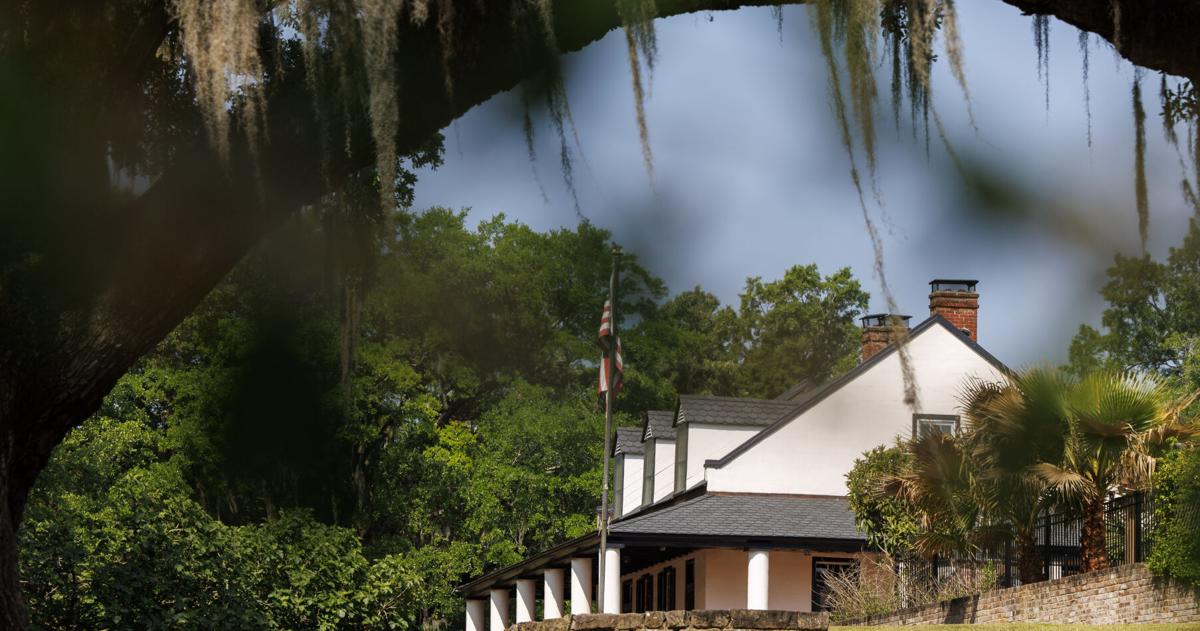
Whatever the details of its construction, the handsome home remains standing today in Hanahan within the Otranto neighborhood, a subdivision created in the 1960s within the old plantation grounds. Chris and Debbie Poelker bought the house in 2022 when they retired and moved south from Long Island, N.Y.
Like Garden, the Poelkers said they immediately fell in love with the home, which features a large lawn, a dock and a view of Goose Creek Reservoir. The couple regularly spots alligators, owls, bald eagles, snakes and more in their backyard.
“It’s probably why Garden liked it so much,” said Chris Poelker.
The kitchen house seen from the kitchen at the former home of Dr. Alexander Garden in what is now the Otranto neighborhood on Thursday, April 23, 2026, in Hanahan.
Grace Beahm Alford/Staff
Banishment
Though Garden had found his Eden, assorted factors thwarted his escape to paradise. Demand for his medical expertise, as well as Garden’s own poor health, often kept the physician confined to Charleston in the 1770s.
Garden’s life became complicated, too, by the growing calls for rebellion in the colonies. Foremostly interested in science, Garden tried to steer clear of the distraction of politics. He declined to swear formal support to the Patriot cause, however, and sometimes acted sympathetically to British rule, such as when he treated the British governor of South Carolina or congratulated Lord Cornwallis for his victory over American troops at the Battle of Camden in 1980.
His personal relationships suffered during this period, too. Two of his longtime correspondents regarding the natural sciences, Ellis and Linnaeus, died in 1776 and 1778, respectively. Garden’s son, Alex, was also difficult to reach at his school in England because of the war and the interruption of transatlantic commerce.
Comments are closed.