
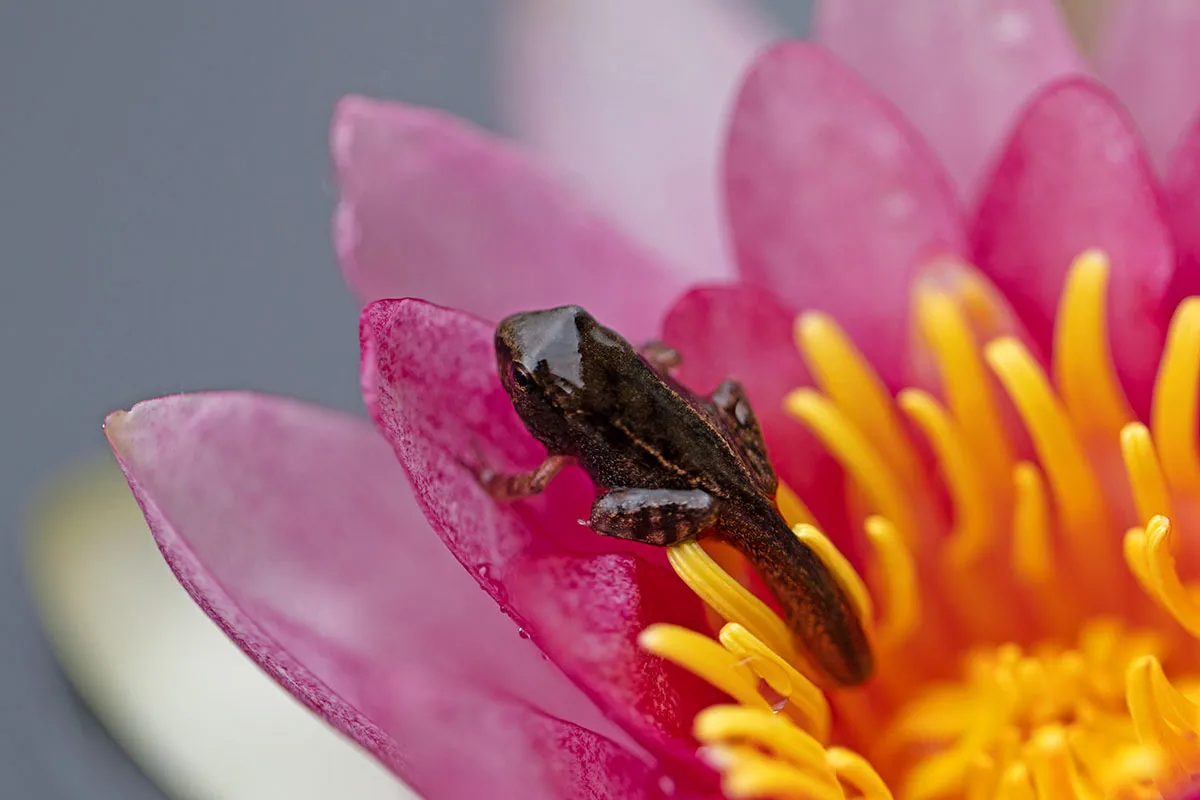
When I moved to Sado Island in Niigata Prefecture six years ago to photograph the crested ibis, there was one thing I made sure to bring with me from my home in Tokyo: the tubs where I kept medaka, or Japanese rice fish.
Over the years, those humble breeding containers have become home to a surprising variety of creatures, many of which have grown and eventually ventured out into the surrounding environment.
Four containers stand side by side, each measuring 80 centimeters long, 50 centimeters wide, and 20 centimeters deep. Water lilies, kakitsubata (Japanese iris), and other aquatic plants transplanted from a garden pond, together with microorganisms living in the mud, naturally purify the water.
The result is a self-sustaining ecosystem that requires no water changes—a miniature garden biotope in its own right.
Guests Take Over
In mid-April, I noticed something unusual in one of the containers. As I fed the medaka as usual, several tiny tadpoles surfaced alongside the fish. I had no memory of introducing them, so it seemed that frogs had laid eggs in the container without my noticing.
A similar incident had occurred two years earlier, when foam-like egg masses of the forest green tree frog appeared on the kakitsubata growing in one of the tubs. The forest green tree frog is a species endemic to Japan that spends most of its life in trees in forested areas. It is known for its unusual breeding behavior, laying foamy egg masses on branches overhanging ponds and other bodies of water in late spring.
 A foamy egg mass of a forest green tree frog laid along the bank of a nearby rice paddy. (©Fumie Oyama)
On Sado Island, however, these frogs can also be found near human dwellings and are known to lay eggs along the banks of rice paddies. Based on the timing, though, the tadpoles that appeared in April were probably not forest green tree frogs but montane brown frogs.
At first, the tadpoles were only about a centimeter long. They eagerly consumed the medaka’s food and, by June, had grown to more than three centimeters—larger than the fish. By then, hundreds of tadpoles were darting frantically through the water, while the medaka, the original residents of the tubs, were forced to feed cautiously among their unexpected guests. The guests had effectively taken over the house.
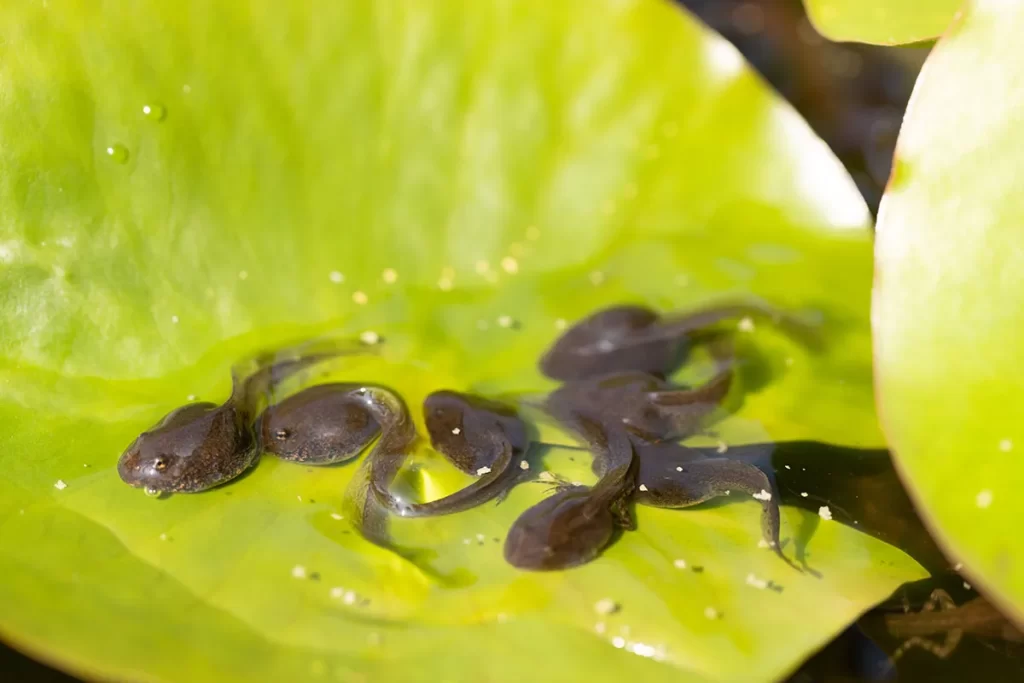 Tadpoles that thrived on food intended for medaka. (©Fumie Oyama)
As I fed the fish everyday, I came to look forward to watching the tadpoles grow. To avoid polluting the water, I initially gave only enough food for the medaka. Before long, however, I found myself adding a little extra for the tadpoles as well.
From Water to Land
By late June, tiny legs began to appear. One by one, the tadpoles transformed into frogs, and increasing numbers of them could be seen hopping across the broad leaves of the water lilies.
Watch the tadpoles feeding on the medaka’s food.
As tadpoles, frogs live underwater, breathing through gills and feeding on algae and organic debris. Once their legs develop and their lungs become functional, they made the transition to life on land, feeding exclusively on live insects.
 A Japanese tree frog takes a break on a watering hose beside the medaka tubs. (©Fumie Oyama)
When the frogs were tadpoles, they would eagerly gather at the surface whenever I approached, as if asking to be fed. But once they became frogs, any sign of gratitude seemed to vanish—they leapt away in every direction.

A Garden Full of Life
On the leaves of the herbs growing beside the medaka tubs, I found newly hatched praying mantis nymphs. Nearby, marsh bluetails emerged from their aquatic stage, shedding their former selves and taking flight as adult damselflies.
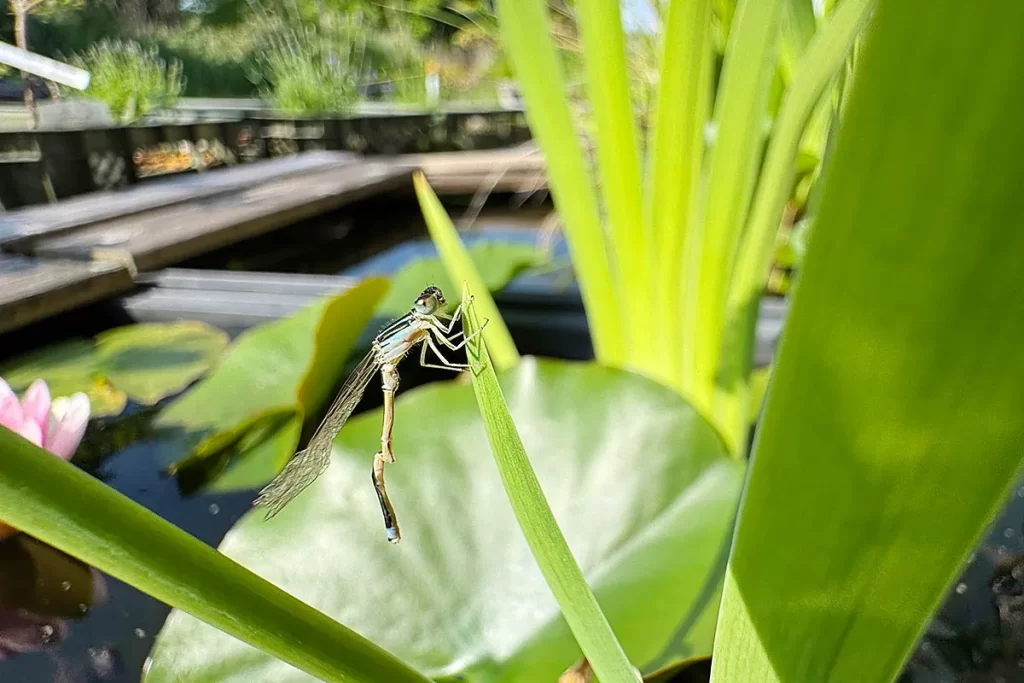 A damselfly emerging from its nymph stage. (©Fumie Oyama)
Simply stepping outside my home allows me to witness the birth, growth, and transformation of insects and small animals that have fascinated me since childhood. It is one of the many pleasures of living on Sado Island.
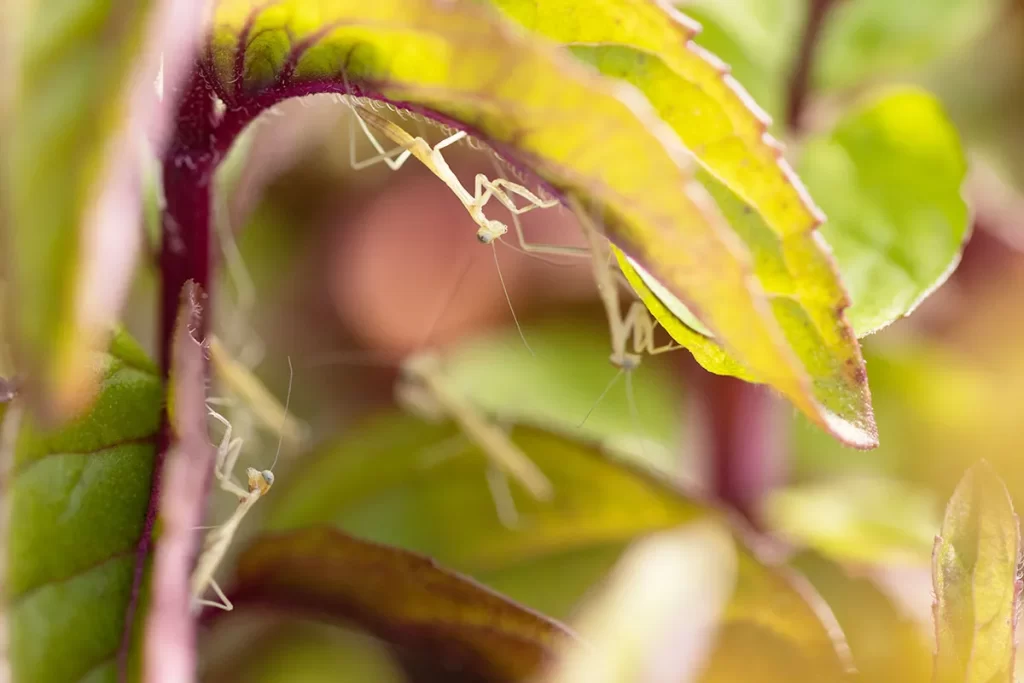 Newly hatched praying mantis nymphs. (©Fumie Oyama)
Now, when I look into the tubs—free at last of their once-overbearing tadpole population and returned to their original residents—I feel a slight sense of loneliness. “I hope they come back next year and continue the cycle of life,” I find myself saying to the medaka, who have finally regained their peace.
RELATED:
This is the 35th in the series Sado Wildlife in Focus by photojournalist Fumie Oyama.
Oyama is a two-time winner of the Japan Newspaper Publishers & Editors Association Award as a photographer for The Sankei Shimbun. After covering the reintroduction of the crested ibis to the wild for 11 years, Oyama left the company in 2020 to move to Sado Island.
There, he continues to photograph the ibis and other wildlife while engaging in farming. He currently promotes the charms of Sado Island as a photojournalist. Follow Oyama on Instagram.
Continue Reading
Comments are closed.