
CHARLESTON — The city and Dominion Energy have committed to providing better information about tree removal and pruning after crews started taking chainsaws to palmetto trees across the peninsula this May, prompting more than 1,400 people to sign a petition demanding transparency and accountability.
Though it’s painful to find unrecognizable stumps in places where trees once provided beauty and shade, vegetation that grows too close to power lines poses hazards that must be addressed, the city’s urban forester, David Grant, said in a social media video that announced the initiative on June 22.
The city and utility company said they will provide better information about why trees that have grown close to power lines must be pruned or removed — and which ones are on the chopping block.
“We’re going to show up here, answer your questions, and tell you how we’re going to do better — starting now,” Grant said in the video.
The city planted thousands of trees after Hurricane Hugo tore through the tree canopy in 1989. Over the decades, some of those trees have grown too close to power lines. That must be remedied to keep the power grid safe and reliable, Grant said.
Palmetto trees, in particular, are difficult because they cannot be shortened or pruned in a specific direction, which means those that have grown into a utility corridor must be removed.

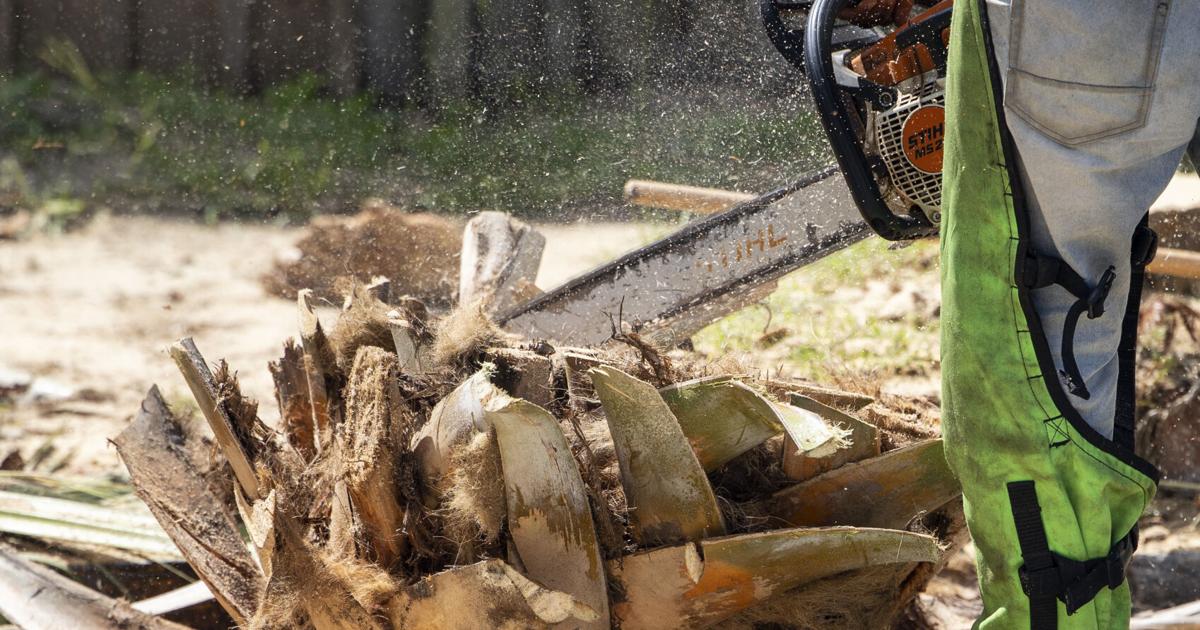
A Dominion crew member cuts down a palmetto tree along Columbus Street, Tuesday, May 5, 2026, in Charleston.
Gavin McIntyre/Staff
Dominion Energy crews are almost done removing about 200 palmetto trees that were planted following Hurricane Hugo, city spokesperson Bay Sheehan said.
The company completes routine maintenance on a five-year schedule to ensure no hanging branches or risky trees remain. Dominion covered the cost of cutting the trunks flush to the ground.
City crews are responsible for grinding the stumps down, which costs about $80,000 total, Sheehan said.
“Palmetto trees are a symbol of this city, and I understand why their removal is so difficult to see,” Grant said. “I promise you I am going to do right by them, and by you.”
Answers to frequently asked questions and an interactive map of where work has occurred and is scheduled are already live on the “Look up, Charleston” initiative website. Over the next six weeks, the city and utility company plan to provide information about what is happening and why.
Dominion Energy meets with the city annually to review upcoming projects, including where and when trees might need to be cut or removed. Once the city learns about that information, it will be published on the website and property owners will be notified, Sheehan said.
The information campaign and the website resource are an encouraging step that shows the city is responding to community concerns, according to Lisa Jones, the advocacy director at the Historic Charleston Foundation. The group created the petition since its mission is to preserve the character of Charleston’s historic neighborhoods.
“The city is responding to public outcry, and we’re happy to see that,” Jones said. “Not all of the work is done, but it’s a good start.”
The city’s ReLeaf program will use a combination of funds the city has budgeted for trees and donations to replant those cut down, Sheehan said. The goal is to be more strategic about what trees are planted where.
Species that don’t reach more than 15 feet tall can be planted near power lines, while palmetto trees should be placed where they can grow tall, according to the initiative.
“Charleston’s trees define our streets and neighborhoods, and we’re committed to expanding that canopy through the ReLeaf program,” Mayor Cogswell said in a statement. “More trees, in the right places, for the people who call this city home.”
Comments are closed.