
When I sat down with the producer and director of Green Templeton College’s (GTC’s) first garden play last week, my final wishes to them were that everything should go “exactly as they like it”. Thankfully, I can now report back that this unambiguously was the case – the director, Pablo Wickham, practically jumped into my arms at the end, “all three shows outside!” he screamed with joy (rain was a continuous fear). Not only a personal success for them, everything was, for the most part, rather as I liked it as well. Overall, Shakespeare’s As You Like It was an evening well-spent in the beautiful GTC gardens, with beautiful weather, costumes, music and acting.
Before I get into the play itself, I just want to point out the level of attention to detail that made this not only an enjoyable piece of theatre, but an experience in general. As I arrived at GTC (which feels rather suburban on the Oxford scale, coming from High Street), I was greeted with complimentary drinks in the bar, the first garden play I have known to do this. More a general celebration of it being their inaugural play, it was not even an exclusive press-pass offer: everyone was welcome and it turned out to be a great opportunity to socialise with other audience members and some of the crew before taking our seats. I managed to catch Sophia Yvonne Hall, one of the assistant directors and photographers, as well as producer Kapil Narain. He then showed me personally to my front-row seat – ah, some press-pass privilege after all.
everything was, for the most part, rather as I liked it as well.
As the show began, the first few moments were hugely atmospheric. A part of this may have been the almost gifted, golden sunlight and gentle breeze rustling the flowers and bushes. But equally, the decision to begin the production with a montage of all the characters, floating across the stage in different actions to define their groups, was an integral part of this compelling world-building. A little picnic tea-party appeared for the ladies; noble swords emerged for the men. This placed us firmly in the presence of a metaphorical aristocratic court, and simultaneously in a deliberate, literally natural environment. As a wheelbarrow rolled across the grounds and characters tended to flowers, set to mellifluous live music composed by Lucinda Bell, it felt magical indeed.
However, this initial, quiet fluidity actually made it slightly jarring once the Shakespearean dialogue started (which I say as a Shakespeare student, so I don’t believe it was the language but rather the delivery). Rasadhi Attale as Duchess Senora delivered her lines with such volume and intensity, looking so directly into audience members’ eyes, that it actually felt a bit too scripted or fourth-wall-breaking too early on. Fortunately, I feel she settled more into her role as the show went on and by the end, there was a better balance of leaning into her powerful character while staying believable.
The fact that this scene opens the play should also alert those with a keen knowledge of Shakespeare (anyone else?) that we have begun with Act 2, Scene 1, and a bit of rearranging has gone on. This is only natural in garden plays for length and feasibility, and I actually think overall that it was done well. They did keep the main plot following Rosalind, an exiled Duke’s daughter, who falls in love with Orlando while dressed as a man in the Forest of Arden. But, I was left unsure about the decision to open with one of the Duchesses – I was promised that the gender-swap from the original Dukes to Duchesses would “complicate the female relationships” in the play, but I am not convinced that it added anything necessarily revolutionary in terms of this. Women can wield power, yes, but this was still best demonstrated by what is already in Shakespeare – Rosalind’s agency (whose first scene I think they deferred for a bit too long).
Such props and especially costumes in general were one of my favourite aspects
That being said, the other Duke-turned-Duchess, Tara Seghal as Duchess Freda, played into her power so much that it became a great source of exaggerated comedy – this comedic aspect is where their value shone through to me, as opposed to making a statement about gender. In a laugh-out-loud moment after the interval, she refused to step on stage without a ‘red carpet’ rolled out underneath her, which led to her servants having to move two tiny, red mats intermittently over her head to keep paving a runway. Her haughty energy with her long staff and extravagant hat here was extremely well-played.
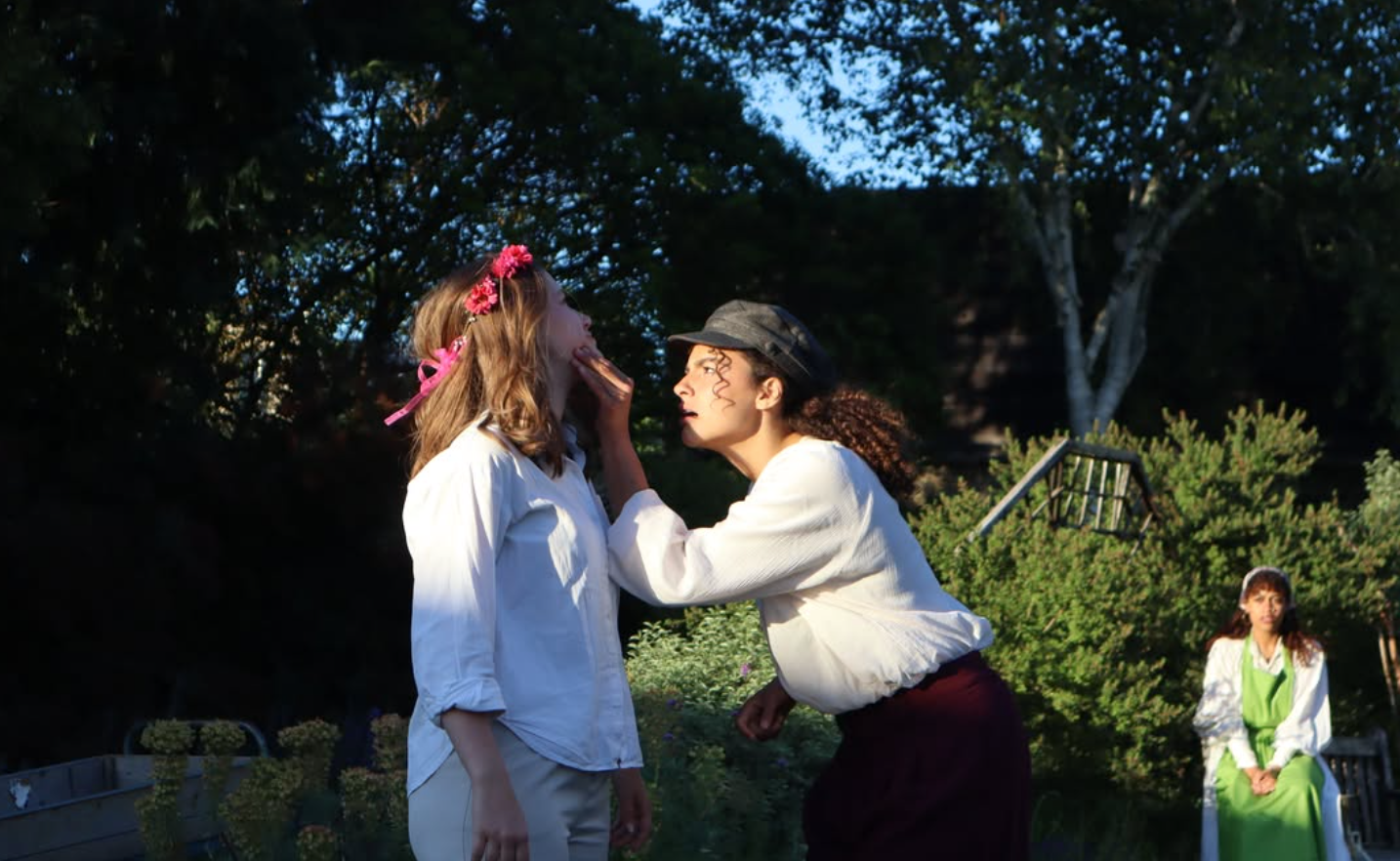
Such props and especially costumes in general were one of my favourite aspects, in particular for the two female leads, Rosalind played by Djan Mbanu and her cousin, Celia by Mayah Savjani. Both in white blouses and skirts, Mbanu was initially styled with matching pink, hyperfeminine accessories of a rosy bow, sash and fan, which felt deliberate and proleptic, considering she spends the second half of the play in male attire. Savjani was as much a contrast as complement to her “coz”, with accents of green and red that became even more dominant with an apron for her later, shepherdess disguise. These two had brilliant chemistry throughout: Mbanu was a pleasure to watch from the start and Savjani came into her own at the end when she got a romance too.
This romance was with Oliver Crosher as Oliver, whose arc from evil brother in the first half to lovestruck boy in the second is always a difficult switch to pull off convincingly. Similarly to Seghal, his strategy was to play his character as over-the-top as possible, singing “Aliena and Oliver sitting in a tree, K-I-S-S-I-N-G”, while swooning on a bench. But by far the stand-out brother was Orlando played by Martha Thompson. She excelled in both realism and comedy, fighting believably in both her wrestling scenes but also muttering a comedic, improvised “Oh shit” when she was momentarily on the losing side. Her chemistry with Mbanu as the plot’s main couple was also commendable – a very well-cast pair indeed, and a huge part of the play’s overall success.
Other notable comedic parts were Elana Roberts as Charles the wrestler and Paloma Diaz as Touchstone the fool – both commanded physical comedy whether it was through hyping themselves up before the fight with the former, or a clownish heel-kick every now and then with the latter. But perhaps the loudest (quite literally) comedic highlight was Evangeline LaFond as Silvius, a young shepherd desperately in love with the shepherdess Phoebe (Meg Bruton). When LaFond howled out “Oh Phoebe!” and skidded on her knees towards her love-object, the audience similarly erupted in laughter. Bruton matched this level of energy in terms of her opposition – they became my unexpected, favourite underdog duo on the stage.
by far the stand-out brother was Orlando played by Martha Thompson
On the flipside, sadly, Phoebe Thomas as Jaques was not my favourite embodiment of the role for me – perhaps because I went in with larger expectations knowing his character delivers the iconic “All the world’s a stage speech”. She was able to capture his melancholy, whimsical energy overall, and I understood an attempt at making the “stage” speech memorable, with miming for each stage of life from the “infant” to the “slipper’d pantaloon”. However, it was perhaps the moment where the scene actually felt the most static in the whole production, with other characters standing rigidly around her. Given the creativity throughout the rest of the show with the entrances and exits, I would have loved to see something similar to the starting montage during lines like “And all the men and women merely players; / They have their exits and their entrances…”.
However, overall, I would judge the GTC’s first garden play as a thoroughly creative and successful use of the space, consolidated by the ending when they asked us to turn ninety degrees to the left for the final scene of the wedding to take place in an arch at the side of the garden. As Rosalind, back in her white dress, united with Orlando, skipped through the middle of our chairs, the comic denouement was complete and the epitome of garden play was reached. So many details stuck with me throughout – the eating of a real nectarine, the strolling of characters ‘backstage’ but still visible through the bushes and in character – which definitely speaks to the team’s attention to detail that is always refreshing in a student production. As closing night brought in all the flowers and gifts for three successful productions, I left similarly beaming for the whole team that both “Fortune” and “Nature” had been on their side. If As You Like It was not enough to set up a tradition of annual garden plays in GTC, I don’t know what is.
Post Views: 80
Liked this article? Why not share it?
Related
Comments are closed.