
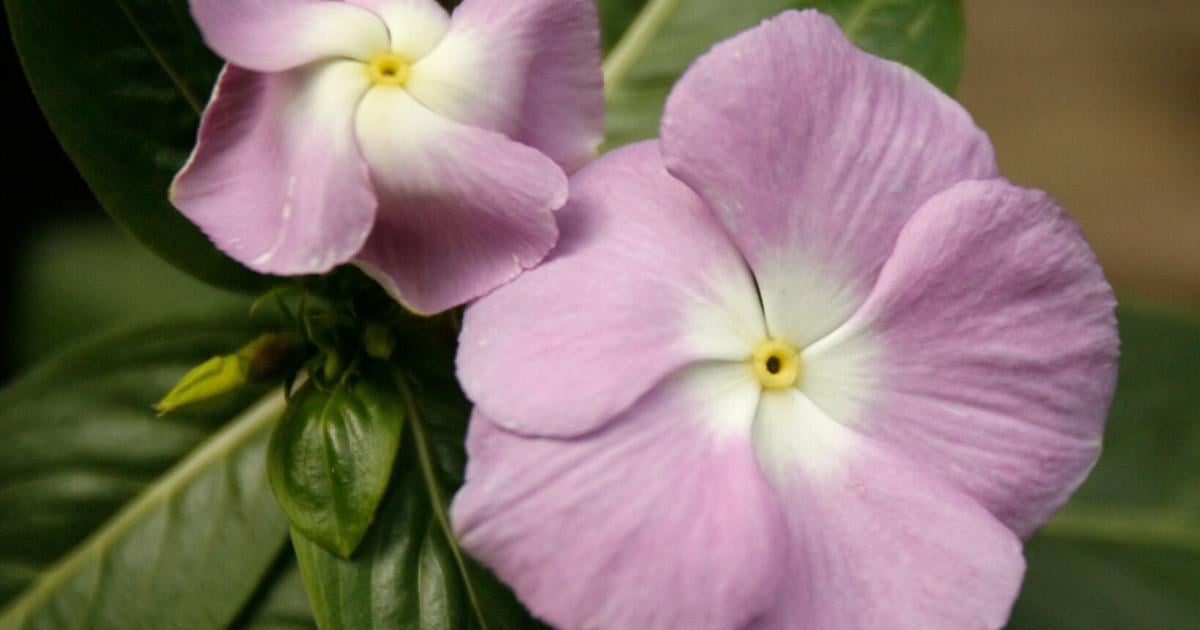
I’m having an issue with vinca in my landscaping this year, and I’m wondering if you can give me a possible reason why my plants are dying. I planted five flats of vinca in late April, and within the first week, they died off. I recently replaced all of them with a new batch of five flats and made sure that my sprinkler heads were adjusted properly to get water to all of the plants. They did well the first week, but they also withered and died. Watering is done one time daily in the morning. — Steven
What is killing your vinca (or periwinkle, Catharanthus roseus) is the disease aerial blight. Caused by Phytophthora, it is a water mold that lives in the soil. It attacks the stems and leaves, causing sections to wither and often leading to the death of the plants.
Abundant moisture is a leading factor that causes aerial blight, and proper watering is the best defense. We must water vincas as little as possible.
Newly planted vincas typically need some irrigation as they establish. But before watering, you should always check the condition of the plants and soil moisture. If the plants look fine and you can feel dampness in the soil, you don’t need to water. When the soil feels dry or the plants show slight wilting, water thoroughly. Then, don’t water again until needed. Established vincas are drought-tolerant and rarely need irrigation.
An irrigation system coming on every day is the main factor in your issues with this disease.
Given two plantings of vincas have failed in that bed, it likely means the level of Phytophthora in the bed is high. You can try planting vinca again. Choose Phytophthora-resistant varieties like the Cora or Nirvana series. Adjust your irrigation, and see how they do.
But if they fail, I would not plant vincas again in that bed this season. Instead, plant another summer bedding plant that does not have this problem. There are no exact substitutes for vinca, but you might consider dwarf lantana, scaevola, blue daze, ornamental sweet potato or purslane, to name a few. None of these need to be watered every day.
I’m having a problem with two hanging basket plants. I’m not sure what they are. The label they came with said “Rio,” and they make large, dark red flowers. There is a white powdery and fuzzy growth on the stems, and the leaves are starting to turn yellow. What is this, and do I need to treat it? Thanks. — Bobby
Rio is a variety of dipladenia. They produce showy flowers on semi-vining, trailing plants that are often sold in hanging baskets. The large, attractive funnel-shaped flowers may be dark red, pink or white.
Based on your description of the situation, the problem is a sucking insect called mealybugs. Dipladenia, and the closely related mandevilla, are prone to mealybugs.
To control them, the least toxic option is to spray the plants two or three times with a light horticultural oil following label directions. Year-Round Spray Oil or All Seasons Spray Oil are two brands to look for. Thorough coverage is important.
You may also use a contact insecticide labeled to control insects on ornamentals, like permethrin or bifenthrin.
How critical are the pH and chemicals of tap water that most of us use to irrigate our vegetable gardens? — Donald
There is no need for concern. Feel free to use tap water to irrigate your vegetables. The pH of tap water is often alkaline, but it will not significantly affect the pH of the soil.
GARDEN TIPS:
WHEN TO PULL PETUNIAS: If you planted petunias this spring, don’t be surprised if they begin to look tired in midsummer. Petunias generally do not tolerate intense heat. When they languish, pull them up and replace them with more heat-tolerant bedding plants such as angelonia, blue daze, celosia, coleus, gaillardia, lantana, ornamental sweet potato, Profusion zinnia, marigold, melampodium, narrow-leaf zinnia, pentas, periwinkle, purslane, salvia, scaevola or torenia.
WHAT’S IN SEASON: Spring and early summer vegetables planted back last March, like snap beans, cucumbers, squash and tomatoes, often finish up in late June or July. When you remove them, you may plant heat-tolerant vegetables like southern peas, peanuts or okra. Or you could plant a green manure crop in the bed to improve the soil over the summer. Peanuts and southern peas make excellent green manure crops. Just as the young plants come into flower, chop them up and till them under. Then apply a few inches of mulch or a layer of cardboard to control weeds. The green manure crop will decompose in the soil over the summer, and the bed will be ready to plant your fall crops.
DON’T BE A SUCKER: Remove suckers that appear at the base of crape myrtles as soon as they appear by cutting them off at their point of origin at the trunk or even below ground. Do not leave a stub, or they are more likely to resprout. You could use a sprout inhibitor, available at local nurseries or online, to help reduce how often you must do this.
GARDEN QUOTE:
“I believe in the magic of preparation. You can make just about any foods taste wonderful by adding herbs and spices.” — Jorge Cruise, fitness expert and author
Comments are closed.