
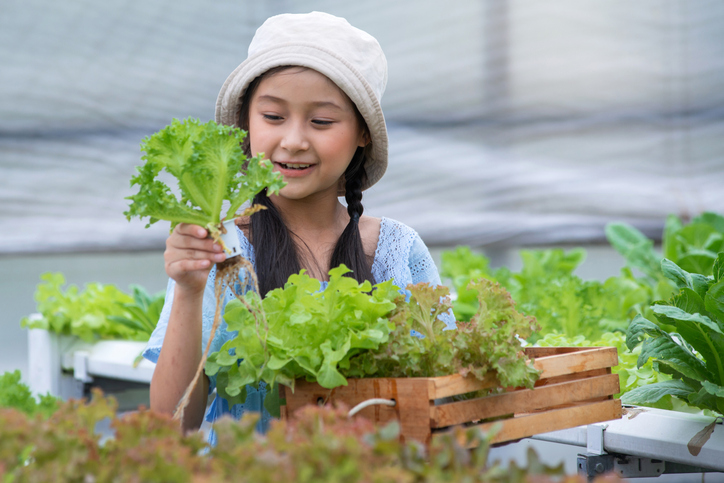
For my students, art has become a gateway to teaching students about nutrition, community, confidence and self-expression in meaningful, hands-on ways.
As an art teacher at The High School for Law, Advocacy, and Community Justice in New York City, I’m always looking for new ways to spark curiosity and creativity in my students. I didn’t expect that one of the most powerful tools for doing that would be a hydroponic farm.
Art and science, rooted in the classroom
The first time I walked past the farm built and operated by Teens for Food Justice, I was immediately drawn in and quickly began asking my students how they could get involved.
What began as curiosity quickly grew into a collaboration that now connects art, science and food education in a way that feels both natural and transformative. With support from DonorsChoose, we’ve been able to extend that experience beyond the farm into the classroom, the kitchen and even students’ homes.
Artists and scientists have more in common than we often think. Both rely on observation, curiosity and creative problem-solving. In the farm, my students get to experience that connection firsthand. They don’t just learn about food; they grow it, cook it, study it and use it as inspiration for their artwork. In the process, I’ve watched them become more confident, more engaged and more connected to their learning.
Where creativity meets wellness
In my classroom, art has always been a way for students to express themselves and explore the world around them. In the farm, that experience becomes immersive. Students sketch plant life, create botanical prints and explore themes of food justice and community through their work. They engage all their senses, taking in the colors, textures and even the smells of the space, which create a calming, grounding environment.
One of my favorite projects started with something simple: I asked students to write “Grow Notes” on the plants, using positive language to encourage growth. That exercise quickly evolved into something more meaningful. Students turned those messages into personal mantras, reflecting on how the way we speak to ourselves and to others can shape our mindset. Eventually, those ideas became a collaboratively designed coloring book.
Part of the DonorsChoose experience is the thank-you card component. In my art room, we explore the theme of gratitude in small-scale masterpieces in the thank-you cards. Students write sentiments of appreciation to the donors and their families. It’s an important, effective exchange and is a beautiful full-circle moment.
Learning by doing across disciplines
What makes this experience so effective is how seamlessly it brings together different areas of learning and how critical access to the right tools has been in making it possible.
On the farm, my students take on the role of growers. They learn about hydroponic systems, participate in seeding and harvesting, and help maintain the space. For many, it’s their first time seeing how food is grown.
Seeing the positive impact the farm had on my students, I decided to continue through the food cycle, from growing food to preparing it. To set up our classroom kitchen, I reached out to the DonorsChoose community. I posted several projects sharing the exciting progress from our hydroponic systems and my desire for students to transform what they’ve grown into meals. DonorsChoose brought our classroom kitchen to life.
Now, my students have access to equipment like air fryers, dehydrators and other tools that allow them to experiment with cooking techniques they might not otherwise encounter. They learn knife skills, sanitation practices and recipe development, all while working together to create something they can share. I’ve noticed that students are much more willing to try new foods when they’ve had a hand in growing and preparing them.
Back in the art room, they reflect on these experiences through creative expression. Whether they’re drawing, printmaking, or designing, they begin to see the parallels between art and science: both require experimentation, observation and a willingness to take risks.
Building confidence through real-world skills
One of the most rewarding parts of this work is seeing how it builds my students’ confidence. They are not just completing assignments; they are also producing something real.
They plant seeds, nurture them, harvest the produce and then use it to create meals or artwork.
That process gives them a tangible sense of accomplishment. I’ve seen students take ownership of the farm, proudly pointing out produce they’ve grown. Many bring food home to their families, excited to share what they’ve made.
Food as a pathway to community and connection
Food has a unique ability to bring people together, and I see that every day in my classroom. When students cook and eat together, something shifts. Conversations open up. Students who might not typically interact find common ground.
These shared experiences create a stronger sense of community. Preparing a meal together isn’t just about the food; it’s about collaboration, communication and connection. It gives students a chance to build relationships in a more relaxed, authentic way.
Connecting learning to advocacy and justice
This work sparks conversations about advocacy and community justice. Students learn about food inequality, food deserts and the systemic challenges that affect access to healthy food.
They explore how policy shapes food systems and how individuals can advocate for change. They’ve written letters to stakeholders, studied how laws are made and even presented at City Hall. These experiences help them understand that their voices matter and that they can help shape their communities.
They also see the direct effect of their work. The produce they grow supports both our school and local families through food distribution efforts, making the learning meaningful and real.
Growing skills that last a lifetime
My goal is for students to leave the classroom with skills they can carry forward, both practical and personal. They learn how to grow food, prepare simple meals, and make healthier choices. But just as important, they build confidence, creativity and a sense of agency.
When students experience the full cycle from seed to table to self-expression, they gain more than knowledge. They begin to see their own potential to grow, contribute, and make an impact. And with the support of partners like DonorsChoose, helping to make these experiences possible, that growth extends far beyond the classroom.
Opinions expressed by SmartBrief contributors are their own.
Subscribe to SmartBrief’s FREE email newsletter to see the latest hot topics on special education. It’s among SmartBrief’s more than 250 industry-focused newsletters.
Comments are closed.