

Among the Bay Area’s many fascinating day trips, a botanical garden is a special experience, given our Mediterranean climate. Particularly worth a visit is the 61-acre Sonoma Botanical Garden in Glen Ellen, which showcases the connection between the flora of California and East Asia, two regions divided and united by the Pacific Ocean.
Now through Sept. 7, you’ll find in this lush setting eight tall sculptures of alebrijes, or chimera-like beings in the exhibition, “Spirit Guides: Fantastical Creatures from the Workshop of Jacobo and María Ángeles.”
Oaxacan papier-mâché artist Pedro Linares first created and named such magical hybrid animals “alebrijes” in the 1930s. The Ángeleses’ fiberglass sculptures were born from this folk tradition, as were the towering artworks in the popular touring outdoor exhibition “Fantastic Animals From Mexico: Alebrijes and Nahuales,” which came to San Jose in late summer last year as “Alebrijes en San Jose.”
The couple also drew inspiration from ancient Zapotec beliefs about “tonas,” or protector animals assigned to individuals at birth, and “nahuales,” spirit animals determined by one’s birth year.
 A walk through the Sonoma Botanical Garden offers expansive views of Sonoma Valley. (Photo courtesy of Sonoma Botanical Garden)
A lovely, peaceful setting
Our drive from the Bay Area to Glen Ellen is soothing as our car barrels through wine Country, evoking both the English countryside and the sweeping, vine-covered vistas of France.
Once inside Sonoma Botanical Garden, our walk leads to expansive views of Sonoma Valley and peaceful moments by the garden’s ponds and waterfalls. During our walk, a vision of France’s Giverny also floats into my mind as I take in the charm of the water lilies and lily pads in the pond, the gurgle of water below the wooden bridges, and the hanging foliage.
Protecting endangered plants
With its 20,000 plants representing almost 1,500 different species, the botanical garden offers a study of rare flora. The garden maintains detailed records for individual plants, contributes climate-change monitoring data, shares plant material with researchers and propagates threatened species as a safeguard against extinction.
Endangered plants grown from wild-collected seed are cultivated at the garden, their offspring sent to other botanical gardens. This safety measure protects the species against natural disasters in an area that has lost thousands of acres of greenery to fire.
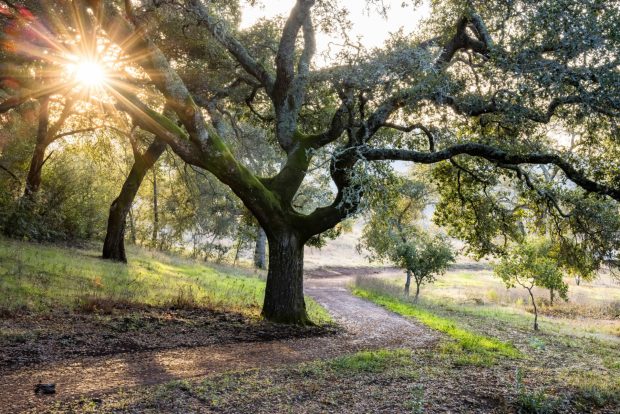 The eight alebrijes in the “Spirit Guides” exhibition are found along the California Oaks Trail at Sonoma Botanical Garden. (Photo by Saxon Holt)
Vines, trees and roses
Along with its 13-acre legacy vineyard growing its iconic red wine grape — cabernet sauvignon — the garden holds over 50 species of Asian magnolias, ranging from large trees to medium shrubs. Many species of maple trees in the garden are not available commercially. From April to July, roses bloom in a sequential parade, from large climbers to delicate shrubs.
Inside the premises is also a formal rose garden. The Jiang Entian Chinese Heritage Rose Garden, named after China’s most notable rosarian, features some hundred complex rose hybrids celebrating “the role Chinese species have played in transforming rose hybridization,” according to the garden.
 A rainbow appears behind Jacobo and María Ángeles’ 2024 sculpture “Crane,” made of fiberglass and acrylic paint, at Sonoma Botanical Garden. (Artwork © Jacobo and María Ángeles, courtesy of Sonoma Botanical Garden)
Following the ‘Spirit Guides’
We find the “Spirit Guides” along the California Oaks Trail, where Jacobo and María Ángeles’ monumental sculptures greet visitors. The couple from San Martín Tilcajete, Oaxaca, are known for their hand-carved and distinctly painted alebrijes.
The fiberglass artworks built by the Ángeleses are enormous, measuring nearly 8 feet tall, 9 feet wide and 4 feet deep, and visually stunning against the hills and dales of Sonoma Valley. They are painted with acrylic colors using intricate geometric patterns inspired by Zapotec and other Indigenous designs.
The Zapotec, like most ancient cultures, believe in other worlds that influence and inform our current lives on earth. A spirit guide is a nonphysical entity — such as an angel, ancestor, ascended master or animal spirit — offering protection, wisdom and intuitive direction throughout a person’s life.
 Jacobo and María Ángeles’ “Jaguar-Eagle” (fiberglass and acrylic paint, 2024) peers out from a shady area at Sonoma Botanical Garden. (Photo by Daniel Perales)
An Indigenous Mesoamerican ethnic group primarily located in the Mexican state of Oaxaca, the Zapotec people are also known as “Cloud People” who built a powerful pre-Columbian society centered at Monte Albán. In Zapotec tradition, animal spirits like tonas and nahuales are linked to the astrological birth chart, acting as a direct reflection of each human’s character, strength and personal traits.
Building on that tradition, the 20th-century concept of alebrijes combines the strengths of two or more animals, as demonstrated by the names of the works in “Spirit Guides”: “Coyote-Fish,” “Jaguar-Eagle,” “Camel-Eagle,” “Armadillo-Insect,” “Monkey-Iguana,” “Rabbit-Deer.”
The mostly flat trail through Sonoma Botanical Garden takes us to each of these spirit guides, allowing us time for reflection, appreciation and, of course, photo opportunities. Along the way are several magnificent lookout points as well as sections full of blooming flowers, ferns and foliage native to California and Asia, with the names of unique flora labeled for our benefit.
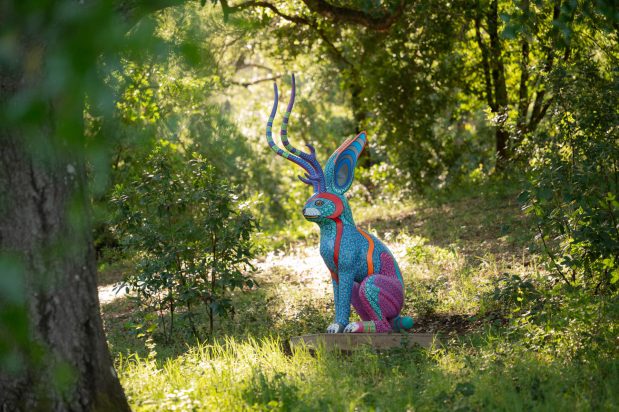 Jacobo and María Ángeles’ “Rabbit-Deer” (fiberglass and acrylic paint, 2024) sits in a lushly forested area in Sonoma Botanical Garden. (Artwork © Jacobo and María Ángeles, photo by Daniel Perales)
Dining among history
After visiting the garden, we stop for lunch at a historic spot from California’s Gold Rush. At the Mill at Glen Ellen restaurant stands a 2.5-story structure, originally built as a sawmill by General Mariano Vallejo in 1839. Seventeen years later, Joseph Chauvet transformed the site into a flour and grist mill.
When we’re seated at the terraced dining overlook, we almost forget to appreciate the scrumptious meal of a delicate house salad and colorful wood-fired pizza topped off by a chocolate mousse with raspberry and fresh fruit. The idyllic setting casts a spell on us, reminding us of all the beauty possible in the natural world as well as the spiritual traditions contained within it.
If you go
Sonoma Botanical Garden: Open from 10 a.m.-5 p.m. daily, and until 8 p.m. on Wednesdays except for July 1. “Spirit Guides: Fantastical Creatures From the Workshop of Jacobo and María Ángeles” will be on display through Sept. 7. General admission is $17, and guided walking tours of the exhibition are available at 10:30 a.m. on certain Saturdays for $10-$20. 12841 Highway 12, Glen Ellen; sonomabg.org
The Mill at Glen Ellen: Open 11:30 a.m.-7:30 p.m. Wednesdays-Sundays. 14301 Arnold Drive, Glen Ellen; themillatglenellen.com
 Jacobo and María Ángeles’ “Coyote-Fish,” (fiberglass and acrylic paint, 2024) looks toward the sky. (Artwork © Jacobo and María Ángeles, photo by Daniel Perales)
Comments are closed.