

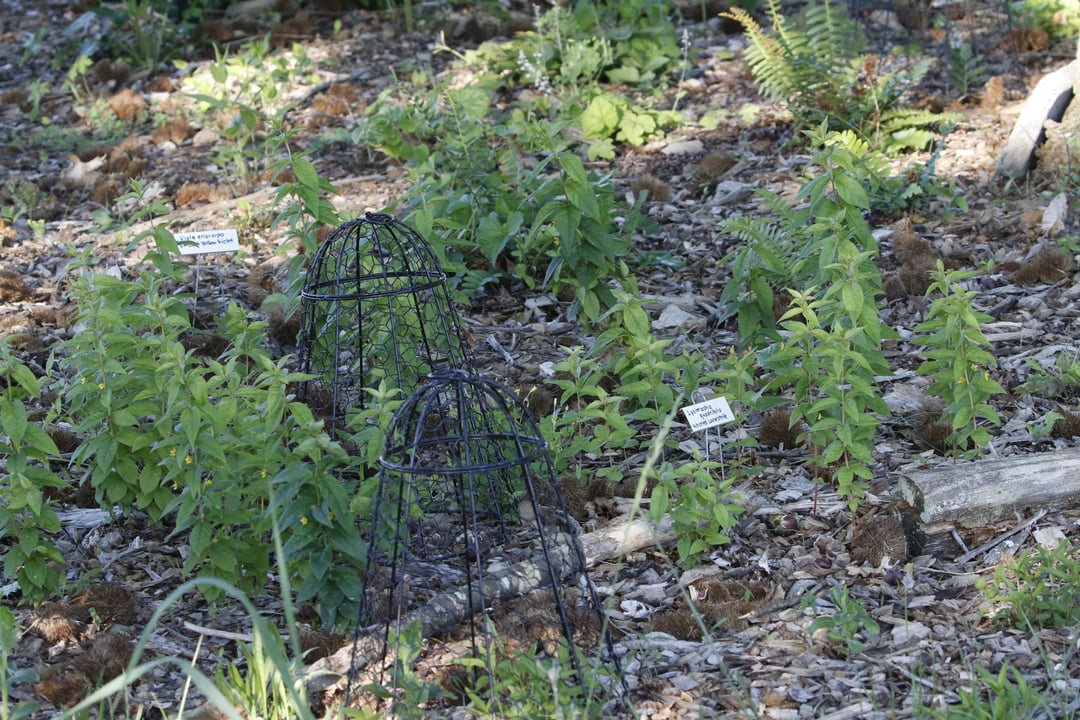

Lysimachia or Loosestrifes are an interesting genus in the Primrose family completely unrelated to the other and more famous Loosestrifes–the invasive Purple Loosestrife (Lythrum salicaria) and the native Winged Loosestrife (Lythrum alatum). While Lysimachia are not keystone species for general wildlife value, they are critical plants for at least four native Macropis bees that only feed on Lysimachia. Instead of nectar, Lysimachia secretes a floral oil and Macropis require this oil to reproduce. Most Lysimachia bloom in late spring or early summer when not much else is blooming, are rhizomatous, and form non-aggressive, loose colonies. Some sources split some Lysimachia off into Steironema or Trientalis so sometimes you will find them under another scientific name while other sources classify them all as Lysimachia.
Whorled Loosestrife (Lysimachia quadrifolia–first and second photo): a highly adaptable loosestrife that forms loose colonies . That colony grew from one plant I planted last fall. It's rarely in the trade but should be since it tolerates sun or shade and dry or moist conditions. Great plant to fill space in a woodland or forest edge. Lysimachia quadriflora–an obligate calcareous, wetland species–is frequently mislabeled as Whorled Loosestrife.
Swamp Candles (Lysimachia terrestris–third photo): This is a wetland obligate loosestrife that quickly forms loose colonies in bogs. I grow it in my pitcher plant bog but it does not require such a setup–any quality wetland will do. In addition to rhizomes and seeds, Swamp Candles forms aerial bulblets where the leaves meet the stem so it spreads quite easily.
Fringed Loosestrife (Lysimachia ciliata): a very aggressive loosestrife of moist forests and woodlands that can form dense colonies. I plant this with other aggressive plants that like similar conditions–like Virginia Bluebells, Zig-Zag Goldenrod, Broad-leaved Enchanter's Nightshade or Canada Waterleaf. Unlike most Lysimachia, Fringed Loosestrife is an aggressive ground cover and should be treated as such. The straight species is easy to find and I would recommend it over the red-foliage Lysimachia ciliata 'Firecracker'.
Lance-leaved loosestrife (Lysimachia lanceolata): is the most common one in the trade–usually the red foliage cultivar 'Burgundy Mist' or 'Purpurea'. Caution: I've read that the specialist bees do not use the cultivar for whatever the reason.
There are many other loosestrifes native to Eastern North America but I have not grown them–Northern Starflower (Lysimachia borealis), Lowland Yellow Loosestrife (Lysimachia hybrida), and Prairie Loosestrife (Lysimachia quadriflora) and would appreciate any insight from those who have.
Unfortunately, there are also several invasive species in this genus: Creeping Jenny (Lysimachia nummularia), Scarlet Pimpernel (Lysimachia arvensis), Gooseneck Loosestrife (Lysimachia clethroides), Dotted Loosestrife (Lysimachia punctata), and Yellow Loosestrife (Lysimachia vulgaris). Our specialist bees are selective about floral oils and I don't believe they can use any of them. As such, I would not recommend planting non-native Lysimachia.
by Tylanthia
Comments are closed.