
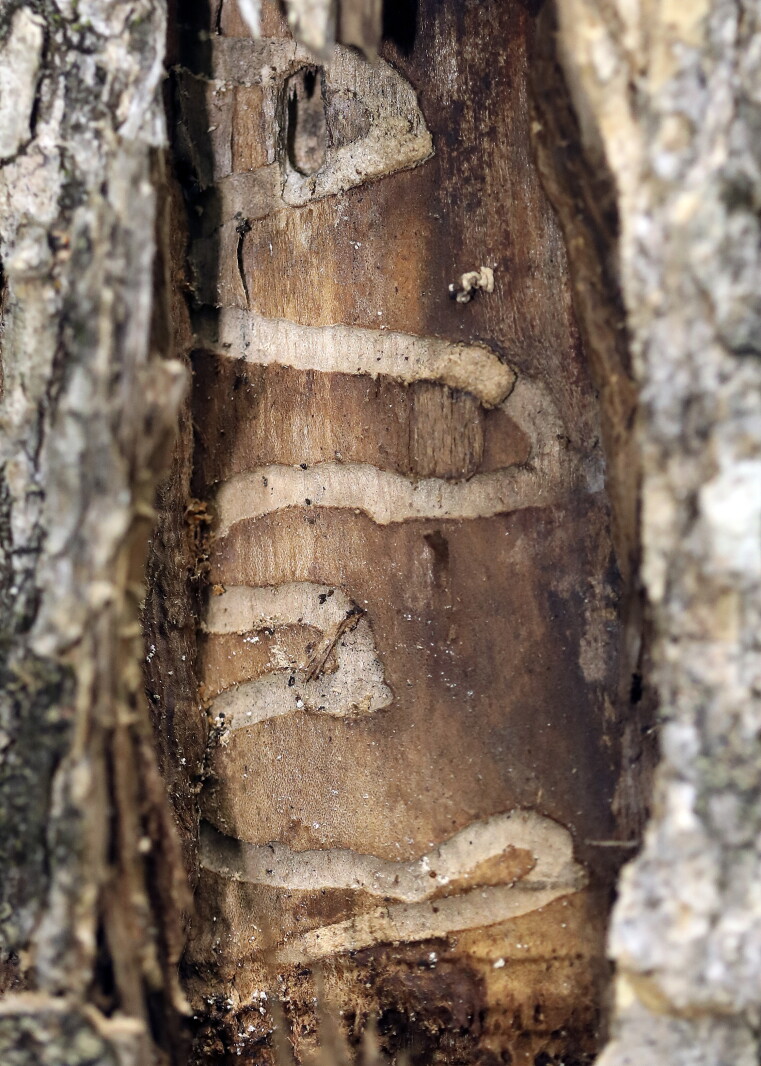
Emerald ash borer has been in the horticulture news for the past few years. We know for certain that it has arrived in Kandiyohi County.
The first symptom that you will notice is dieback in the canopy of the tree. Smaller leaves and closer-spaced buds are also indicators of stress.
In my grove, I’m seeing this happen this spring. During the second year, thinning foliage becomes apparent, and by the third year, the canopy thinning is more pronounced.

By the fourth year, the canopy has seriously declined and may even be dead. Vertical bark splits can be a symptom of an emerald ash borer infestation.
Adults emerge in spring, creating small, one-eighth-inch, D-shaped exit holes. These holes might not be visible right away.
If you suspect emerald ash borer damage, it is best to contact a professional to see what, if anything, can be done to protect your tree.
Planting diverse woody species will help our landscape survive future insect and disease outbreaks. If you have an ash tree in your yard and it is healthy, there is no reason to remove it. The University recommends not planting additional ash.
The University recommends six native tree species to consider for replacing your ash. Each species has its own unique characteristics and is adapted to different sites.
River birch — The Heritage variety is resistant to bronze birch borer. It can thrive in floodplains and near stream banks that are sometimes flooded.
Silver maple — A fast-growing tree that provides a lot of shade. It is widely planted as a shade or ornamental tree. Its leaves are dark green on top and silvery on the bottom, giving the tree its names.
Shallow roots are an issue. The “Silver Queen” variety is about two-thirds the size of the species at maturity. Do not plant it on a boulevard.
Hackberry — A hardy shade tree that can survive a tough environment. (One of my favorite trees.) It can survive heat and drought or wind and ice.
Its corky bark sets hackberry apart from other trees in Minnesota. Birds and other wildlife are attracted to its berry-like fruits. It does well in just about any type of soil.
Disease-resistant elms — Valley Forge and Princeton varieties are most similar to native American elm and have the classic vase-like form when mature. Hybrid Asian elms tend to be shorter than other varieties. Elms require full sun for the best growth.
Swamp white oak — This species does not grow as tall as bur or white oak. It is less susceptible to oak wilt fungus than red oak. Wildlife is attracted to the acorns.
Northern white cedar — This tree survives well in moist soils. If you’re looking for an ornamental variety, it is sold under the name arborvitae. Northern white cedar trees attract wildlife, and deer love to browse on this tree and may congregate in stands of cedar in the winter. So, something to keep in mind if you have deer problems in your area.
For additional information, visit
z.umn.edu/ReplacementAsh.

Master Gardener Sue Morris has been writing a column since 1991 for Kandiyohi County newspapers. Morris has been certified through the University of Minnesota as a gardening and horticulture expert since 1983. She lives in Kandiyohi County.
Comments are closed.