

When Kirsty and Bart Whitehouse moved to Margaret River eight years ago, they set about turning a cow paddock into a permaculture paradise.
“We hardly had any birds here, we hardly had any lizards, there was just no flora or fauna to support that,” Ms Whitehouse said.
“One of the most satisfying things is to see all the birds come back.”
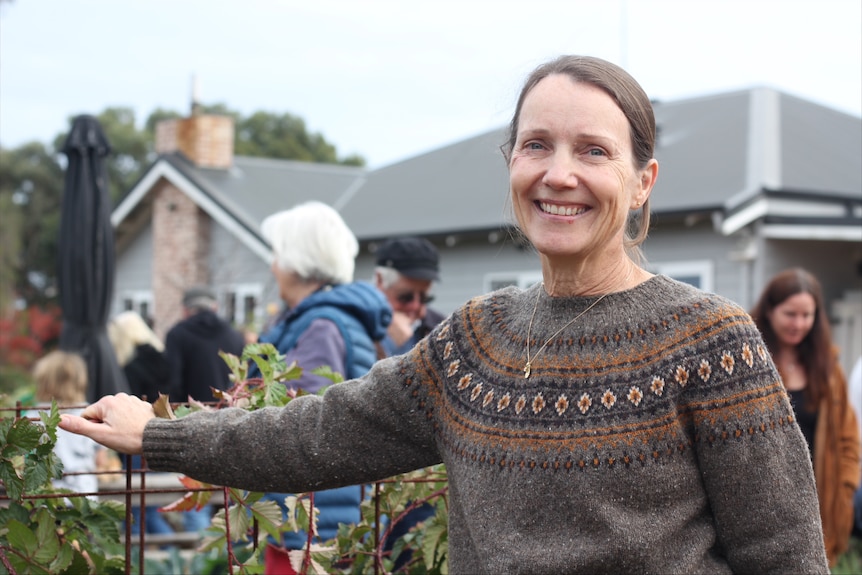
Kirsty Whitehouse turned a cow paddock into a permaculture garden in Margaret River. (ABC News: Georgia Loney)
The couple is part of a new generation embracing the principles of sustainability espoused by the permaculture movement.
Permaculturists say there is renewed interest in the counter-culture, amid rising costs and concerns for food security.
It is perhaps no surprise, considering the movement’s roots trace back to the last global oil crisis in the 1970s.

Plants in Kirsty Whitehouse’s permaculture garden. (ABC News: Georgia Loney)
Gardening as a political act
Permaculture was described by co-founders David Holmgren and Bill Mollison as an agricultural system that was sustainable and self-sufficient in the 1978 book Permaculture One.
Mr Holmgren said the movement was as relevant today as it was 50 years ago.

David Holmgren with a newly planted and stone mulched fruit tree at Jackeys Marsh, Tasmania in 1977. (Supplied: David Holmgren)
“There was a huge ferment of ideas around intentional communities, the back-to-the-land movement and a sort of new wave of organic agriculture that was developing,” he said.
He noted the parallels between the 1970s and today’s political environment.
“[It] coincided with a period where there was a loss of faith in the mainstream economic processes, and that continuous boom since the Second World War, to that first global recession in affluent countries,” Mr Holmgren said.
He said the book’s success was inextricably linked to its political context, bracketed between the oil crisis of 1973 and the second oil crisis within the Iranian Revolution in 1979.
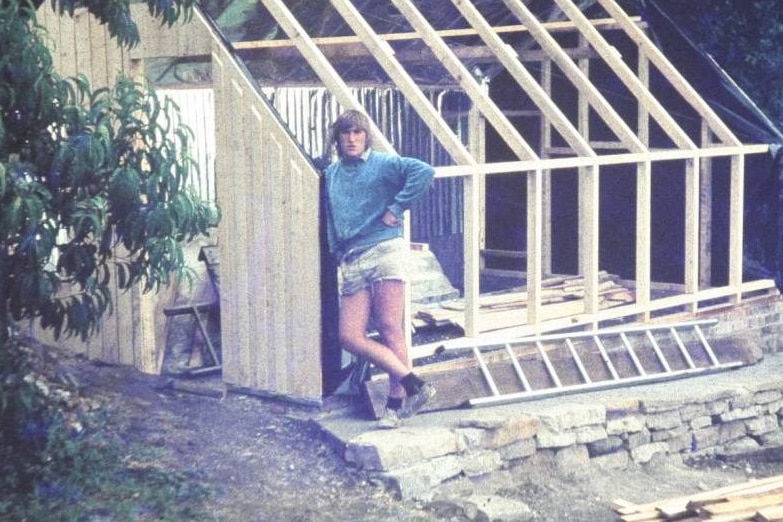
David Holmgren building a greenhouse in Hobart in 1978. (Supplied: David Holmgren)
“I’ve even argued that if permaculture had been launched in the mid-80s … as the greed-is-good culture got going, it probably would have sunk like a lead balloon.”
Permaculture for the rich
University of Newcastle sociologist Terry Leahy has researched the political roots of permaculture, which by the 80s had grown to a large counter-cultural social movement.
Dr Leahy noted that today’s generation was far more constrained by rising land prices and availability.
Having enough space for a private permaculture plot is now out of reach for most families, but Dr Leahy noted the movement also espoused communal land and living, and broader societal change.
Margaret River, 270 kilometres south of Perth, has become a hotspot for permaculture practices.
A permaculture festival held there earlier this month attracted hundreds of attendees and sold out well in advance.
These days, plots of land in the regional community are few and far between, fetching a median price of $1 million.
Permaculture teacher Pippa Buchanan transformed her Margaret River property into an edible oasis after returning from Austria during the COVID pandemic in 2020.

Pippa Buchanan is a permaculture consultant in Margaret River. (ABC News: Georgia Loney)
“Even as someone who has the luck to have access to land, and who already has a vegetable garden, I’m feeling that, and my personal purchasing has changed in the last six months, just because everything is getting more expensive,” she said.
She insists the counterculture is not out of reach to the average family.

Pippa Buchanan’s backyard in Margaret River in November 2020. (Supplied: Pippa Buchanan)
In Austria, Ms Buchanan lived in a 64sqm apartment, where they grew food on window sills and took part in community gardens.
She said people who rented or lived in apartments could also practise permaculture and construct their own temporary garden.
“Sometimes it is better to ask for forgiveness rather than permission.”
Comments are closed.