
Walk down the aisle of any nursery or garden center and you’ll see bag after bag of materials for potted plants or garden beds. But before you heft the cheapest one into your cart, you should understand the differences so you choose the correct type for your plant’s needs.
Technically, soil is what’s found in your yard. It’s composed of minerals, organic materials (such as decomposed plant and animal matter), water, and air. It consists of different sizes of particles, classified as clay, silt, or sand, which make up the soil texture. Thus, bags of potting soil, or garden soil, are intended for in-ground use.
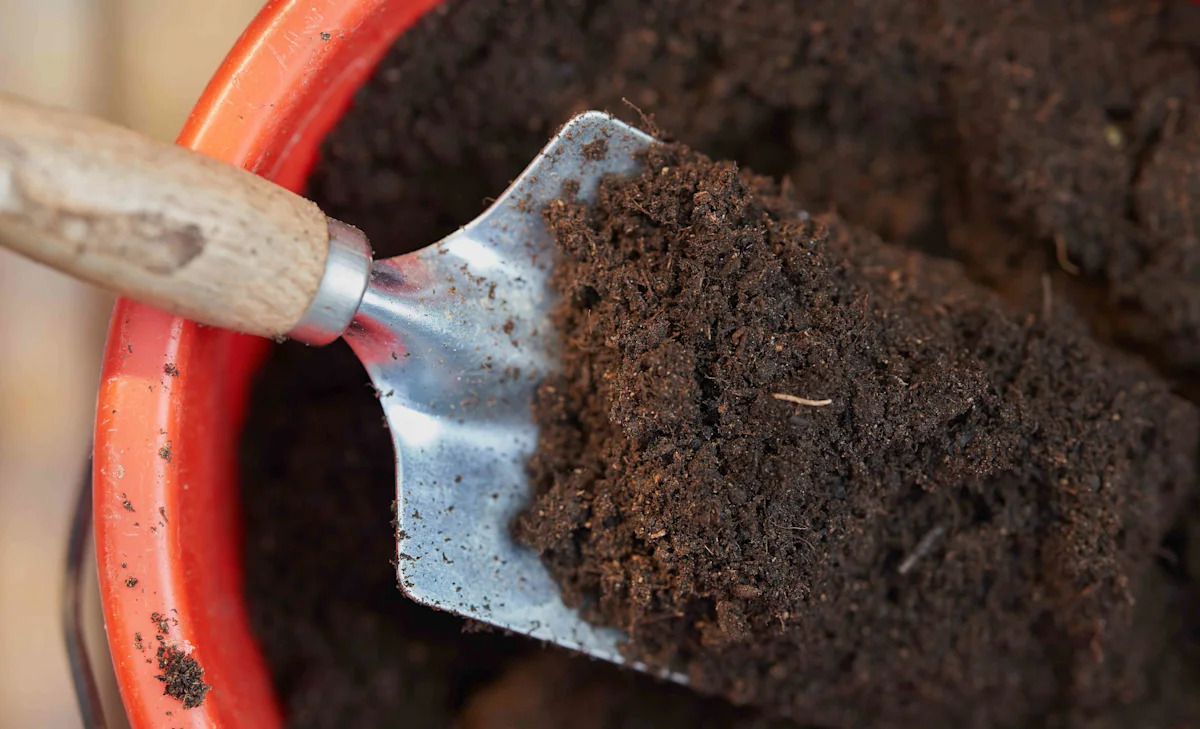
Potting mix is not the same thing as soil. “Potting mix contains no soil and is a lightweight mixture that’s ideal for growing plants in containers,” says Justin Hancock, horticulturalist with Costa Farms. “There are an infinite number of ‘recipes,’ but most general purpose potting mixes include a peat or coir base.”
Advertisement
Advertisement
Many gardeners use the terms “potting mix” and “potting soil” interchangeably. “But, technically, potting mix is the correct term for the soil-less product we use to grow plants in pots and containers,” says Hancock.
Read on to understand the difference between potting mix and potting soil—and why it matters:

Credit: Getty Images
What’s the Difference Between Potting Mix and Potting Soil?
Most of the time, gardeners refer to potting mix and potting soil as the same thing. But products labeled with the word “soil,” such as garden soil or topsoil, are meant for in-ground use only—not for containers.
That’s because garden or topsoil products are too dense to use in containers and will compact more each time you water. This doesn’t allow for good air and water movement, which is essential for root health, says Hancock.
What Does Potting Mix Contain?
General-purpose potting mix typically will contain:
Advertisement
Advertisement
Peat, a type of organic matter that comes from decomposed peat in bogs; it retains moisture well and doesn’t become easily compressed.
Coir, a fibrous material made from by-products of coconut husks; it is often used as a substitute for peat.
Vermiculite, a fine, puffed, gold flecks mica, which helps with drainage.
Perlite, a porous white volcanic rock that improves drainage and aeration.
Slow-release fertilizer is sometimes added to potting mixes. It looks like tiny, round balls and lasts a few months.
Specialty potting mixes, such as for orchids and cacti, also are sold. Although not necessary, they can be beneficial for some plants, such as succulents, especially if you tend to overwater. That’s because these mixtures, which may contain bark or sand, drain quickly, and won’t hold on to water that can keep roots too soggy, says Hancock.
If you’d like, you also can make your own potting mix, but that’s obviously not as convenient as picking up a premade bag at the nursery. “Most gardeners also don’t have the storage space to keep all the raw materials around,” says Hancock.
Should You Use Potting Mix or Potting Soil?
It depends! Read the bag to ensure sure you’re choosing the best option:
Advertisement
Advertisement
Always use potting mix for houseplants and container plants, says Hancock.
If adding to or mixing into raised beds, choose potting soil, also called garden or raised bed soil, which will be labeled for in-ground use.
Read the original article on Southern Living
Comments are closed.