
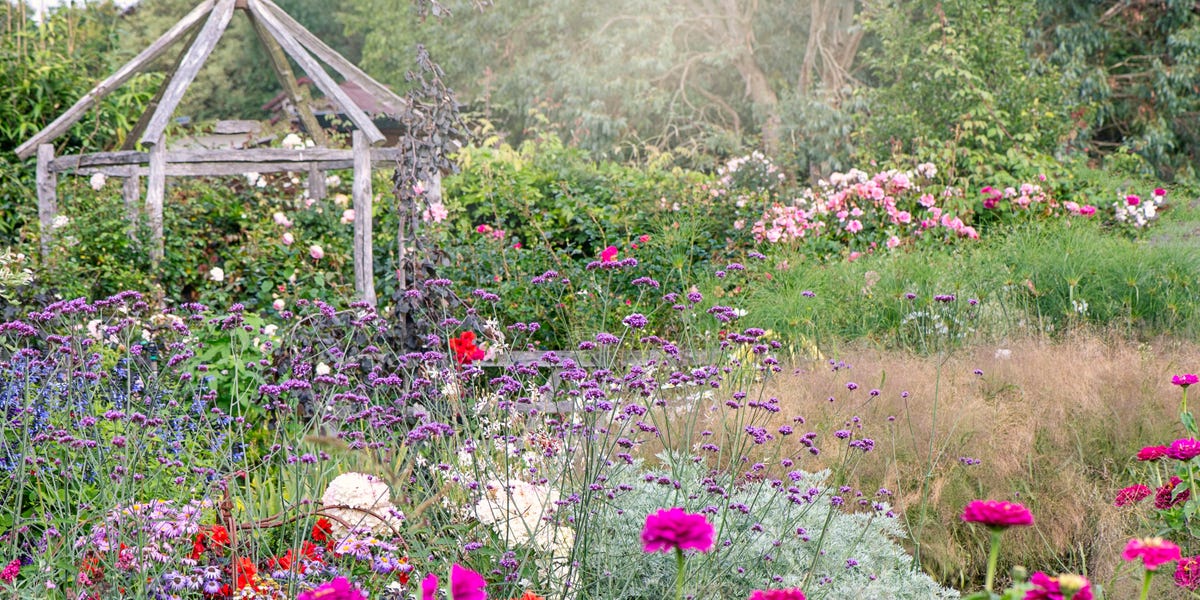
The English cottage garden is a national obsession – a bucolic fantasy that’s woven into nursery rhymes, fairy tales and childhood books. ‘We have a very high-bound idea in this country of what constitutes a good garden,’ agrees the nation’s favourite gardener, Monty Don. ‘And that’s influenced by the fact that we have so many good gardens.’ Sissinghurst, Great Dixter, Charleston… Hidcote and neighbouring Kiftsgate Court Gardens in Gloucestershire. And while these may be grand, there are takeaways for all of us – including techniques like the ‘cram cram cram’ method. Here’s everything you need to know:
Layering plants
The most enchanting gardens are packed with plants, climbers arching over walls and fences, and layers of plants packed into borders – gardener Vita Sackville-West famously advised her readers to ‘cram, cram, cram’, just as she did at Sissinghurst Castle. Build up layers of plants – add flowering shrubs (viburnum, lilacs or weigela) for height, and climbers, including clematis or honeysuckle, to provide background foliage and seasonal colour, then layer perennials of different heights through your borders. It’s this undulating contrast of forms that helps create visual interest. Plant perennials in groups – drifts of three or five or even seven plants are more impactful than lots of different plants dotted together.
Roses
Shorthand for the English country garden look, the rose is unsurpassed for delivering incredible colour and scent all through summer and often well into late autumn. You can’t have too many. In smaller spaces, use them to scramble up walls and arches – but choose the right size rose. ‘Ghislaine de Féligonde’ is a short rambler that will grow to around 3.75m, with repeating sprays of soft apricot flowers with a musk scent. In borders, choose shrub roses renowned for their disease resistance; ‘Olivia Rose Austin’ has dark-green foliage and beautiful rosettes of mid-pink flowers, and grows up to 110cm tall.
Colour theory
Harmonious planting schemes tend to focus on a reduced colour palette. The most soothing – the ones we associate with English gardens – are soft pinks, lilacs, blues and whites. It helps that many summer garden favourites are within this colour range; groups of blue delphiniums or pastel-toned foxgloves contrasted with mounds of white peonies or soft pink roses (‘Scepter’d Isle’ has a wonderful pale pink open flower that works brilliantly with blue). In late summer, drifts of airy white Oenothera lindheimeri look beautiful contrasted with blue or lilac scabious.
Soften the edges
To really ramp up the atmosphere in your garden, blur out any hard lines; the prettiest cottage gardens use limited hard landscaping (if any) and natural materials wherever possible with gravel or grass paths. Use low-growing, spreading perennials, such as Erigeron karvinskianus, which will give you mounds of daisy-like flowers and soften the edges of paths or steps (it’s also easy to pull out if it spreads too much), while flowering thymes will fill in cracks, providing flowers and scent.
Scent
Colour and form may be the first things we think of when choosing plants – but scent is also key to getting a cottagey feeling. Scented plants add to the immersive sensory mood, especially on warm summer nights when the air is heavy with fragrance wafting from night-blooming plants such as jasmine or nicotiana. Add scented plants to pots close to areas where you sit – Pelargonium ‘Attar of Roses’ is one of the best geraniums, with rose-scented leaves, while heliotrope has pretty purple flowers, a marzipan scent and works well in pots. Smaller daphnes, including ‘Eternal Fragrance’, will grow in neat evergreen mounds and pump out a heady perfume all summer.
Birds, bees and butterflies
Having a nature-friendly garden that sustains wildlife is a win-win. Being biodiverse – and chemical-free – makes a healthier garden that’s less susceptible to pests; an outbreak of aphids on your roses will be swiftly gobbled up if you have abundant birdlife. But taking a nature-first approach also brings a space to life.
A dawn wander around the garden in midsummer – hands-down my favourite time to enjoy all the flowers with a cup of tea in hand – is so much better with the sound of birdsong and bees hunting early morning nectar. It all adds to the atmosphere, romance and beauty of a garden – and that surely is the essence of an English garden.
5 favourite cottage garden plants
Get that English country garden vibe with these beautiful blooms
‘Sutton’s Apricot’ (Digitalis)
A cottage garden must-have. Tall spires of soft peachy flowers beloved by bees.
‘Burgundy Beau’ (Scabious)
Great for cutting and will keep flowering all summer and autumn.
‘Aureomarginata’ (Daphne odora)
Another must-have scented shrub with evergreen foliage.
‘Helen Johnson’ (Verbascum)
Spires of pinkish-brown flowers that look stunning in drifts.
‘Jane Phillips’ (Iris)
Bearded iris with soft blue flowers. Perfect for a sunny spot.
Comments are closed.