
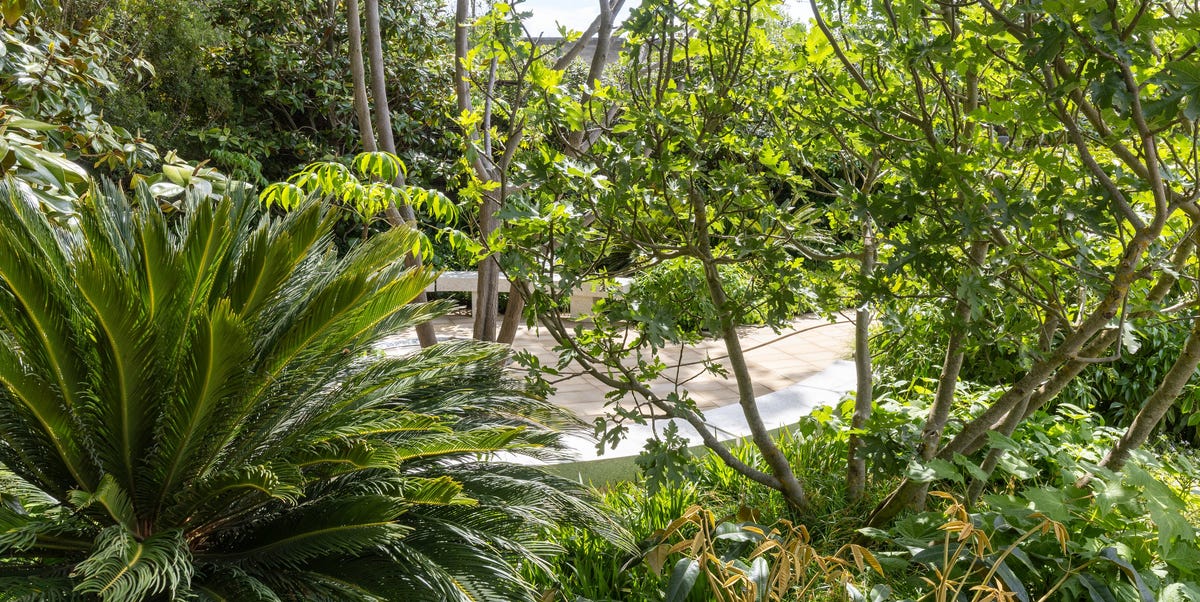
The strongest gardens at the RHS Chelsea Flower Show 2026 looked wildly different on the surface – woodland sanctuaries, climate-resilient courtyards, contemplative Japanese-inspired spaces, immersive wellness gardens – but underneath, the same design principles kept appearing again and again. The most impressive gardens were not the most complicated or flashy – they succeeded because they balanced core design rules such as structure, layering, repetition and restraint to beautiful effect.
Here are the seven rules that united the most successful gardens – and what we can replicate in our own outdoor spaces.
1. Structure first, plants second
 RHS / Neil Hepworth
The Killik & Co ‘A Seed in Time’ Garden
From wild, naturalistic woodland planting to crisp urban courtyards, the standout Chelsea gardens all shared one thing: a strong structural framework. This is what gives a garden its backbone and creates cohesion and year-round interest long after the flowers fade and the seasons change.
Structure can come from trees, hedges, pathways, walls, pergolas or even tall architectural grasses – as seen in The Killik & Co ‘A Seed in Time’ Garden by Baz Grainger, where grasses such as Melica altissima and Phragmites australis were used to create height and movement.
 RHS / Neil Hepworth
The Lady Garden Foundation ‘Silent No More’ Garden
The Lady Garden Foundation ‘Silent No More’ Garden by Darren Hawkes, showed how bold sculptural forms can create structure and set the tone with planting layered around them.
CHELSEA TAKEAWAY: Think about structure before you even think about plants – imagine your garden in winter stripped back to its essentials. What still looks good in December? What creates height, rhythm or a natural pause point?
2. Layer plants for depth and interest RHS / Sarah Cuttle
Woodland Trust: Forgotten Forest Garden
The most memorable Chelsea gardens all used layering – a simple technique that transforms a garden from flat and one-dimensional into a lush, abundant space. By planting in layers, you don’t see everything all at once; instead, the eye moves through different heights, shapes and textures, creating depth, movement and interest. It’s also a clever trick to make even a small garden feel larger.
Classic planting layers include the canopy layer (trees or sculptural features), the shrub layer (mid-height planting), the herbaceous and geophyte layer (perennials and bulbs), and the ground layer (low-growing plants and ground cover), often punctuated with vertical accents such as flower spires – yes, foxgloves, always a Chelsea favourite, were everywhere this year.
A good example of layered planting was the Woodland Trust: Forgotten Forest Garden by Ashleigh Aylett – a naturalistic woodland environment but still carefully composed.
CHELSEA TAKEAWAY: Never plant at just one height – even the most ‘wild’ and natural Chelsea gardens used carefully planned layers to create depth, softness and abundance.
3. Repeat, repeat, repeat RHS / Sarah Cuttle
RHS and The King’s Foundation Curious Garden
Repetition is what makes a garden feel cohesive and thoughtfully designed, rather than simply a collection of plants. It’s about creating a sense of rhythm throughout the space. That rhythm might come from repeating plant or flower shapes, a particular colour palette, containers, trees or even paving materials. When the eye recognises familiar elements appearing again and again, the whole garden feels calmer, more connected and beautifully intentional.
At Chelsea, the best gardens used repetition subtly – drifts of similar planting, recurring textures, or echoes of colour woven through different areas – giving each space an identity without feeling overly formal. A strong example was the utterly charming RHS and The King’s Foundation Curious Garden by Frances Tophill, with its repeated raised beds, recurring edible planting themes and repeated materials.
CHELSEA TAKEAWAY: Choose three to five plant shapes, two to three key materials and a restrained colour palette, then repeat them throughout the garden to create flow, harmony and a stronger sense of design.
4. Give your garden a focal point RHS / Neil Hepworth
Campaign to Protect Rural England Garden: On The Edge
The most talked about Chelsea gardens all featured at least one statement piece. A focal point helps anchor the design, drawing the eye in and giving it somewhere to rest before taking in the rest of the space. It creates structure and instantly makes a garden feel more intentional.
Sarah Eberle’s giant carved Gaia sculpture for the Campaign to Protect Rural England Garden: ‘On The Edge’, was a perfect dramatic example. A focal point doesn’t have to be enormous or elaborate, though. It could be as simple as a beautifully shaped tree, a striking shrub, a water feature, a bench, or an oversized planter – you don’t even need to fill the planter but just allow its shape and texture to speak for itself.
The key is to choose one element that stands out from its surroundings and helps give the garden a sense of balance and identity.
CHELSEA TAKEAWAY: Your focal point doesn’t need to be expensive – it can be something as simple as a sculptural pot, a multi-stem tree, a painted bench or even a single standout shrub placed where the eye naturally falls.
5. Don’t be afraid of negative space RHS / Neil Hepworth
Asthma & Lung UK Breathing Space Garden
One of the strongest themes at Chelsea this year was restraint. Four of the nine main show gardens drew inspiration from Japanese garden design, with its emphasis on calm, simplicity and tranquillity. Rather than filling every inch with planting, designers used space intentionally – allowing the garden to feel balanced, peaceful and uncluttered.
A beautiful example was the Asthma & Lung UK Breathing Space Garden by Angus Thompson, which embraced the Japanese concept of yohaku no bi – the beauty of empty space. Designed for people living with lung conditions, the garden celebrated stillness and simplicity, giving both the planting and its visitors room to breathe.
Elsewhere, many of the award-winning gardens resisted the temptation to pack in more plants. Open areas, quiet corners and uncluttered pathways became design features in themselves. These moments of ‘negative space’ acted as pause points, helping to highlight textures, shapes and standout plants more effectively.
It’s a useful reminder that sometimes what you leave out is just as important as what you put in.
CHELSEA TAKEAWAY: Don’t feel the need to fill every gap. The most successful gardens have moments of quiet as well as moments of abundance, giving the eye space to rest and allowing key plants and features to truly shine.
6. Texture is as important as colour
RHS / Neil Hepworth
This year’s Chelsea gardens placed emphasis on texture and foliage rather than over-the-top displays of flowers. Many of the most striking spaces felt calm, natural and immersive, relying on layers of contrasting shapes and surfaces rather than bold colour alone.
The secret is often in the contrast. Feathery grasses were paired with solid stone, delicate seedheads floated against clipped hedging, and soft petals sat alongside strong, glossy foliage.
Texture also helps a garden hold its structure throughout the seasons. While flowers come and go, foliage, bark, seedheads and grasses continue to provide shape, light and atmosphere.
At Chelsea, this softer, more textural style gave gardens a relaxed and contemporary feel – proof that a beautiful garden doesn’t have to rely on colour to make an impact.
CHELSEA TAKEAWAY: Think beyond flowers when choosing plants. Mix contrasting textures – soft with structured, glossy with matt, fine with bold – to create a garden that feels rich, layered and interesting all year round.
7. Movement brings a garden to life RHS / Neil Hepworth
Parkinson’s UK – A Garden for Every Parkinson’s Journey
The most thought-provoking Chelsea gardens incorporated movement: ornamental grasses waving in the breeze, hanging foliage creating dappled shadow, and water features such as rain chains and rills adding sound and sparkle – water was everywhere this year!
Movement is what creates atmosphere in your garden – it brings spaces to life and makes them feel calm, natural and immersive. Movement also softens hard landscaping and makes the space feel more welcoming.
CHELSEA TAKEAWAY: Include at least one moving element such as ornamental grasses, gently swaying planting, climbing plants, or a simple water feature to create a garden that feels dynamic, relaxing and full of life.
Follow House Beautiful on Instagram, TikTok and Pinterest
The Garden Edit Folding Bistro Set, 3 Pieces
 Scalloped Edge Smooth Fibre Clay Plant PotCredit: Dunelm
 Marcy 2-Seater Sling Garden Sofa, GreigeCredit: John Lewis
 Gsycle Watering CanCredit: Amazon
 Natural Pebble Outdoor Solar LightCredit: Next
 Dibor Dining Chair Seat Pad SetCredit: Amazon
Comments are closed.