


Adding colour to your garden is easy and highly effective (Image: Getty)
It’s a great time to look at how colour works in your garden. Borders are filling out now, and some of the early summer perennials are starting to emerge, but there’s plenty of time to make adjustments for your summer display. One of the simplest ways to pull a garden design together is to repeat shades. Designers often call this ‘colour echoing’, working to give a united feel to the space.
Choose your colours
Start with a colour you already love, and may already have in your garden. It might be the soft pink of a favourite rose, or the fresh white of a foxglove, or even refreshing lime greens. Then, look for ways to repeat that colour through more plants, at varying heights, and in different parts of your garden borders. The colour doesn’t need to be an exact match. In fact, it’s often better when it varies slightly, giving more depth to the space. Creams and whites can look lovely together, without losing the connected feel.
Repeat through the garden
A good colour echo should lead the eye through the garden. For a white and green scheme, you could start with white foxgloves in May, then continue with Astrantia major ‘Alba’, Hydrangea arborescens ‘Annabelle’ and white cosmos later on. This would give you a continuous colour scheme from late spring through summer. For warmer planting, try pink and apricot echoes with aquilegias, geums, roses, achillea and pelargoniums. If you prefer a brighter palette, calendula, rudbeckia, coreopsis and marigolds can help create a cheerful gold theme.
Read more: ‘Take inspiration from Chelsea Flower Show – even if you can’t get along’
Read more: Banish hay fever-causing plants from your garden this spring with these tips

Pink flower peonies will brighten your plot (Image: Getty)Using foliage colour
Flowers aren’t the only way to repeat a colour. Foliage is often a reliable alternative, as it lasts much longer. Silver leaves from stachys, artemisia, or lavender can soften a sunny border. Dark foliage from heuchera, cotinus or dahlias adds contrast and depth. Green shades matter too. Lime foliage from Alchemilla mollis or golden oregano can lift shady edges and make pinks, white, and oranges feel fresher. They can also help to fill gaps while summer flowers are still developing.
Utilise containers
Pots are a great way to strengthen your colour echo. If your border has apricot tones, repeat them in a container with geum, calibrachoa or begonias. If the garden leans towards white and green, use nemesia, ferns, heuchera, or clipped evergreens.
Keep it simple
The key is keeping it restrained; two or three main shades, repeated with confidence, should be all you need for a strong impact. This way, you have plenty of variety, but the garden will feel calmer, fuller and more polished. For more design inspiration, the Chelsea Special episode of Step-by-Step Gardening is now available on my YouTube channel, @daviddomoney, filmed at Blue Diamond Garden Centres’ Bridgemere Show Gardens.
Focus Plant – Ceanothus
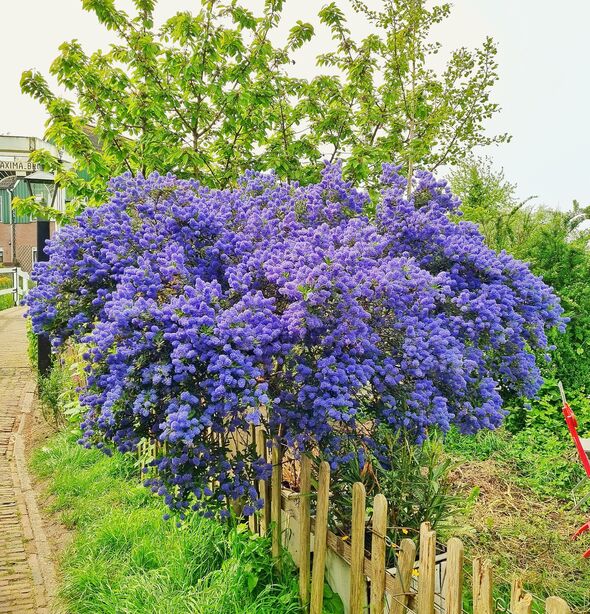
A blue Ceanothus grows lushly as a stunning garden embellishment (Image: Getty)
Offering a rush of blue in late spring, ceanothus is hard to beat. Often called Californian lilac, this shrub can be covered in tiny cloud-like clusters of flowers through May and into early summer. It’s especially useful if you want a plant with strong colour, glossy evergreen foliage, and impact without requiring a lot of maintenance.
Ceanothus is happiest in a warm, sheltered spot with plenty of sun and well-drained soil. A south or west-facing wall is ideal, providing protection from cold winds and helping the plant to ripen its wood. It can also work well in a border, as an informal hedge, or trained against a wall where space is tighter. If planting a container-grown ceanothus now, water it in well and keep an eye on it during dry periods while it gets established.
There are some excellent varieties to consider. ‘Concha’ is a popular choice, with deep blue flowers and a good, bushy habit. ‘Puget Blue’ is another strong option for some intense colour. For a smaller garden, ‘Skylark’ is more compact, while creeping forms like Ceanothus thyrsiflorus var. Repens can be useful for banks or low cover.
Care is simple once it is in the right place. Avoid heavy pruning, as older wood may not regrow well. Evergreen types are usually tidied lightly after flowering, removing straggly or misplaced shoots.
Fun fact: Despite the common name Californian lilac, ceanothus is not a true lilac at all. True lilacs are Syringa, while ceanothus belongs to a different plant family.
Gardening jobs
Take cuttings of shrubby herbs like rosemary, thyme and sage now, using healthy, non-flowering shoots. Snip short pieces, remove the lower leaves, and place them around the edge of a pot of gritty compost. Keep them sheltered and lightly moist while they root.
Treat wooden garden furniture before regular summer use kicks in. Clean it first, letting the wood fully dry, then apply a suitable oil or stain, according to the product instructions. It’s a practical job for a dry May day, before furniture is being used every weekend. Learn more about treating wooden garden furniture at my YouTube channel, @daviddomoney.
Watch for bolting as temperatures rise and crops respond to longer days or stress. Lettuce, spinach, rocket, coriander and some root crops can quickly go to seed. Harvest affected plants promptly while they are still usable, and keep sowing small batches for a steadier supply.
Strawberry runners are more something to keep an eye on in summer, but remove any early runners if plants are fruiting, and you won’t be propagating them. This keeps energy going into flowers and fruit. Later, you can peg down healthy runners if you want new plants.
Start feeding houseplants more regularly now that active growth is speeding up. Use a suitable houseplant feed, following the label’s instructions. Plants in bright positions, or those making lots of new leaves, will usually need feeding more often than slow growers.
Facebook – https://www.facebook.com/DavidDomoneyTV
Instagram – https://www.instagram.com/daviddomoney/
Pinterest – https://www.pinterest.co.uk/daviddomoney/overview/
TikTok – https://www.tiktok.com/@daviddomonry
Did you know?

Lupins are natural soil improvers (Image: Getty)
Lupins are soil improvers by design. Like many legumes, they can work with bacteria in root nodules to capture nitrogen from the air, helping the plant to grow and supporting soil fertility.
Garlic’s famous punch appears when cloves are crushed or chopped. That damage triggers sulphur chemistry, including allicin, which helps create the strong smell and flavour we know so well.
The dead-nettle plant is a clever spring lookalike. Its leaves resemble stinging nettles, but it belongs to the mint family and does not sting.
Peony buds do not need ants to open. The ants are usually there for the sugary nectar on the buds, and the flowers can bloom perfectly well without them.
Comments are closed.