
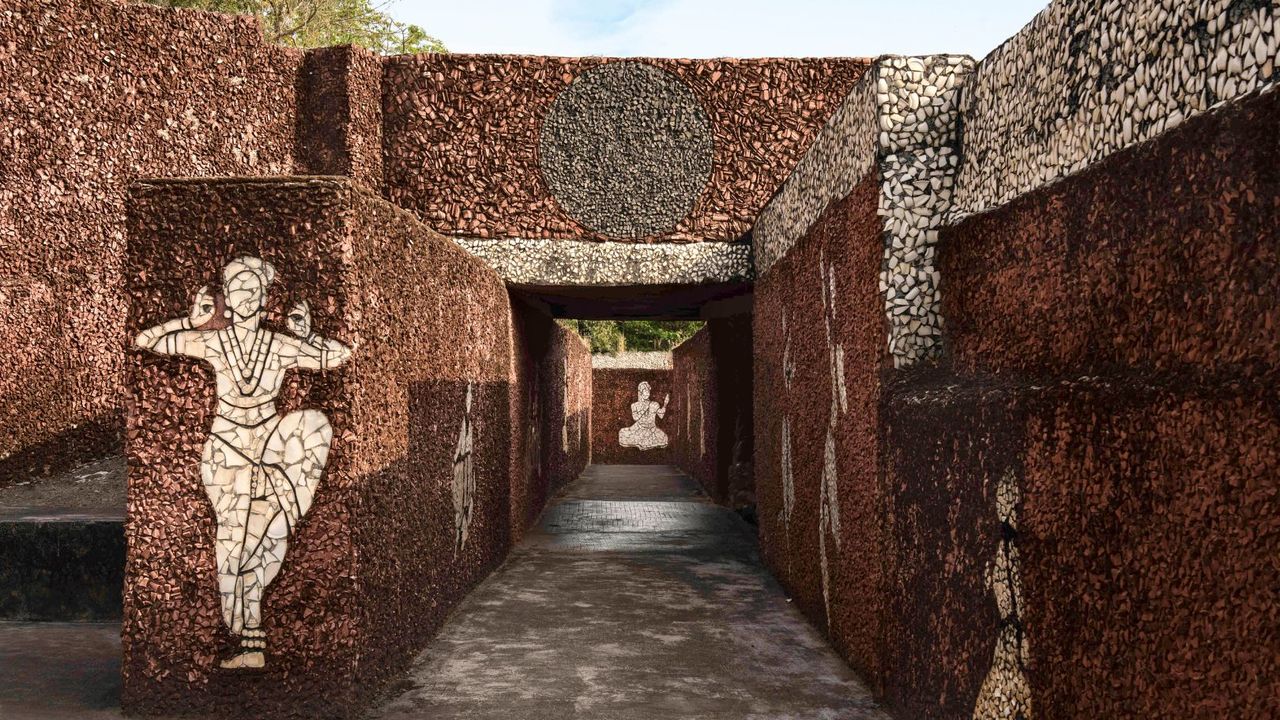

A long corridor that leads to a waterfall within the Rock Garden.
Iain Jackson
Vaibhav Passi

Vaibhav Passi
To frame the Rock Garden purely as “outsider art” is to diminish it. When we first began studying it seriously in the early 2000s, spending extended periods on-site with Chand, what struck us was the sophistication of its spatial organisation. The garden is a designed environment of exceptional complexity—a series of distinct phases, each with its own character and scale, linked by winding pathways and punctuated by waterfalls, amphitheatres, archways and chambers. The culturally embedded architectural vocabulary draws on Mughal precedent that provides crafted grandeur, on vernacular memory miniaturised into rural environments, on the forms of Chand’s pre-Partition childhood in what is now Pakistan—all curated through a sensibility that was entirely his own.
The more than 10,000 sculptures— warriors, goddesses, musicians, animals, fantastical figures—are embedded in walls and terraces, arranged in ceremonial groupings, positioned to be encountered through movement. You cannot take in the Rock Garden from outside. You must enter it and be absorbed by it. The experience is fundamentally architectural: sequential, spatial, bodily. Notwithstanding the rationality of the city grid, the garden and the Capitol Complex appear to have intriguing parallels in their understanding of resilient, almost archaeological, fragments and upturned ground. In a way, both are primeval. The garden is not a gallery; it is a landscape, an environment, a topography.
Comments are closed.