
As always, I delight in your correspondence. Sharon Cohen wrote in response to the online column about names of plants and plants that pair well to say that she grows lamb’s-ear with her irises. I confess, I have never grown lamb’s-ear. I will pick some up the next time I have a chance. She mentioned that the irises came with the house. Perhaps in the future, I will write about plants inherited and received from friends and neighbours. Like fanciful plant names, these associations orient me in my garden.
Also on plant names, Emily Kopley sent the last page of a book called Lost in Translation by Eve Hoffman, in which the memoirist is learning English and delighting in the various plant names. When I garden, I like getting immersed in idiosyncratic associations.
For example, when I see corkscrewing tendrils reaching determinedly upwards, I remember distinctly the time I first saw a hops vine at the Cloisters museum in New York City, in one of the medieval courtyards for which the museum is named, overlooking the Hudson River and the woodlands of the Palisades on the opposite bank. I don’t remember when exactly it was, but it was at least 25 years ago and must have been late autumn because the vine was enormous, shading one of the lovely indoor-outdoor spaces and the flowers or “cones” as they are called, were abundant and already turning slightly brown.
Hops is a truly beautiful plant growing enormously high and voluminously, granting plenty of shade and giving that lovely citrusy smell from its flowers that flavoured so many monastic brews (though they need to be bruised to really give their scent).

Hop field before the harvest.
Photo: Getty Images / aaron007
I was very taken with this plant that was cultivated in the Middle Ages and growing in the transplanted European monastery’s garden, mixing the spiritual and the earthy. I think it was the first time I thought, “Maybe I could grow that one day.” And I am happy to report that I have done so though it took a long time.
I planted a vine (or bine) perhaps twelve years ago, but it never produced flowers. I struggled to get it to flower, thinking it lacked sun or that I had failed it in some other way. Hops are sexed plants with the female bearing the seed cones. Somehow I got a male plant. During that sad time I was walking through the alleys of St. Raymond and saw an alley that was absolutely overflowing with flowering hops. I figured if it could grow wild in St. Raymond I could grow it, too. I dug out the male plant and got another one and it has done very well for me and my friend Brian, brews us up a batch of very hoppy beer every year.
I have grown beans, but they never did the Jack in the Beanstalk thing for me, but hops grows so fast I think sometimes that I can hear it when I am out in the garden. Unlike some other vines that I grow and love — like grapes, wisteria and clematis — hops dies right back to the ground each year yet by September it is taller than any of the others, clambering up anything it can find to reach more sun.
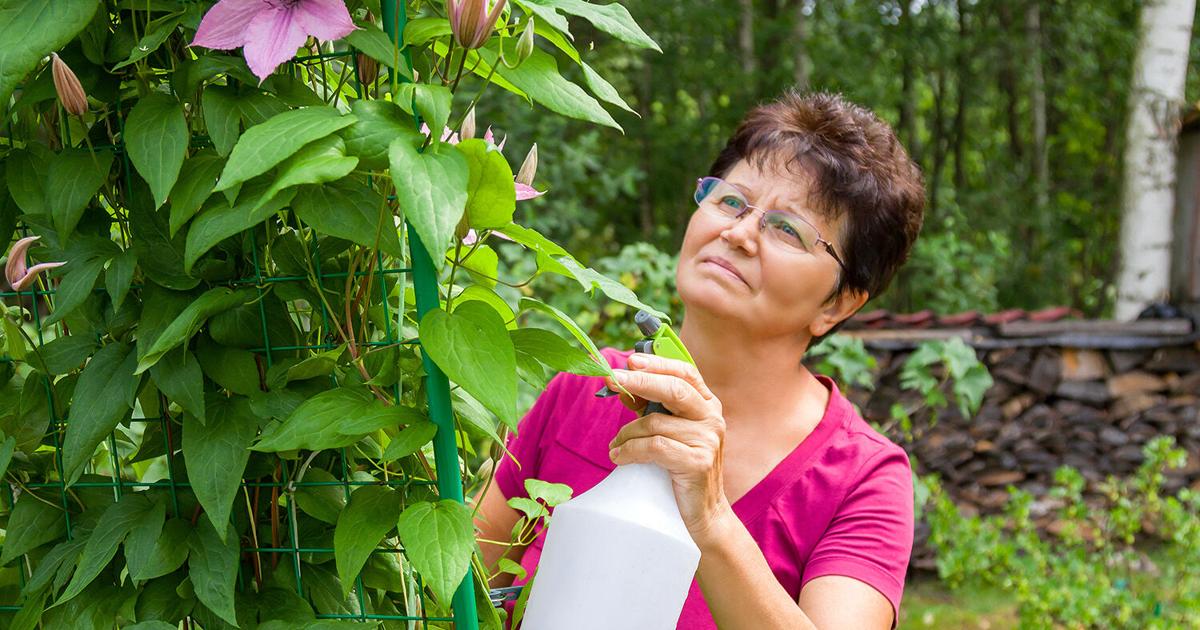
Vines are a wonderful way to maximize space and sunshine in a small, shady garden. I read that Vita Sackville-West grew clematis up lots of small trees in her garden at Sissinghurst and I have been trying with some success. I actually moved a mock-orange last summer to provide a stand for a beautiful John Paul II clematis, which produces white flowers shading to deep pontifical purple.
Black grapes in the vineyard.
Photo: Getty Images / Pawzi
My scarlet red clematis that I hoped would climb up the hydrangea tree looks terribly dead, but I am loath to pull it out because sometimes clematis plays possum. I have the well-known, tough and lovely purple Jackmanii clematis growing up several walls and trellises.
I am trying to train a wisteria up to a first-floor skylight in our kitchen ceiling to provide some green and lavender shade for summer days when the sun beams in. It is hard for me to believe that it will continue to survive our winters, but it is back again this year. In warmer climates wisteria can be incredibly long-lived. There is one in California that was planted in 1894 and is estimated to weigh around 250 tons. I remember seeing a wisteria in bloom in Vancouver in the spring. It had gone wild and was climbing up one of the enormous pacific fir trees perhaps 60 feet high, the one plant hugging the other, giving the grey bark an unexpected lavender garland.
Do you associate a plant with a special place? What vines do you love? Let me know at jeremywexler9@gmail.com
— AB
Comments are closed.